Homeschooling 101: A Beginner’s Guide to Mastering an Integrated Weekly Routine

So, you’ve decided to take the leap into homeschooling. First of all: Congratulations! You are about to embark on a journey that offers more freedom, flexibility, and personalized growth than any traditional classroom ever could.
But if you’re like most beginners, that initial excitement is likely mixed with a little bit of panic. How do you fit everything in? How do you make sure they’re actually learning? And most importantly, how do you keep your house from turning into a chaotic mess of half-finished projects and loose-leaf paper?
The secret isn’t a rigid, hour-by-hour schedule that feels like a prison. The secret is an Integrated Weekly Routine.
Ready to stop feeling overwhelmed and start feeling empowered? Let’s dive in.
Shift Your Mindset: Why "Integrated" Wins
Most people start homeschooling by trying to recreate "School at Home." They set up a tiny desk, buy a bell, and try to teach Math at exactly 8:00 AM.
Spoiler alert: This rarely works.
Life happens. The laundry needs folding, a doctor’s appointment pops up, or your student hits a breakthrough in history and wants to keep reading for another hour. An integrated routine allows education to flow with your life, not against it. Instead of separate "school time" and "life time," we blend them. This approach ensures you’re hitting your academic goals while also teaching the essential life skills: like financial literacy and time management: that traditional schools often skip.
Step 1: Start with Your Anchor Points
Before you touch a single textbook, you need to map out your "Anchor Points." These are the non-negotiables that happen every week regardless of what’s on the lesson plan.
- Fixed Appointments: Sports practices, co-ops, music lessons, or therapy sessions.
- Family Rhythms: Shared mealtimes, morning walks, or your Friday night movie tradition.
- Self-Care: Your own gym time or deep-work hours if you’re a working parent.
By identifying these first, you create a realistic framework. You aren't "failing" at homeschooling because you didn't do math on Tuesday afternoon; you simply scheduled it for Wednesday because Tuesday is your busy co-op day.

Step 2: Layer in Your Core Academics
Now that you have your anchors, it’s time to add the "Big Rocks." For most homeschooling families, this means Math and Language Arts.
- Be Consistent, Not Constant: These subjects usually require daily practice to build mastery. However, "daily" doesn't have to mean two hours. A focused 30-45 minute session using effective studying techniques is often more productive than a three-hour marathon.
- Rotate "Soft" Subjects: History, Science, and Art don't need to happen every day. Try a Loop Schedule. For example, you might do Science on Mondays/Wednesdays and History on Tuesdays/Thursdays. This keeps the workload manageable and the content fresh.
Step 3: Map Out Your Visual Routine
Human brains: especially young ones: crave predictability. A visual schedule helps your student understand exactly what is expected of them, which reduces "homework battles" and builds personal responsibility.
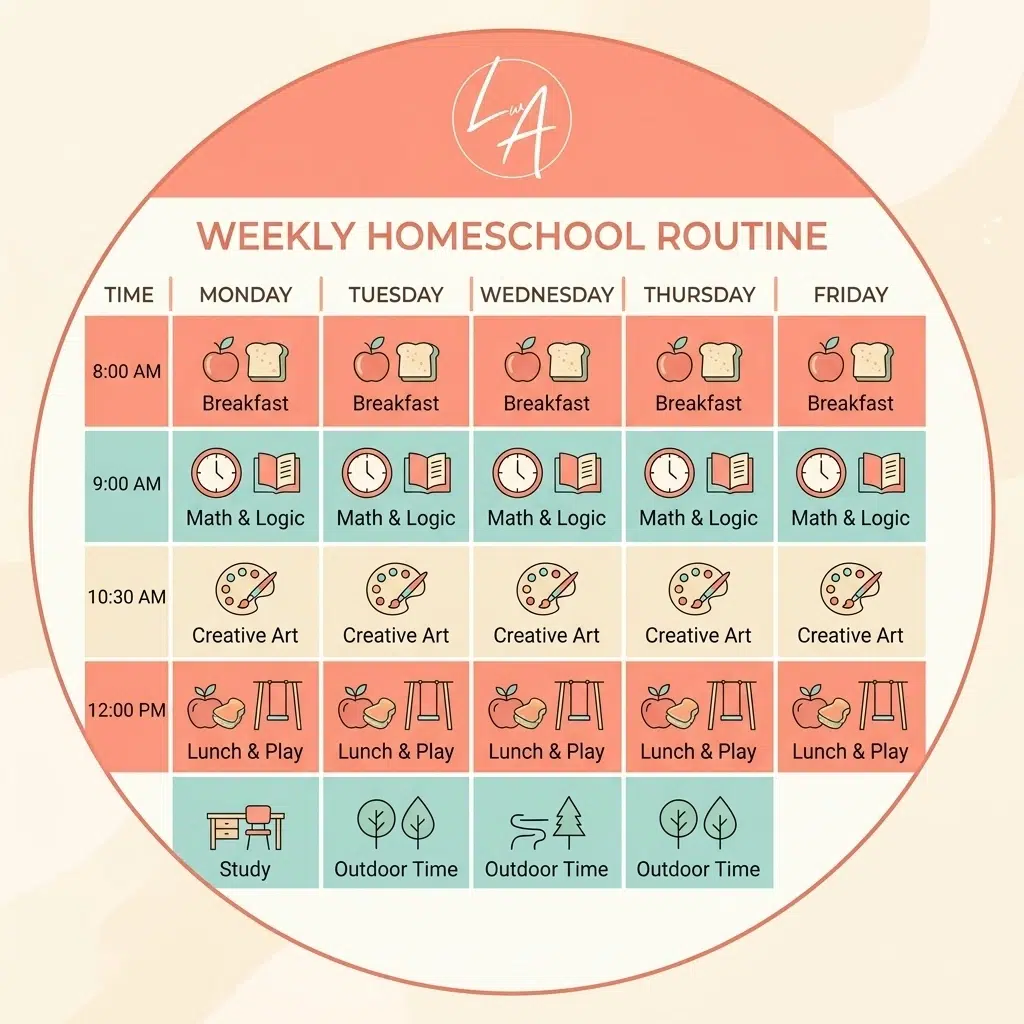
Pro-Tip: Use a Chunk-Based System. Instead of saying "Math at 9:15," try "Morning Learning Block." This gives you the flexibility to start a little late if the morning is slow, without feeling like the whole day is "ruined."
Step 4: Integrate Life Skills (The "LwA" Secret)
At Learning With Angie, we believe education is about the whole person. If your student graduates with an A in Calculus but doesn't know how to manage a budget, have we really set them up for success?
Integrate these skills directly into your week:
- Financial Literacy: On "Grocery Day," have your student help with the budget and money management.
- Productivity Hacks: Teach them how to use a digital planner or Notion template to track their own assignments.
- Personal Growth: Schedule 15 minutes of "Mindfulness or Hobbies" after lunch to reduce stress and build confidence.
Step 5: Essential Tools to Streamline Your Journey
You don't need a thousand-dollar curriculum to succeed, but you do need the right tools to stay organized. Using a mix of physical and digital resources allows you to find the workflow that fits your family's unique style.
- The Physical Anchor: Our Undated Monthly Planner is perfect for mapping out those big-picture anchor points and tracking weekly goals.
- The Digital Hub: For high schoolers looking toward the future, a Notion College Search Template helps integrate long-term planning into their weekly routine effortlessly.

Step 6: Build in "Flex Days"
One of the biggest mistakes beginners make is over-scheduling. If you plan five days of intense academic work, you will burn out by week three.
Instead, try a 4+1 Model:
- 4 Days: Focused core academics and routine.
- 1 Day: "Exploration Day." Use this for field trips, deep-dive projects, catch-up work, or even just some aesthetic note-taking and creative journaling.
This "buffer" day is what makes your routine sustainable for the long haul.

Ready to Master Your Routine?
Homeschooling is a marathon, not a sprint. By building an integrated routine that respects your family’s time and focuses on both academics and life skills, you aren't just teaching: you're preparing your student for the real world.
Ready to become the organized, confident homeschooling parent you know you can be?
Join The Community! Sign up for our biweekly emails to receive exclusive study tips, productivity hacks, and free resources delivered straight to your inbox. Let’s make this your most successful school year yet!
Want a head start? The Ultimate Student Planner in my shop was made for exactly this — it’ll save you a ton of time.