Are you tired of feeling like you’re constantly behind, no matter how many hours you put in? Does the thought of another "grind-mode" study session make you want to close your laptop and hide?
If you've been scrolling through social media seeing "5 AM morning routines" and "12-hour study-with-me" videos, it’s easy to believe that burnout is just part of being a student. But here’s a secret: intensity isn’t the same as impact. In fact, the harder you push yourself without a strategy, the faster you’ll hit a wall.
At Learning With Angie, we believe that student success shouldn't come at the cost of your mental health. It’s time to trade in "hustle culture" for soft productivity: a sustainable, gentle approach to getting things done without the stress. Ready to reclaim your time and actually enjoy your life while getting better grades?
Here are 7 soft productivity hacks you can implement immediately.
1. Reframe Your Pomodoro for Sustainability
You’ve probably heard of the Pomodoro Technique, but are you using it as a weapon against yourself or as a tool for recovery? Traditional productivity culture tells you to squeeze every second out of those 25 minutes. Soft productivity tells you to use those minutes to find a rhythm.
Instead of racing against the clock, use a timer to lower the barrier to starting. When a task feels huge, tell yourself you’ll only do one "soft" Pomodoro.
- Work for 25 minutes at a relaxed, steady pace. No rushing.
- Take a mandatory 5-minute break where you actually leave your desk. No phone scrolling: try a quick stretch instead.
- Reward your focus with a longer 30-minute break after four sessions.
Using tools like the Pomodoro Technique helps you build regular recovery into your day.
2. Swap Your To-Do List for a "Done" List
Standard to-do lists can be overwhelming. You wake up with ten items, finish seven, and go to bed feeling like a failure because of the three you missed. This "deficit mindset" is a primary driver of student burnout.
A "Done" List flips the script. Start with a blank page and write down every single thing you accomplish as you do it: even the small things like "answered one email" or "read five pages."
- Celebrate small wins to keep your dopamine levels high and your stress low.
- Visualize your progress at the end of the day to see how much you actually achieved.
- Reduce anxiety by focusing on what is finished rather than what is pending.

Practicing aesthetic note-taking or keeping a "Done" list makes the process of learning feel more rewarding.
3. Practice "Digital Sunsets" to Protect Your Peace
Your brain isn't a machine; it can't switch from "intense study mode" to "deep sleep mode" in five minutes. Soft productivity emphasizes the importance of the pre-rest period.
A digital sunset is a hard boundary you set for your devices. At a specific time each night (ideally an hour before bed), put your phone in another room and close your laptop.
- Reduce blue light exposure to improve the quality of your sleep.
- End the comparison trap by stepping away from social media notifications.
- Create a transition ritual like reading a physical book or practicing mandala coloring to signal to your brain that work is over.
4. Embrace the Art of Monotasking
We’ve been lied to: multitasking doesn't make you faster; it just makes you more tired. Switching back and forth between an essay, a group chat, and a YouTube video creates "attention residue," which drains your mental energy.
Soft productivity is about doing one thing at a time, with intention.
- Close unnecessary tabs to remove visual clutter and distractions.
- Put your phone on Do Not Disturb to protect your focus blocks.
- Finish one task completely before even looking at the next one on your list. This creates a sense of "flow" that is far more satisfying than the frantic feeling of multitasking.
5. Use AI to Delegate Your "Boring" Admin
Why spend two hours searching for sources or formatting a bibliography when you could be focusing on the actual learning? Soft productivity means working smarter, not harder. By delegating routine tasks to digital tools, you save mental energy for the work that actually matters.
- Streamline your research by using AI tools to summarize long articles.
- Organize your life with templates that do the heavy lifting for you.
- Automate your schedule to avoid the "What should I do now?" decision fatigue.

Whether you're prepping for exams or organizing your college search, using a Notion template can save you hours of administrative stress.
6. Curate a "Low-Stimulation" Study Aesthetic
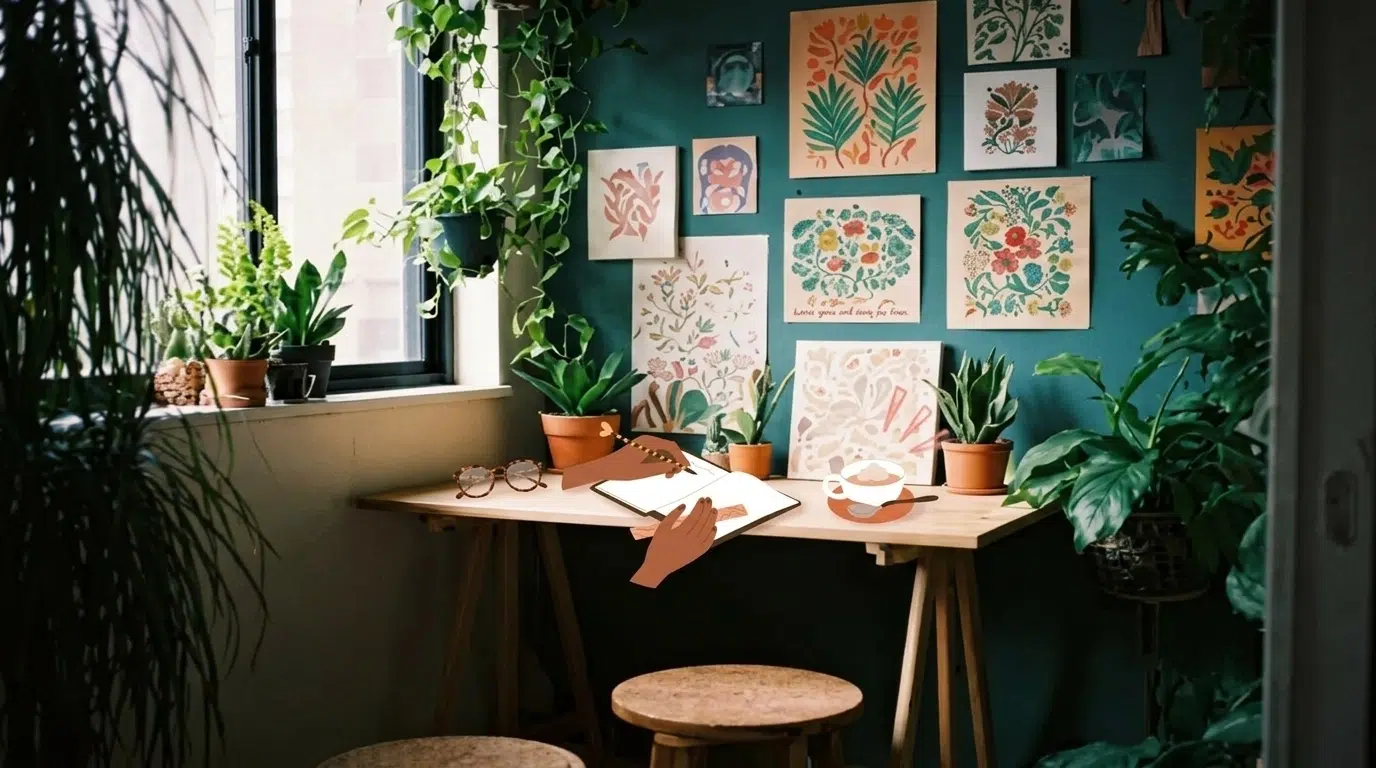
Your environment dictates your energy. If you’re studying in a cluttered, dark room with loud noises, your nervous system is going to stay in a state of high alert. Soft productivity encourages you to create a "study sanctuary."
Creating a calming environment isn't just about looks: it’s about stress management for students.
- Incorporate natural light and plants to boost your mood and creativity.
- Use lo-fi beats or brown noise to mask distracting background sounds.
- Keep your desk minimalist so your brain doesn't have to process unnecessary visual information.

A creative and calming atmosphere is essential for focused work and personal growth.
7. The 10-Minute Movement Rule
When you feel the "brain fog" setting in, don't try to power through it with more caffeine. That is the burnout culture way. The soft productivity way is to acknowledge that your body and mind are connected.
If you hit a wall, commit to 10 minutes of movement.
- Walk away from the screen to reset your eyes and your posture.
- Increase blood flow to your brain to naturally improve concentration.
- Break the cycle of stagnation by changing your physical state. Often, the solution to a difficult problem comes to you when you stop staring at it.
Ready to stop the grind and start growing?
Productivity shouldn't feel like a punishment. It should be the engine that helps you build a life you love. By implementing these soft productivity hacks, you aren't just getting better grades: you're learning how to take care of yourself for the long haul.
Join The Community
Want more honest, unfiltered advice on how to navigate student life without the burnout? We send out biweekly resources, study tips, and exclusive tools designed to help you succeed on your own terms.
Sign up for our newsletter today and let’s make learning feel good again.
Want a head start? The Ultimate Student Planner in my shop was made for exactly this — it’ll save you a ton of time.