
Standardized Testing 101: What SAT and ACT Mean for Families
Every parent faces questions about how the SAT and ACT impact college admission. With evolving test-optional policies and the importance of standardized assessments in the United States, understanding the basics of these exams can ease worries about your child’s future. This guide demystifies the key features of both tests, explains their role in admissions, and shares preparation tips to help your family navigate this crucial stage with confidence.
Key Takeaways
| Point | Details |
|---|---|
| Understand Test Differences | The SAT emphasizes analytical skills, while the ACT includes a science section; choose based on your strengths. |
| Prepare Early | Start studying six months in advance with practice tests to increase confidence and performance. |
| Know How Colleges Use Scores | Test scores help colleges assess academic readiness and scholarship eligibility, but policies vary by institution. |
| Utilize Test-Optional Policies | Even if a college is test-optional, strong scores can enhance your application; research specific policies for each school. |
Understanding the SAT and ACT Basics
Standardized tests can feel like a mysterious maze for high school students and parents. The SAT and ACT are two key college admission exams that help universities assess your academic readiness and potential. While they might seem similar, these tests have unique characteristics that can impact your college application strategy.
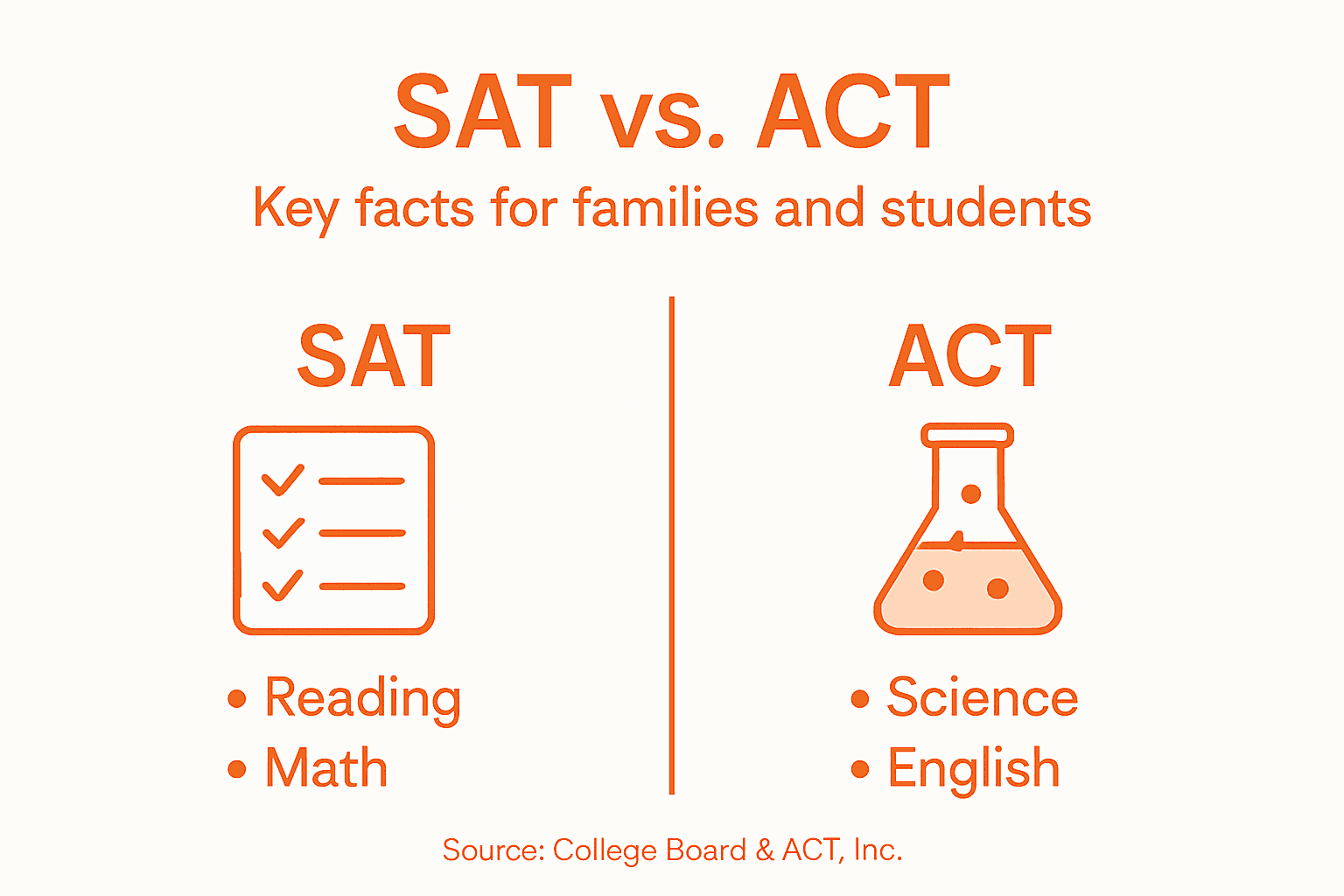
Here are the core differences between the SAT and ACT:
- SAT focuses more on reasoning and analytical skills
- ACT includes a dedicated science reasoning section
- Both tests measure college preparedness through multiple-choice questions
- Each test has different scoring ranges and time limits
The primary goal of these exams is to provide colleges with a standardized measure of student abilities. Unlike your school grades, which can vary across different educational systems, these tests create a uniform benchmark. College Board research shows that most four-year universities require either the SAT or ACT as part of their admissions process.
Most students take these tests during their junior or senior year of high school. Typically, students will complete the exam in one sitting, which takes approximately 3-4 hours depending on whether you include the optional writing section. The testing experience can feel intense, but proper preparation can help reduce anxiety and improve performance.
Pro tip: Start preparing for these tests at least six months in advance by taking practice exams, identifying your weak areas, and developing targeted study strategies.
Differences Between the SAT and ACT Tests
When it comes to college admissions testing, understanding the nuanced differences between the SAT and ACT can help students create a strategic testing approach. While both exams aim to measure academic readiness, they have distinct structures, scoring methods, and content focuses that can significantly impact a student’s performance.
Here’s a comprehensive breakdown of key differences:
- SAT offers a score range of 400-1600
- ACT provides a composite score from 1-36
- SAT eliminates penalty for wrong answers
- ACT includes a dedicated science reasoning section
- SAT math section allows calculators for some sections
- ACT allows calculators throughout the math portion
The test content varies in subtle but important ways. College admissions experts note that the SAT tends to emphasize analytical reasoning and problem-solving skills, while the ACT provides a more straightforward approach to testing academic knowledge. The SAT math section, for instance, includes more complex problem-solving questions that require deeper mathematical reasoning.

Time management differs between the tests as well. The SAT typically takes about 3 hours, while the ACT is slightly shorter at 2 hours and 55 minutes. The ACT moves at a faster pace, with less time per question compared to the SAT, which can be challenging for students who need more time to process information.
Here’s a side-by-side comparison of the SAT and ACT to help you quickly evaluate which exam fits your strengths:
| Exam Aspect | SAT | ACT |
|---|---|---|
| Score Range | 400–1600 (total) | 1–36 (composite) |
| Science Section | No standalone science section | Dedicated science reasoning section |
| Calculator Policy | Allowed only in some math areas | Allowed throughout math section |
| Pace | More time per question | Faster, less time per question |
| Math Focus | More advanced reasoning problems | More straightforward math questions |
| Test Length | About 3 hours (without essay) | 2 hours 55 min (without essay) |
Each test measures academic skills differently, so students should choose the exam that best matches their individual strengths and testing style.
Pro tip: Take practice tests for both the SAT and ACT to determine which test format feels more comfortable and aligns better with your personal testing strengths.
How Colleges Use SAT and ACT Scores
College admissions teams view standardized test scores as more than just numbers on a page. SAT scores help predict college success by providing a standardized measure of academic potential across diverse educational backgrounds. These scores serve multiple critical functions in the complex college admissions landscape.
Colleges typically use SAT and ACT scores for several key purposes:
- Assessing overall academic preparedness
- Identifying students for scholarship opportunities
- Placing students in appropriate coursework
- Providing context for high school academic performance
- Comparing students from different educational backgrounds
- Determining potential academic support needs
The role of standardized test scores has evolved in recent years. While many universities have adopted test-optional policies, these scores remain an important tool for comprehensive student evaluation. College admissions research indicates that scores can provide critical insights into a student’s academic capabilities, especially for competitive programs and scholarship considerations.
The following table summarizes how colleges use SAT and ACT scores in their admissions process:
| Use Case | Impact on Admissions | Student Benefit |
|---|---|---|
| Academic Assessment | Gauges academic preparedness | Provides national benchmark |
| Scholarships | Identifies eligibility criteria | Access to financial aid options |
| Course Placement | Guides placement decisions | Ensures proper class alignment |
| Comparative Evaluation | Contextualizes high school record | Levels applicant comparison |
| Support Determination | Finds potential support needs | Helps access academic resources |
Not all colleges weigh test scores equally. Some use them as a primary factor, while others consider them just one part of a holistic admissions review.
Pro tip: Request score reporting from colleges to understand exactly how they incorporate SAT and ACT scores into their admissions process, as policies can vary significantly between institutions.
Navigating Test-Optional Admissions Policies
The landscape of college admissions has dramatically transformed with the rise of test-optional policies, a trend accelerated by the global pandemic. Research on test-optional trends reveals a complex picture of how these policies impact student applications and university enrollment strategies.
Key considerations for students exploring test-optional admissions include:
- Understanding each college’s specific policy
- Evaluating personal test score strengths
- Determining when to submit or withhold scores
- Recognizing potential impacts on scholarship opportunities
- Preparing alternative academic evidence
- Reviewing holistic admissions criteria
Contrary to initial expectations, academic studies suggest that test-optional policies have not dramatically increased diversity in elite college admissions. Many universities continue to receive and enroll students with strong test scores, indicating that standardized testing remains an important factor in the admissions process, even when not mandatory.
Test-optional does not mean test-irrelevant. Strong test scores can still significantly enhance your college application.
Pro tip: Contact each college’s admissions office directly to understand their specific test-optional policy and how they evaluate applications without standardized test scores.
Effective SAT and ACT Prep Strategies
Preparing for standardized tests requires a strategic and comprehensive approach that goes beyond simple memorization. Test preparation is about understanding the exam’s structure, developing critical thinking skills, and building confidence through systematic practice and targeted learning techniques.
Here are the most effective preparation strategies:
- Create a consistent study schedule
- Take full-length practice tests under timed conditions
- Analyze your practice test results thoroughly
- Focus on improving weak subject areas
- Learn test-taking strategies specific to SAT and ACT formats
- Practice time management techniques
- Use official practice materials from test providers
- Consider working with a tutor or study group
Successful test preparation involves more than just academic knowledge. Students need to develop mental stamina, reduce test anxiety, and learn specific strategies for each test section. This means practicing not just content, but also understanding how questions are structured and learning efficient problem-solving techniques that work within the exam’s strict time constraints.
Your preparation strategy should be as unique as you are. What works for one student might not work perfectly for another.
Pro tip: Start your preparation at least three to four months before the exam, dedicating consistent time each week to build skills and confidence gradually.
Interpreting Test Scores and Next Steps
Understanding your standardized test scores is more than just reading a number – it’s about comprehending what those digits mean for your college admissions journey. Test scores serve as a critical snapshot of your academic potential, providing insights that go beyond simple numerical rankings.
Here’s what different score ranges typically indicate:
- Scores below 50th percentile suggest potential academic preparation needs
- Scores between 50-70th percentile demonstrate average academic performance
- Scores above 70th percentile indicate strong academic readiness
- Top 10% scores can qualify for competitive scholarship opportunities
- Scores near college-specific averages increase admission likelihood
- Scores significantly below target range might require strategic planning
Each college interprets test scores differently, making it crucial to research specific institutional expectations. Some universities have explicit score requirements, while others take a more holistic approach to evaluating student potential. Understanding your score’s context helps you make informed decisions about college applications, scholarship opportunities, and potential academic support needs.
Your test score is just one piece of your academic profile. Colleges look at the entire picture, including grades, extracurricular activities, and personal achievements.
Pro tip: Request score reports from colleges to understand exactly how they evaluate standardized test results and what score ranges align with their specific admissions criteria.
Unlock Your Best SAT and ACT Performance with Support You Can Trust
Navigating the complexities of the SAT and ACT can feel overwhelming as you strive to understand test formats, manage time, and boost your academic readiness. This article highlights the importance of strategic preparation and personalized approaches to standardized testing success. If you are looking to conquer challenges like test anxiety, time management, and scoring improvements, you are not alone.
At Learning With Angie, we empower students and parents with proven strategies in studying techniques, productivity, and maintaining a balanced lifestyle that directly support your test preparation journey. Discover tools and insights designed specifically to raise your confidence and maximize your results so you can approach these exams feeling equipped and ready. Ready to turn your test stress into test success Visit our main site now and start transforming your preparation today.
Frequently Asked Questions
What is the difference between the SAT and ACT?
The SAT focuses more on reasoning and analytical skills, while the ACT includes a dedicated science reasoning section. Both tests measure college preparedness through multiple-choice questions but have different scoring ranges and time limits.
How do colleges use SAT and ACT scores in admissions?
Colleges assess academic preparedness, identify students for scholarships, and compare applicants from different educational backgrounds using SAT and ACT scores. These scores provide a standardized measure of a student’s potential across various educational systems.
Should I take the SAT or ACT?
Selecting between the SAT and ACT depends on your strengths and comfort with each test format. Take practice tests for both to see which one aligns better with your skills and testing style.
How can I effectively prepare for the SAT or ACT?
To prepare effectively, create a study schedule, take full-length practice tests under timed conditions, focus on improving weak areas, and use official practice materials. Consistency in your study routine is key to building confidence and skills for the exams.
Recommended
- What Do Colleges Look for? A Step-by-Step Guide to Getting Into Your Dream College
- SAT Reading Section Tips That Helped Me Get a 780 On My 1st Try
- Ultimate College Application Planner + 14 Must-Do Tasks
- Is AP Lang Harder Than APUSH? A Guide to Decide What to Take
- SATs English Success at St Vincent’s Catholic Primary School | Pass 11 Plus Grammar
Want a head start? The All-in-One College Application Organizer in my shop was made for exactly this — it’ll save you a ton of time.