Can AI Really Help You Study? The Truth About Fact-Checking and Critical Thinking

You’ve probably seen the headlines: "AI is the future of education," or conversely, "AI is the end of original thought." But if you’re a student today, you’re not looking for a philosophical debate: you’re looking for a better way to get through your Chem 101 notes without burning out.
The truth is, AI tools like ChatGPT, Claude, and Notion AI can be your greatest academic allies, or they can be the reason you lose points for "hallucinations" and plagiarism. The difference lies in how you use them.
Ready to turn AI from a risky shortcut into a high-powered study partner? Let’s break down how to use these tools effectively while keeping your critical thinking skills sharp and your academic integrity intact.
The AI Benefit: More Than Just Fast Answers
Before we dive into the risks, let’s acknowledge why everyone is talking about this. When used correctly, AI offers a level of personalized support that was previously only available through expensive private tutoring.
- 24/7 Intelligent Tutoring: Stuck on a calculus problem at 2 AM? AI can explain the concept step-by-step, helping you understand the "why" instead of just giving you the "what."
- Instant Feedback: You can paste a draft of your essay and ask for feedback on your argument’s clarity. It’s like having a writing center in your pocket.
- Customized Study Materials: Use AI to generate practice quizzes based on your own class notes to ensure you're actually retaining the information.
- Summarizing Complex Text: If you're struggling with a dense 50-page research paper, AI can help identify the core arguments and key findings, saving you hours of frustration.
To see how AI can specifically enhance your digital workflow, check out our resources on studying techniques and note-taking methods.
The Truth About Hallucinations: Why AI Lies To You
Here is the most important thing you need to know: AI doesn't "know" facts. It predicts the next most likely word in a sentence based on patterns. This leads to hallucinations: moments where the AI confidently provides information that is completely made up, from fake historical dates to non-existent scientific citations.
Think of AI as an "Information Smoothie." It blends millions of sources into one smooth, convincing output, but it loses the original ingredients along the way. You can’t always tell where a specific "fact" came from, which is why fact-checking is your most essential new skill.
Mastering the "SIFT for AI" Method
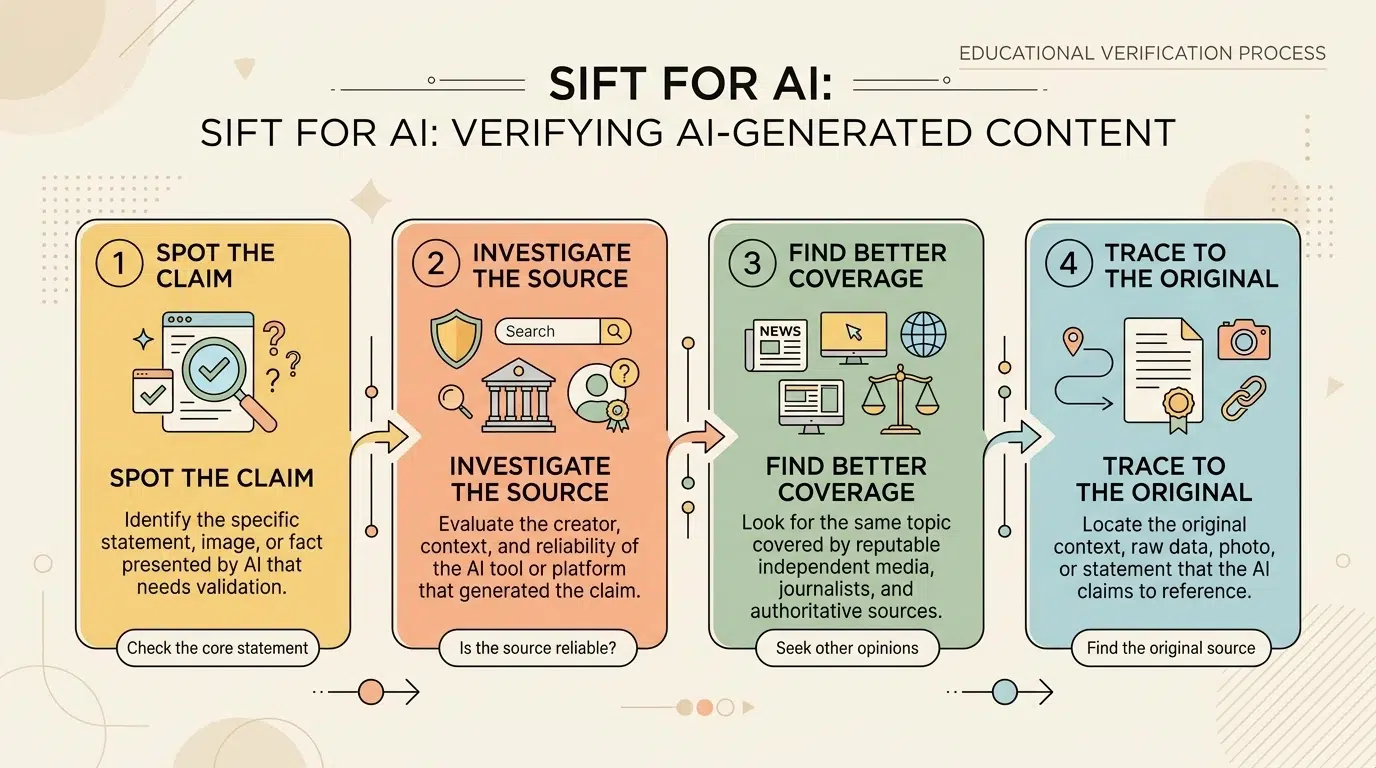
To avoid falling for AI-generated myths, you need a system. We recommend the SIFT for AI framework to keep your work accurate:
- Get it in: Identify the specific claim or fact the AI has given you. Don't just scan: pinpoint the exact dates, names, or statistics.
- Track it down: This is the most crucial step. Use a search engine to verify the claim independently. Does a reputable source (like a university site or major news outlet) confirm this?
- Find better coverage: Look for the original source. If the AI quotes a "study," find the actual PDF of that study to see if the AI interpreted the data correctly.
- Follow up: Don't treat the AI as a "one-and-done" tool. Use iterative prompting. If something sounds off, ask the AI: "Are you sure about that date? Can you provide a verifiable source or suggest where I might find one?"
Critical Thinking: Using AI as a Sparring Partner
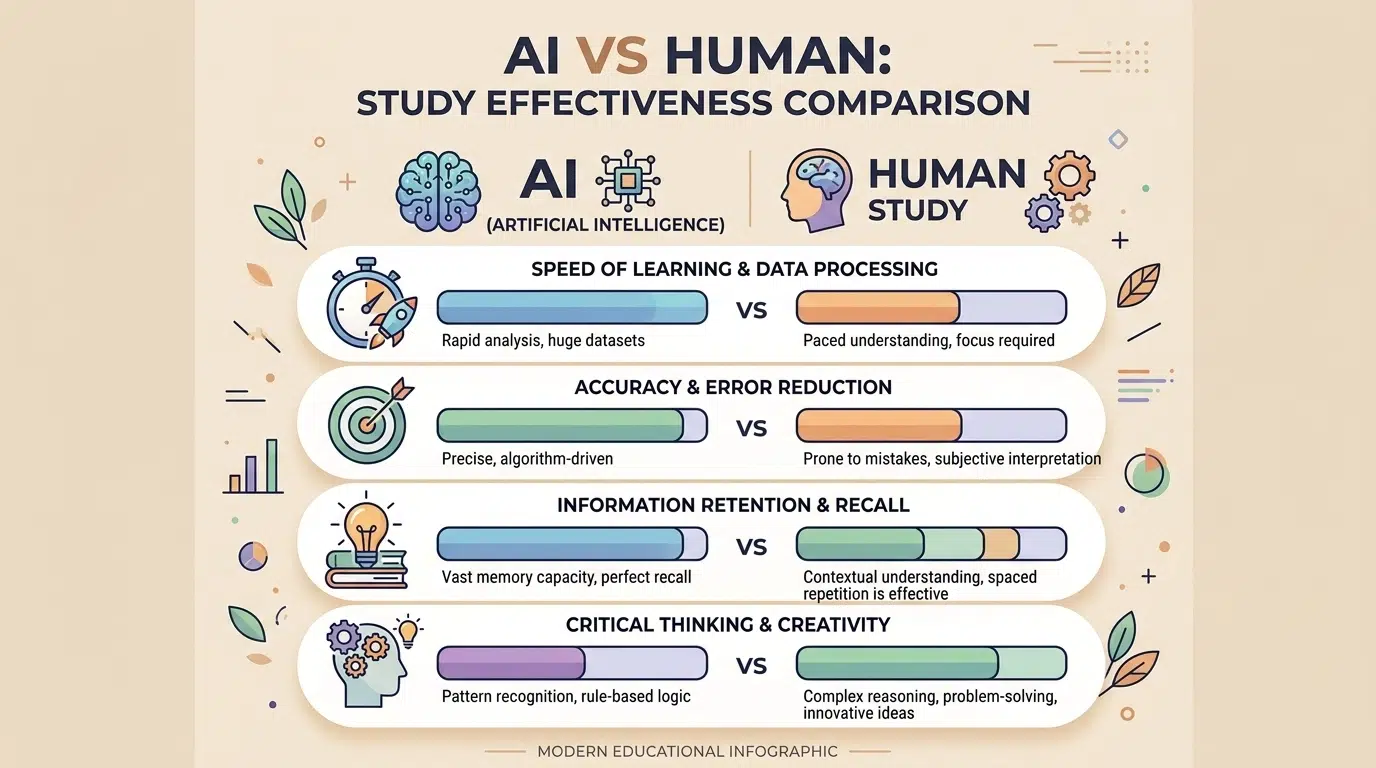
The goal of studying isn't just to finish the assignment; it's to change the way you think. If you let AI do the thinking for you, you’re missing out on the brain-building "heavy lifting" that leads to true success.
Instead of asking AI to "write an essay on the Great Depression," try using it as a sparring partner:
- Ask for Counter-Arguments: "I’m arguing that X caused Y. Can you give me three strong counter-arguments that a historian might use to challenge my thesis?"
- Use Dialogical Prompting: Engage in a conversation. "I don't understand the relationship between supply and demand. Can you explain it using a coffee shop as an example, then ask me a question to see if I got it?"
- Draft Refinement: Write your own paragraph first, then ask the AI: "How can I make this argument more persuasive? What evidence am I missing?"

Ethics 101: Assistance vs. Plagiarism
Where is the line? In the age of AI, the boundaries of academic integrity are shifting, but the core principle remains: The work you submit must be a reflection of your own understanding.
- Assistance: Using AI to brainstorm ideas, explain a difficult concept, or suggest ways to restructure your own writing.
- Plagiarism: Copying and pasting AI-generated text directly into your assignment without disclosure or significant modification.
Pro-Tip: Always check your school’s specific AI policy. Some professors allow it for research but ban it for writing. When in doubt, disclose. A simple note like, "I used ChatGPT to help brainstorm the structure of this outline," goes a long way in building trust with your instructors.
Creating Your AI-Ready Study Space
To get the most out of these tools, you need an environment that supports focus. Whether you're using AI to summarize a lecture or Notion to organize your application pipeline, your physical and digital space matters.

Your Next Steps for AI Success
Ready to stop guessing and start mastering these tools? AI is a permanent part of the modern student’s toolkit, and learning to use it ethically and effectively is a superpower that will serve you long after graduation.
- Practice SIFT today: The next time you use an AI tool, pick one fact it gives you and try to verify it in under two minutes.
- Change your prompts: Move from "Tell me about…" to "Challenge my argument that…"
- Join the Community: We’re constantly testing new tools and workflows to help you stay ahead of the curve.
If you’re ready to dive deeper into ethical AI use and master the latest productivity hacks, consider signing up for our AI University. We’ll show you exactly how to build a study system that’s fast, effective, and: most importantly: honest.
Ready to become the most efficient version of yourself? Join the community and let's get to work!
Want a head start? The Ultimate Student Planner in my shop was made for exactly this — it’ll save you a ton of time.