Decoding the College Application: A Parent’s Guide
Every parent faces that moment when preparing college application materials feels like navigating a mountain of details. With colleges requesting transcripts, standardized test scores, personal essays, and recommendation letters, the process can seem overwhelming. A clear plan for gathering and verifying each document helps families avoid last minute stress and missed deadlines. This guide offers practical steps so you can help your child present a complete and compelling academic profile for each application.
Quick Summary
| Key Point | Explanation |
|---|---|
| 1. Comprehensive academic review is essential | Assess your child’s academic profile and strengths at least six months before applications to identify areas for improvement. |
| 2. Organize application materials meticulously | Create a checklist of all required documents to ensure completeness for each college application, avoiding last-minute stress. |
| 3. Utilize the Common App effectively | Register early and gather necessary information to complete the Common Application efficiently, treating it like a detailed portfolio of achievements. |
| 4. Support supplemental essay writing | Guide your child through the essay process by providing feedback and encouraging authentic storytelling to reveal their personality and experiences. |
| 5. Verify all application components thoroughly | Double-check every section and document of the application to ensure accuracy, utilizing tracking tools for submission confirmation. |
Step 1: Assess your child’s academic profile
Decoding your student’s academic journey begins with a comprehensive and strategic review of their current educational standing. Understanding your child’s academic profile is crucial for navigating the complex college application landscape.
Start by gathering all essential academic documents, including high school transcripts, standardized test records, and a detailed report of grades from the past three years. This holistic snapshot will help you evaluate your child’s academic strengths and potential areas for improvement.
Here are key elements to examine in your child’s academic profile:
- Cumulative Grade Point Average (GPA)
- Rigor of course selections (honors, AP, advanced classes)
- Standardized test scores (SAT/ACT)
- Extracurricular academic achievements
- Consistency of academic performance
A comprehensive academic review provides critical insights into college readiness and potential scholarship opportunities.
Work closely with your child’s school counselor to obtain an unofficial transcript and discuss any nuanced aspects of their academic record. Some schools offer detailed academic progress reports that can provide deeper insights beyond basic grades.
Pro tip: Request a comprehensive academic review at least six months before college application deadlines to allow time for strategic improvements.
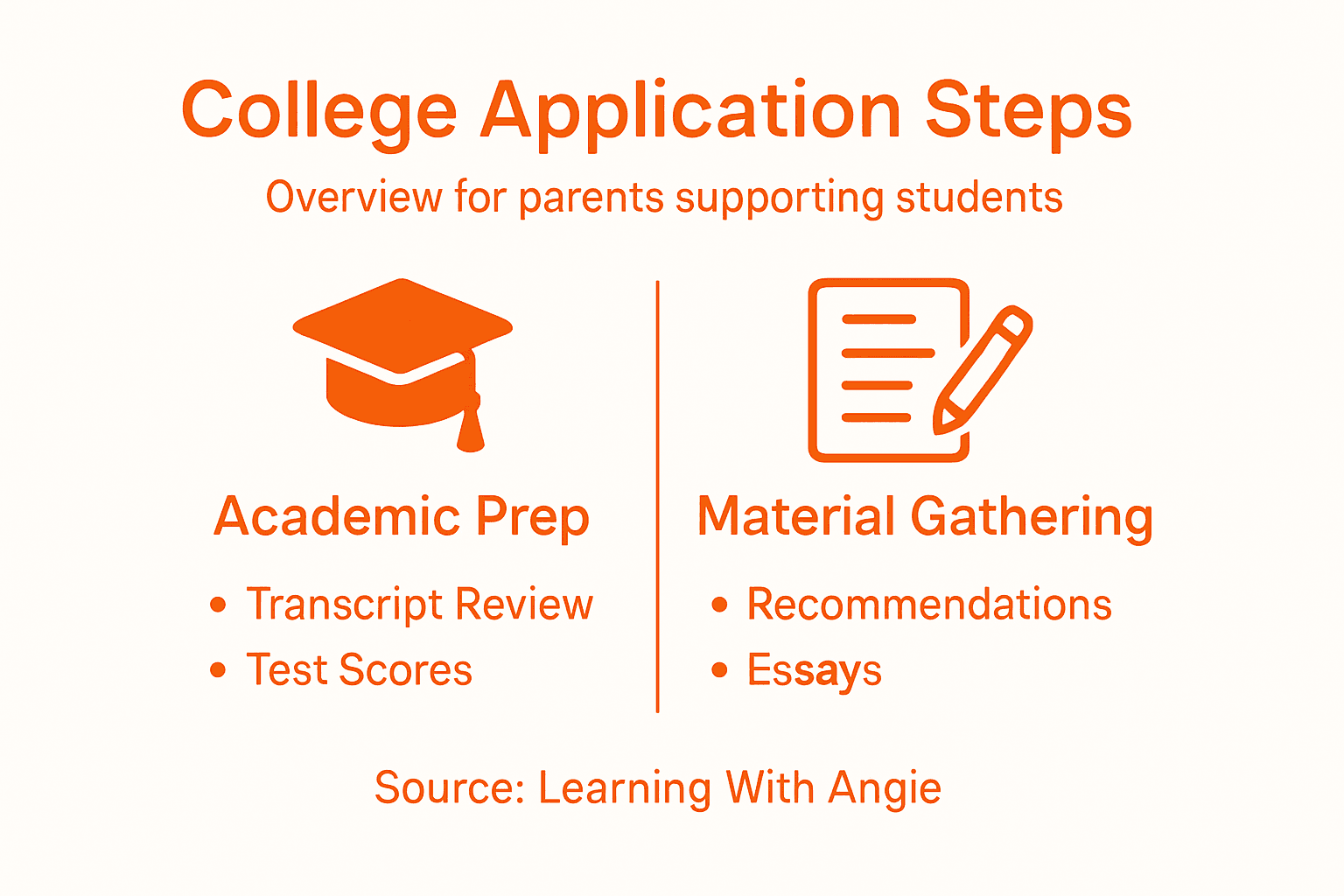
Step 2: Gather key application materials
Navigating the college application process requires meticulous preparation and organization of critical documents. In this step, you’ll compile all essential materials that universities need to evaluate your child’s candidacy.
Begin by creating a comprehensive checklist of application requirements. Each college may have slightly different expectations, so carefully review individual school guidelines. Essential documents typically include:
- High school transcripts
- Standardized test score reports (SAT/ACT)
- Personal statement or essay
- Letters of recommendation
- Financial aid documentation
- Proof of extracurricular activities
Your goal is to present a complete and compelling snapshot of your child’s academic and personal achievements.
Timing is crucial in this process. Request official transcripts well in advance and ask teachers for recommendation letters at least two months before deadlines. Many high school counseling offices have specific procedures for submitting these materials, so communicate early and often.

Pro tip: Create a digital and physical folder for each application to track submission status and ensure no critical documents are missed.
Here is a high-level overview contrasting proactive versus reactive approaches in the college application process:
| Approach Type | Description | Benefits | Common Challenges |
|---|---|---|---|
| Proactive | Planning and acting early, preparing materials in advance | Reduces last-minute stress, higher application quality | Requires consistent time management |
| Reactive | Acting as deadlines approach or after issues arise | Leverages urgency for quick decisions | Higher risk of errors or missed items |
Step 3: Complete the Common App efficiently
The Common Application represents a crucial milestone in your college application journey, offering a streamlined pathway to submit materials to multiple universities. Your goal is to navigate this digital platform with precision and strategy.
Start by creating an account and carefully reviewing application dashboard details. The Common App platform requires meticulous attention to detail and systematic organization of your child’s academic information.
Key strategies for efficient completion include:
- Register early and create login credentials
- Gather all required personal and academic information beforehand
- Complete profile sections systematically
- Review each section for accuracy
- Save progress frequently
- Understand specific college supplemental requirements
Treat the Common App like a comprehensive academic portfolio that represents your student’s entire educational journey.
Encourage your child to work on the application in focused, short sessions to prevent overwhelming stress. Most sections can be completed in 30-45 minute increments, making the process more manageable and less intimidating.
Pro tip: Schedule dedicated application work times and use browser bookmarks to quickly access saved progress on the Common App.
Step 4: Support supplemental essay writing
Supplemental essays represent your child’s opportunity to showcase their unique personality, experiences, and perspectives beyond standard application materials. Your role is to provide strategic guidance and emotional support throughout the writing process.
Help your student navigate essay writing strategies by breaking down complex prompts and encouraging authentic storytelling. Each supplemental essay requires careful attention to the specific college’s requirements and nuanced approach to personal narrative.
Key strategies for effective essay support include:
- Read essay prompts together
- Brainstorm meaningful personal experiences
- Encourage authentic voice and storytelling
- Review drafts without rewriting
- Provide constructive feedback
- Ensure grammatical accuracy
The most compelling essays reveal character, passion, and personal growth through specific, vivid details.
Encourage your child to start early and write multiple drafts. Different perspectives can emerge with time and reflection, transforming initial rough ideas into polished, powerful narratives that capture their unique strengths.
Pro tip: Schedule dedicated essay writing sessions with minimal distractions and create a supportive environment that nurtures creativity and self-expression.
Step 5: Review and verify all application components
The final stage of college applications demands meticulous attention to detail and comprehensive verification. Your goal is to ensure every single component of the application is complete, accurate, and submitted correctly.
Utilize application status tracking tools to monitor submission progress and confirm receipt of all required documents. Each university has unique verification processes, so systematic checking is crucial for a successful submission.
Critical verification steps include:
- Double-check personal information
- Confirm all sections are fully completed
- Verify recommendation letter submissions
- Check standardized test score reporting
- Review financial aid documentation
- Ensure supplemental essay uploads
Treat your child’s college application like a critical legal document – precision matters in every detail.
Allocate dedicated time to review each application component together. Some universities send confirmation emails, but don’t rely solely on these. Proactively follow up with admissions offices if any documentation seems missing or incomplete.
Pro tip: Create a digital spreadsheet tracking submission dates, confirmation numbers, and required documents for each university application.
Below is a summary of key roles for parents and students at each stage of the application:
| Stage | Student’s Main Role | Parent’s Main Role | Collaborative Task |
|---|---|---|---|
| Academic Assessment | Provide academic records | Request transcripts | Discuss strengths and gaps |
| Gathering Materials | Draft essays, collect reports | Track deadlines | Organize document folders |
| Completing Common App | Enter personal information | Offer guidance and review | Check section completion |
| Essay Writing | Draft and edit content | Give feedback, encourage | Review for authenticity |
| Final Review and Submission | Confirm all submissions | Double-check requirements | Maintain a tracking spreadsheet |
Support Your Student’s College Journey with Proven Strategies
Navigating the complex process of college applications can feel overwhelming, especially when managing transcripts, essays, and deadlines. This guide highlights the critical steps parents face, from assessing academic profiles to reviewing every detail before submission. If you want to reduce last-minute stress and help your student build confidence through effective time management, study habits, and balanced living, your next move is clear.
Discover tailored resources designed to empower both you and your student at Learning With Angie. Whether it’s mastering productivity, honing study aesthetics, or supporting essay writing, we offer practical tools that align perfectly with the challenges outlined in the article. Start today to turn college preparation into a structured, manageable, and even inspiring experience by visiting Learning With Angie. For strategies that transform pressure into progress take control now by exploring support options and proven techniques at Learning With Angie.
Frequently Asked Questions
How can I assess my child’s academic profile for college applications?
To assess your child’s academic profile, gather essential documents like high school transcripts and standardized test records. Review elements such as GPA, course rigor, and extracurricular achievements to identify strengths and areas for improvement.
What materials do I need to gather for my child’s college applications?
The key materials for college applications include high school transcripts, test scores, personal statements, recommendation letters, and financial aid documentation. Create a checklist and start collecting these documents at least two months before application deadlines to ensure nothing is missed.
How do I complete the Common Application efficiently?
To complete the Common Application efficiently, register early and gather all required personal and academic information before starting. Work systematically through each section, save your progress frequently, and review all details for accuracy before submission.
What should my child focus on when writing supplemental essays?
In supplemental essays, your child should focus on authentic storytelling that highlights their unique experiences and perspectives. Encourage brainstorming of personal anecdotes and provide constructive feedback without rewriting their work to maintain their voice.
How can we verify all components of the college application before submission?
You can verify all components of the application by double-checking personal information, confirming completion of each section, and ensuring recommendation letters and supplementary materials are submitted. Allocate dedicated time for a final review and track the submission status actively to avoid any last-minute issues.
Recommended
- Ultimate College Application Planner + 14 Must-Do Tasks
- What Do Colleges Look for? A Step-by-Step Guide to Getting Into Your Dream College
- All-in-One College Application Tracking Spreadsheet to Ace College Apps
- 10 Unique College Essay Ideas to Stand Out in Applications
Want a head start? The All-in-One College Application Organizer in my shop was made for exactly this — it’ll save you a ton of time.