
Understanding Study Advice for Students: A Complete Guide
Study advice shapes more than just test scores and homework habits. Research shows students using proven study strategies can see grade improvements of up to 30 percent over a single semester. Most people assume success just comes down to being smart or working extra hours. The real surprise is that with the right study techniques, anyone can transform their entire approach to learning and unlock potential they never knew they had.
Quick Summary
| Takeaway | Explanation |
|---|---|
| Effective study techniques enhance learning | Utilizing methods like spaced repetition and retrieval practice can boost memory retention and understanding. |
| Personalized learning strategies are key | Identifying individual learning styles helps tailor study approaches for better academic outcomes. |
| Mindset affects academic performance | Adopting a growth mindset encourages persistence and transforms challenges into learning opportunities. |
| Stress management boosts motivation | Managing academic stress effectively can enhance focus and motivation, driving better educational experiences. |
| Lifelong learning skills are essential | Skills acquired through effective studying prepare individuals for continuous personal and professional development. |
What is Study Advice and Why is it Important?
Study advice represents strategic guidance designed to help students improve their learning processes, academic performance, and overall educational experience. At its core, study advice encompasses practical techniques, psychological strategies, and structured approaches that transform how individuals absorb, process, and retain information.
Understanding the Core of Study Advice
Study advice goes beyond simple recommendations. It is a comprehensive framework that addresses multiple aspects of learning, including time management, cognitive skills, emotional resilience, and personal study techniques. Students who implement effective study advice can significantly enhance their academic potential by developing systematic approaches to learning.
Key components of study advice include:
- Developing personalized learning strategies
- Identifying individual learning styles
- Creating effective study environments
- Managing academic stress and motivation
The Critical Importance of Strategic Learning
Why does study advice matter? Academic success is not solely determined by intelligence but by how effectively students approach their learning journey. Strategic study methods can help students overcome learning challenges, maximize comprehension, and build confidence. By understanding and implementing proven study techniques, students can transform their educational experience from a struggle to an empowering process.
Moreover, study advice prepares students for long-term success. The skills developed through strategic learning extend far beyond classroom performance, building critical thinking, discipline, and self-management capabilities that are valuable in professional and personal contexts. Discover effective habit-building strategies that can revolutionize your approach to learning and personal development.
The Science Behind Effective Study Techniques
Cognitive science has revolutionized our understanding of learning, revealing that effective studying is not about working harder, but working smarter.
Modern research demonstrates that our brains have specific mechanisms for processing, storing, and retrieving information, which can be strategically leveraged to enhance learning outcomes.
Cognitive Processing and Memory Formation
Learning is fundamentally a neurological process involving complex interactions between different memory systems. The brain does not simply record information like a camera but actively constructs understanding through intricate neural networks. Short-term memory temporarily holds information, while long-term memory creates durable connections that facilitate deeper comprehension and recall.
Key neurological principles of effective learning include:
- Active engagement with material
- Creating meaningful connections between new and existing knowledge
- Utilizing multiple sensory inputs during study
- Implementing strategic repetition
Proven Psychological Learning Strategies
Researchers have identified several evidence-based techniques that significantly improve information retention and understanding. These strategies exploit the brain’s natural learning mechanisms, transforming study sessions from monotonous memorization to dynamic knowledge acquisition.
The table below organizes the core proven study techniques mentioned in this guide, outlining each method and its main benefit for student learning.
| Study Technique | Description | Main Benefit |
|---|---|---|
| Spaced Repetition | Reviewing information at increasing intervals | Transfers knowledge to long-term memory |
| Retrieval Practice | Actively recalling information from memory | Strengthens recall and understanding |
| Interleaving | Mixing different subjects or problem types when studying | Enhances flexible knowledge application |
Some of the most powerful study techniques grounded in psychological research include spaced repetition, retrieval practice, and interleaving. Spaced repetition involves reviewing information at gradually increasing intervals, which helps transfer knowledge from short-term to long-term memory. Retrieval practice requires actively recalling information, which strengthens neural pathways and improves future recall. Interleaving involves mixing different types of problems or subjects during study sessions, which enhances the brain’s ability to distinguish between concepts and apply knowledge flexibly.
Understanding Different Learning Styles and Preferences
Every student is unique, with distinct ways of processing, understanding, and retaining information. Learning styles represent individual approaches to absorbing and comprehending educational content, highlighting the importance of personalized learning strategies that align with personal cognitive preferences and strengths.
To help readers differentiate the major types of learning preferences discussed, the following table summarizes the primary learning styles and their key characteristics.
| Learning Style | Key Characteristics | Preferred Study Methods |
|---|---|---|
| Visual | Learns best through images and spatial information | Diagrams, charts, visual aids |
| Auditory | Processes information through hearing and speaking | Lectures, discussions, audio recordings |
| Kinetic (Kinesthetic) | Prefers hands-on experiences and movement | Experiments, role-play, active exercises |
| Reading/Writing | Thrives on text-based information | Note-taking, reading, written summaries |
The Foundations of Learning Style Theory
Learning styles are not rigid classifications but flexible frameworks that describe how individuals most effectively engage with educational material. Cognitive diversity plays a critical role in understanding how people learn differently. Some students excel through visual representations, while others thrive with auditory explanations or hands-on experiences.
Primary learning style categories include:
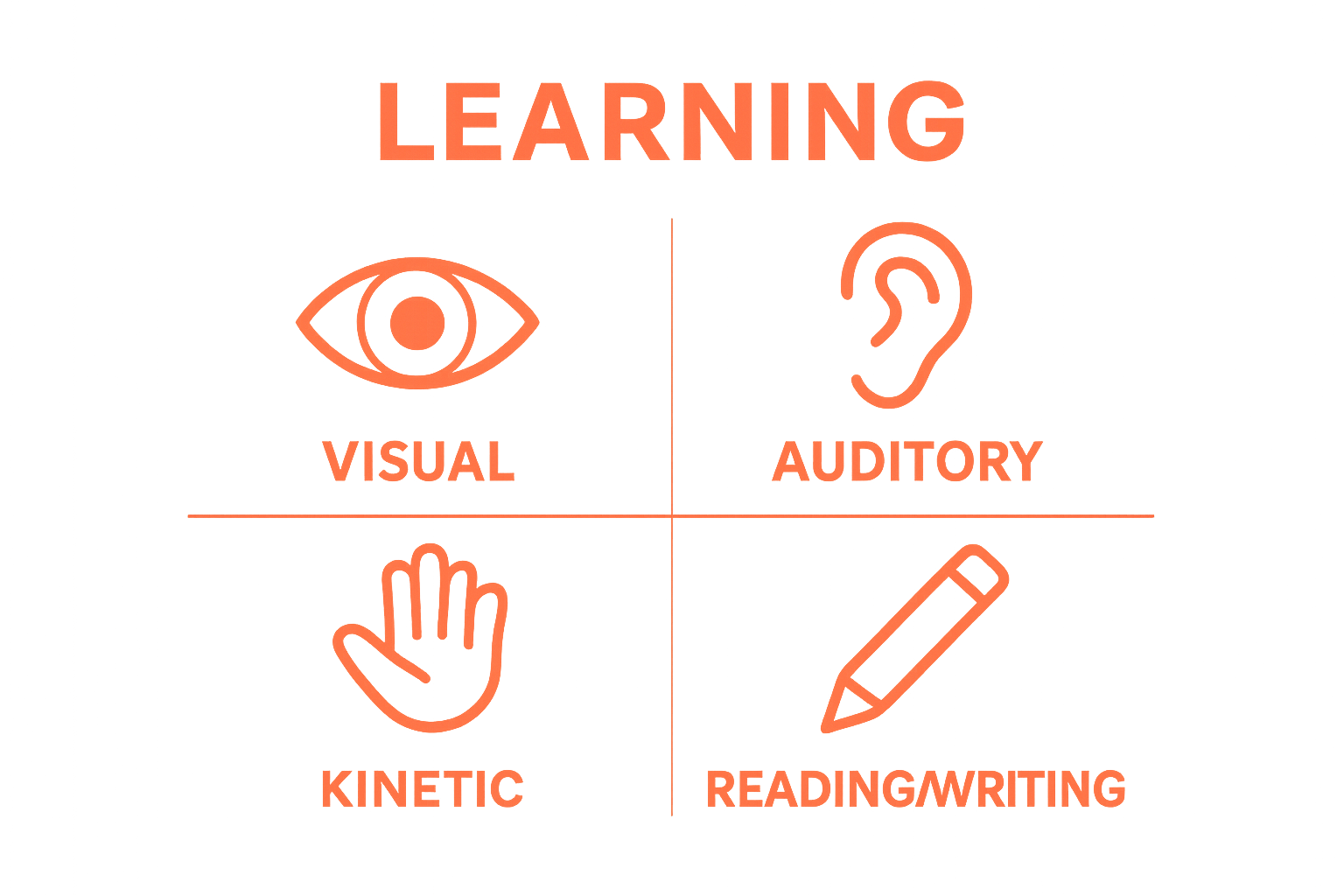
- Visual learners who understand best through images, diagrams, and spatial information
- Auditory learners who process information most effectively through listening and verbal instruction
- Kinetic learners who learn through physical movement and hands-on experiences
- Reading/Writing learners who prefer text-based information and written explanations
Personalized Learning and Cognitive Flexibility
Recognizing your dominant learning style is not about limiting yourself but about understanding your natural strengths and developing strategies to enhance overall learning potential. Discover your unique learning approach and learn how to leverage your cognitive preferences for academic success.
Successful learners understand that while they might have a preferred learning style, true academic growth comes from developing flexibility across different learning modalities. By experimenting with various study techniques and being open to multiple information presentation formats, students can expand their cognitive capabilities and become more adaptable, resilient learners capable of thriving in diverse educational environments.
How Motivation and Mindset Affect Study Habits
Motivation and mindset are powerful psychological forces that fundamentally shape learning experiences and academic performance. These interconnected mental frameworks determine how students approach challenges, perceive their abilities, and ultimately engage with educational material.
The Psychology of Academic Motivation
Motivation represents the internal drive that propels students toward learning goals. It is not a static trait but a dynamic process influenced by beliefs, emotions, and environmental factors. Students with high motivation view academic challenges as opportunities for growth rather than insurmountable obstacles.
Key components of academic motivation include:
- Intrinsic motivation driven by personal interest and enjoyment
- Extrinsic motivation stemming from external rewards or consequences
- Self-efficacy beliefs about personal learning capabilities
- Goal orientation and commitment to academic achievement
Growth Mindset and Learning Potential
The concept of mindset, pioneered by psychologist Carol Dweck, distinguishes between fixed and growth perspectives. Students with a growth mindset believe intelligence and abilities can be developed through dedicated effort, strategic learning, and persistent practice. Explore strategies for developing resilient study habits that transform challenges into opportunities for personal development.
A growth mindset enables students to reframe setbacks as learning experiences, maintain motivation during difficult academic periods, and continuously improve their cognitive skills.
 By understanding that abilities are not predetermined but malleable, students can cultivate a more adaptive and resilient approach to learning, ultimately enhancing their academic performance and personal growth.
Real-World Applications of Study Advice for Lifelong Learning
Study advice transcends academic settings, serving as a fundamental toolkit for continuous personal and professional development. The strategies and cognitive skills cultivated through effective learning approaches become powerful instruments for navigating complex real-world challenges and maintaining intellectual growth throughout one’s lifetime.
Transferable Learning Skills
Metacognitive strategies developed during academic learning create robust cognitive frameworks applicable across diverse life domains. These skills enable individuals to approach problems systematically, analyze information critically, and adapt quickly to changing environments. By mastering learning techniques during educational years, students prepare themselves for continuous skill acquisition and intellectual flexibility in professional and personal contexts.
Key transferable learning skills include:
- Strategic problem-solving approaches
- Self-directed learning capabilities
- Information processing and critical analysis
- Adaptable learning methodologies
- Efficient knowledge retention techniques
Professional and Personal Development
Lifelong learning is not merely an academic concept but a critical survival strategy in today’s rapidly changing world. Explore strategies for integrating continuous learning into your daily routine, transforming study skills into a comprehensive personal development framework. Professionals who maintain learning agility can swiftly adapt to technological changes, industry shifts, and emerging workplace requirements.
The most successful individuals view learning as an ongoing journey rather than a destination. By applying study advice principles such as curiosity, systematic approach, and continuous self-improvement, people can maintain intellectual relevance, personal growth, and professional competitiveness across various life stages and career transitions.
Ready to Transform Your Study Habits?
Are you struggling to find the best way to turn proven study advice into real results? Many students find it hard to create effective routines, handle motivation, and manage the pressure of constant exams. If terms like spaced repetition or metacognitive strategies seem overwhelming, you are not alone. But you do not have to stay stuck. Get the targeted solutions you need to finally make studying less frustrating and more rewarding by exploring our Studying resources, packed with actionable advice.
Frequently Asked Questions
What is study advice and why is it important for students?
Study advice consists of strategies and techniques designed to improve students’ learning processes and academic performance. It is important because it helps students develop better study habits, manage time effectively, and enhance overall educational experiences.
How can I identify my learning style?
You can identify your learning style by reflecting on how you process information best. Common categories include visual (learn by seeing), auditory (learn by listening), kinetic (learn by doing), and reading/writing preferences. Trying different study methods can also help you discover what works best for you.
What are some effective study techniques?
Effective study techniques include spaced repetition, retrieval practice, and interleaving. Spaced repetition involves reviewing material at increasing intervals to improve retention. Retrieval practice encourages actively recalling information, while interleaving involves mixing different subjects during study sessions for enhanced comprehension.
How can motivation and mindset affect my study habits?
Motivation and mindset greatly influence your approach to learning. A growth mindset enables you to view challenges as opportunities for growth, which can enhance resilience and persistence in studying. Maintaining motivation, whether intrinsic or extrinsic, can help you engage more fully with your academic work.
Recommended
- Organizing Your Study Space for Maximum Focus
- A Guide To Starting A Studygram
- Gifts that Students Actually Can Use
- How to Apply Atomic Habits to Studying to Get Better Grades