From Gamer to Coder: How to Turn Your Screen Time into a Skill
Every serious gamer knows the thrill of defeating a tough boss or solving a challenging puzzle, but what if those moments could reveal your hidden talents for programming? For high school students across the United States and Canada, the leap from gaming sessions to coding careers is more natural than you might think. By breaking down your favorite games and connecting their mechanics to real programming concepts, you can discover your own path to a future fueled by transferable skills gained through gameplay.
Quick Summary
| Key Point | Explanation |
|---|---|
| 1. Identify Your Gaming Strengths | Analyze games you excel in to uncover skills like problem solving and teamwork that relate to coding. |
| 2. Connect Game Mechanics to Coding | Draw parallels between game elements and programming concepts, such as resource management equating to variable tracking. |
| 3. Explore Beginner-Friendly Platforms | Choose coding platforms that engage you like games, utilizing gamification techniques to enhance learning. |
| 4. Build Simple Game Projects | Start creating your own games with beginner-friendly tools to apply what you’ve learned and solidify your coding skills. |
| 5. Test and Refine Your Creations | Engage in iterative development by rigorously testing your code to identify and fix bugs, improving your overall coding quality. |
Step 1: Identify Gaming Strengths and Interests
Want to transform your gaming skills into a killer coding career? This step is all about uncovering your secret superpowers hidden inside those epic gaming sessions. Every game you play reveals something special about your potential programming talents.
Start by analyzing the types of games you absolutely crush. Are you a strategy game master who can plan multiple moves ahead? That screams computational thinking. Do you dominate in multiplayer games where teamwork and communication are key? Those are essential software development skills. Maybe you love RPGs with complex character progression systems that show your talent for understanding intricate rule sets and algorithmic thinking.
Grab a notebook and break down your gaming strengths. Write out the specific skills you use most often in your favorite games. Are you great at resource management? Problem solving? Quick decision making? These translate directly into programming competencies. Some gamers excel at debugging game mechanics while others shine in creative world building. Your unique gaming style hints at which coding paths might fit you best.
Pro tip: Track which game genres make you feel most engaged and challenged for at least two weeks to discover your true technical talents.
Step 2: Connect Game Mechanics to Coding Concepts
Ready to unlock the secret language between your favorite games and actual programming? This step transforms your gaming skills into real coding knowledge by drawing direct connections between what you already know and what you need to learn.
Start by examining game mechanics as programming patterns. Think about how game elements mirror coding concepts. Resource management in strategy games mirrors variable tracking. Character skill trees represent complex conditional statements. Boss battle sequences demonstrate algorithmic thinking. Your ability to navigate game systems is basically writing invisible code without realizing it.
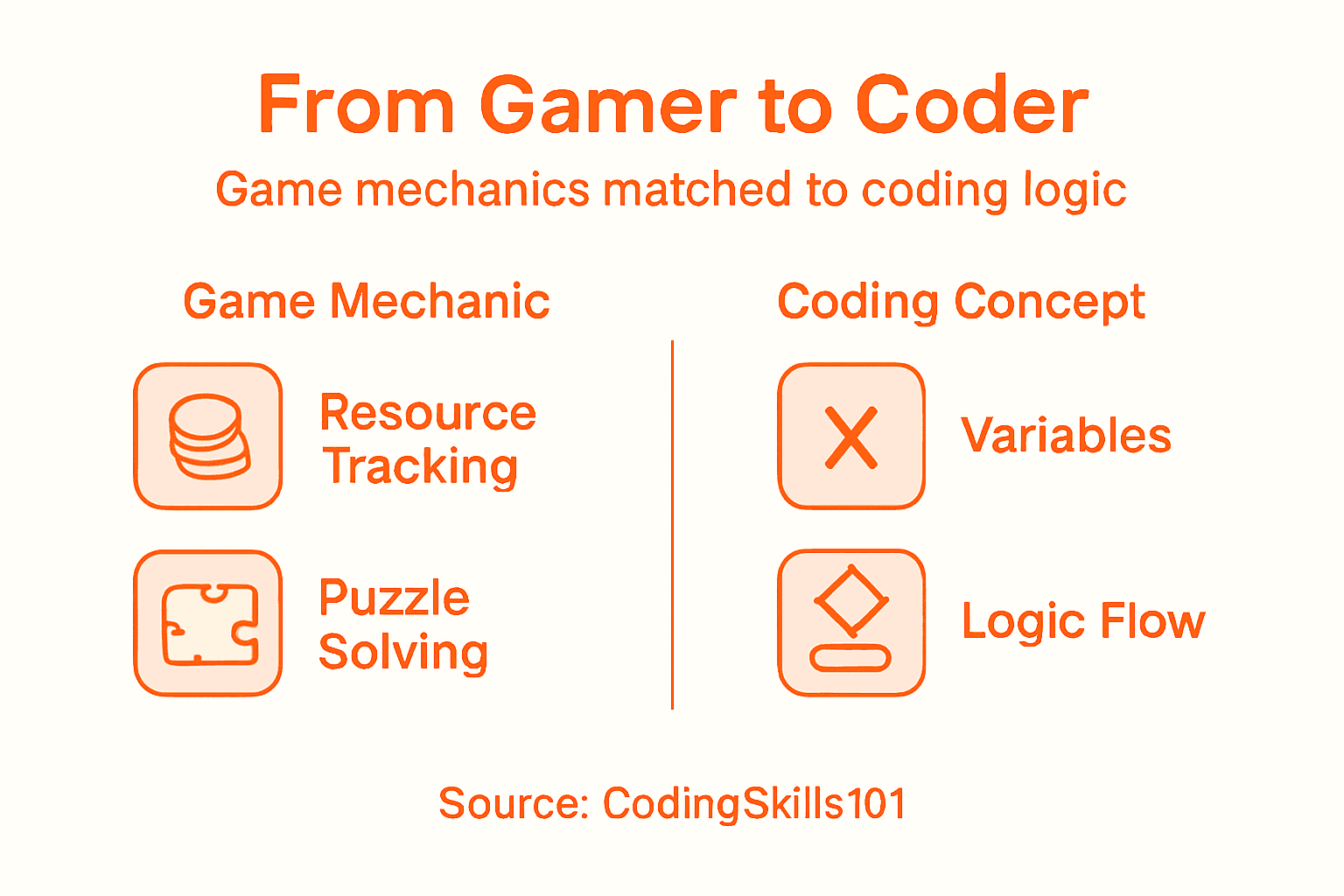
Break down your favorite games into their core mechanical components. In RPGs how do character stats change? In strategy games how do resources flow? In puzzle games how do rules interact? Each of these questions represents a fundamental programming concept waiting to be understood. Your gaming intuition is already teaching you computational thinking without textbooks or lectures.
Pro tip: Keep a gaming journal where you map game mechanics directly to programming concepts to accelerate your learning journey.
The table below summarizes how common game mechanics connect to key programming concepts:
| Game Mechanic | Programming Concept | Example in Coding |
|---|---|---|
| Resource management | Variable tracking | Managing player health |
| Skill trees | Conditional statements | Unlocking new features |
| Level progression | Loop structures | Repeating code actions |
| Puzzle solving | Logical operators | Determining win/lose logic |
Step 3: Select Beginner-Friendly Coding Platforms
Ready to turn your gaming passion into actual coding skills? This step is all about finding the right digital playground where you can learn programming without feeling overwhelmed or lost.
Start by exploring free coding platforms for beginners. Platforms like SoloLearn and freeCodeCamp are perfect for gamers because they offer interactive lessons that feel more like playing a game than studying. Look for apps that break down complex programming concepts into bite-sized challenges. Think of these platforms like tutorial levels in a game where you progressively unlock more advanced skills.
Consider your learning style and gaming preferences when choosing a platform. If you love strategy games, you might enjoy more structured learning paths. If you prefer RPGs, look for platforms with character progression style learning tracks. Some apps even gamify the entire learning experience with points, badges, and level systems that will feel familiar to any serious gamer. Coding apps designed for beginners often use similar engagement techniques that make learning feel like playing.
Pro tip: Try multiple coding platforms and stick with the one that feels most like a game to keep yourself motivated and engaged.
Here’s a quick comparison of popular beginner coding platforms and how they appeal to gamers:
| Platform | Learning Approach | Gamification Features | Ideal Gamer Style |
|---|---|---|---|
| SoloLearn | Interactive challenges | Points and badges | Competitive multiplayer fans |
| freeCodeCamp | Project-based curriculum | Progress tracking, certifications | Strategy game enthusiasts |
| Scratch | Visual drag-and-drop | Shareable projects, avatars | Creative world builders |
| CodeCombat | Story-driven coding | RPG progression, battles | RPG and adventure fans |
Step 4: Build Simple Game Projects from Scratch
You are about to transform from a game player to a game creator. This step is your gateway to turning those endless hours of gaming into actual coding skills by building your first interactive project.
Scratch provides the perfect beginner-friendly platform for turning your game ideas into reality. Think of it like building with digital Lego blocks where each programming block represents a specific game action. Start with simple projects like a basic catch game or a character movement challenge. These starter projects teach you fundamental programming concepts while letting you create something that feels like an actual game. Drag and drop programming blocks to control character movements, add scoring systems, and create interactive elements.
As you progress, challenge yourself to add more complex mechanics. Maybe create multiple levels, implement point tracking, or design game over conditions. Coursera game development tutorials can guide you through more advanced project structures. Remember that every great game developer started exactly where you are right now turning simple ideas into playable experiences.
Pro tip: Start with the smallest possible game project and focus on making one single mechanic work perfectly before adding complexity.
Step 5: Test and Refine Your Coding Creations
Now that you have built your first game project, get ready to become a debugging master. This step is all about transforming your raw code into a polished, functional experience that works smoothly and looks awesome.
Iterative development is the secret sauce of great programmers. Think of testing like playing a game on hard mode where you hunt down every possible glitch and imperfection. Run your game multiple times and try to break it intentionally. Click everywhere, input random values, and see how your code responds. Your goal is to find and fix issues before anyone else does. Pay attention to unexpected behaviors just like you would spot a bug or cheat in a video game.
Learn the art of systematic software debugging by tracking down problems methodically. Start by identifying symptoms like unexpected outputs or game crashes. Then trace back to find the root cause. Did a character get stuck? Is the scoring system working correctly? Each problem you solve makes you a stronger programmer. Remember that even professional game developers started exactly where you are right now.
Pro tip: Document every bug you find and how you fixed it to build a personal debugging reference guide.
Unlock Your Coding Potential by Turning Gaming Skills Into Academic Success
Struggling to focus your gaming passion into meaningful skills can feel overwhelming. This article highlights how skills like problem solving and resource management in games connect to coding concepts and development. If you want to take that first step toward a rewarding coding journey while maintaining balance in your life and studies, it helps to gain strategies tailored to your unique learning style and goals.
Explore proven study techniques and productivity hacks specifically designed for students ready to elevate learning and lifestyle at High School – Learning With Angie or dive deeper into advanced methods at College – Learning With Angie. Your transformation from gamer to coder does not have to be done alone. Find supportive resources that make mastering coding concepts, time management, and motivation feel achievable today.
Frequently Asked Questions
How can I identify my gaming strengths that relate to coding?
To identify your gaming strengths, analyze the types of games you excel in and note the skills you utilize, such as problem solving or resource management. Start by keeping a notebook for two weeks to track which games engage and challenge you the most.
What game mechanics can help me understand programming concepts?
Game mechanics, like resource management and puzzle solving, have direct parallels to programming concepts such as variable tracking and logical operators. Break down your favorite games to map these mechanics to coding concepts, which will help solidify your understanding of programming.
What are some beginner-friendly coding platforms I should explore?
Beginner-friendly coding platforms, such as interactive sites that offer bite-sized lessons, include those that gamify the learning process with points and achievements. Explore various platforms to find one that fits your learning style and keeps you engaged.
How do I start building my own simple game projects?
To start building simple game projects, use beginner-friendly platforms like Scratch which allows you to create interactive games through a visual interface. Begin with small projects and focus on perfecting a single mechanic before adding complexity.
How can I effectively test and refine my coding creations?
To effectively test and refine your coding creations, run your game repeatedly and attempt to break it intentionally to identify glitches. Document each bug you find and note how you fixed it, building a personal reference that will improve your debugging skills.
How long does it typically take to see progress from gaming to coding?
You can start seeing progress in your coding skills within 30–60 days by actively engaging in learning and building projects. Consistency in practice, like dedicating time each week to coding, will help you skill up faster.