
Why plan your semester: boost academic success in 2026
TL;DR:
- Effective semester planning improves grades, reduces stress, and boosts study engagement.
- Flexibility and regular review are crucial to avoid burnout and ensure successful adaptation.
- Personalizing your plan to fit your life enhances consistency and long-term academic success.
Cramming the night before a big exam feels productive, but research tells a different story. Time management through steady semester planning actually leads to measurably higher academic performance and study engagement compared to last-minute sprints. If you’ve ever finished a semester feeling burned out, blindsided by deadlines, or disappointed by your grades, the missing piece might not be effort. It might be planning. In this article, we’ll walk through why semester planning works, what the research says, how it looks at different school levels, and exactly how to build a plan that fits your real life.
Key Takeaways
| Point | Details |
|---|---|
| Consistent planning wins | Regular semester planning boosts academic performance and reduces stress compared to last-minute cramming. |
| Balance structure and flexibility | Effective plans let you adapt to changes, preventing burnout and missed opportunities. |
| Customize for your journey | High school and college students should tailor plans to their unique goals, requirements, and life factors. |
| Use research-backed steps | Following proven steps and tools leads to measureable gains in grades and study engagement. |
The proven impact of semester planning on your performance
Let’s talk numbers first, because the data here is genuinely eye-opening. Research shows that time management correlates with higher study engagement at r=0.29 and with academic performance at r=0.38. In plain terms, that means students who plan their time consistently tend to earn better grades and stay more engaged in their coursework. These aren’t tiny differences. They’re meaningful, measurable gains.
Here’s a quick comparison to put things in perspective:
| Approach | Study engagement | Academic performance | Stress level |
|---|---|---|---|
| Semester-long planning | High (r=0.29) | Strong (r=0.38) | Lower |
| Last-minute cramming | Low | Inconsistent | Higher |
| No planning | Very low | Unpredictable | Highest |
The contrast is pretty clear. Cramming might feel like a solution in the moment, but it doesn’t build the kind of consistent engagement that leads to real academic gains. And in STEM courses especially, regular study activities throughout the semester are a strong predictor of course performance. That means showing up consistently, not just before the test.
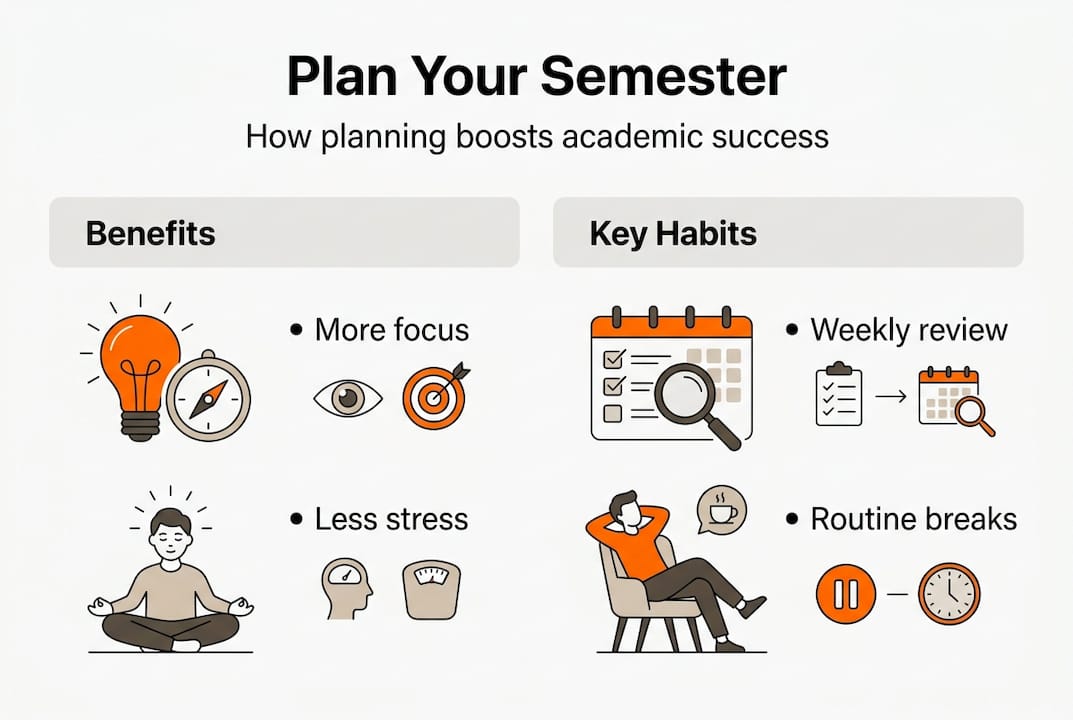
So what does semester planning actually do for you? Here’s a snapshot of the key benefits:
- Reduced stress because you always know what’s coming next
- Higher grades through consistent review and practice
- Improved focus since your study time has a clear purpose
- Fewer distractions because you’re working from a plan, not guessing
- More free time when you stop scrambling at the last minute
“Self-control acts as a key bridge between time management and academic outcomes. Students who plan consistently develop stronger self-regulation habits over time.” (Based on findings from PMC research on time management and academic performance)
One of the most interesting findings is that self-control plays a central role here. Planning your semester doesn’t just organize your calendar. It actually builds the mental habit of following through, which carries over into every area of your academic life. For more ways to make the most of your study hours, check out these time management tips and explore strategies for managing study time more effectively.
What effective semester planning looks like in high school and college
Semester planning isn’t one-size-fits-all. What works for a high school junior looks pretty different from what a college sophomore needs. Here’s a side-by-side look:
| Focus area | High school | College |
|---|---|---|
| Course selection | Balance rigor with graduation requirements | Sequence courses, meet prerequisites |
| Goal setting | GPA targets, test prep, extracurriculars | Major milestones, internships, gen-ed completion |
| Flexibility | Work around school schedule | Self-directed time management |
| Support systems | Teachers, counselors, parents | Advisors, professors, peer groups |
According to Georgia Tech’s admissions guidance, students should balance rigor with requirements by grade level, while college students benefit from spreading out general education, major courses, prerequisites, and experiential learning across their semesters. The core idea is the same at both levels: be intentional about what you’re taking on and when.
Here’s a simple numbered process to build your semester plan from scratch:
- Review your course requirements. Pull up your syllabus for every class and list all major assignments, exams, and projects.
- Set realistic but challenging goals. Think about your target GPA, specific skills you want to build, and any personal milestones.
- Schedule regular study blocks. Assign specific times each week for each subject, not just “whenever I have time.”
- Add buffer time. Leave gaps in your schedule for unexpected events, rest, and catching up.
- Revise as you go. Check in with your plan weekly and adjust based on what’s actually happening.
Let’s say you’re a high school junior balancing AP Chemistry, English, and two extracurriculars. You might block out Sunday afternoons for chemistry review, Monday evenings for English reading, and keep Friday nights free for rest. That kind of intentional structure makes a real difference over a full semester. Using a study planner checklist can help you stay on track without feeling overwhelmed.

Pro Tip: Build flexibility into your plan from the start. Life happens. A plan that bends without breaking is far more useful than a perfect schedule you abandon by week three.
Balancing structure and flexibility: Avoiding burnout and common pitfalls
Here’s something a lot of students don’t realize: having a plan can actually backfire if it’s too rigid. Over-scheduling yourself is one of the most common mistakes, and it leads straight to burnout.
Some of the most frequent planning pitfalls include:
- Forgetting to adapt when assignments shift or life gets complicated
- Packing the schedule with back-to-back study blocks and no breathing room
- Ignoring personal needs like sleep, meals, social time, and mental health
- Setting vague goals that don’t give you a clear sense of progress
- Treating the plan as permanent instead of a living document you update regularly
Research also reveals something counterintuitive about how students actually study. External agendas like tests tend to drive study time more than internal plans, and over-rigid plans often fail because they don’t account for real-life disruptions. In other words, your plan needs to respond to what’s actually happening around you.
“Students who try to follow a fixed, unchanging schedule often find it collapses under the weight of real academic demands. Adaptability is not a weakness in planning. It’s a core feature.” (Adapted from research on study allocation and external events)
Burnout signs to watch for include losing motivation, feeling exhausted even after rest, dreading every study session, and struggling to concentrate. If any of those sound familiar, it’s a signal to ease up and recalibrate, not push harder. Exploring productivity hacks for students can help you find smarter ways to work without running yourself into the ground.
Pro Tip: Do a five-minute weekly check-in every Sunday. Ask yourself: What worked this week? What didn’t? What needs to shift? This tiny habit can prevent burnout before it starts.
Step-by-step guide: How to create a semester plan that works
Ready to build your own semester plan? Let’s walk through it together, step by step.
- Gather all your course syllabi. Collect every syllabus at the start of the semester and read through them completely.
- Map out key dates. Add every exam, paper deadline, quiz, and project to one master calendar. Color coding by subject is genuinely helpful here.
- Plan weekly study slots. Assign dedicated time for each course each week. Even 30 to 45 minutes of focused review per subject adds up fast.
- Add flexibility windows. Block out at least two or three open slots per week for catch-up, unexpected assignments, or just resting.
- Do regular reviews. Revisit your plan weekly and monthly. Adjust as your workload shifts.
Let’s make this real. Imagine a college student with four classes, a part-time job on weekends, and a club sport on Tuesday and Thursday evenings. She blocks Monday, Wednesday, and Friday mornings for studying, uses her lunch breaks for light reading, and keeps Saturday mornings for longer review sessions. Because she planned ahead, she’s never scrambling the night before an exam.
Consistent engagement outperforms irregular study spikes every time, and time management skills built through semester planning support long-term academic success well beyond any single course.
Here’s a quick checklist of signs your plan is actually working:
- Your grades are stable or improving
- You feel less anxious before exams
- You have genuine free time without guilt
- You’re sleeping better and feeling more focused
- Deadlines no longer sneak up on you
Pro Tip: Start with a simple paper planner or a free app like Google Calendar before investing in anything fancy. The best planning tool is the one you’ll actually use consistently. You can also explore study efficiency techniques to get even more out of your study blocks.
A fresh perspective: Why personalizing your semester plan matters more than perfection
Here’s something I genuinely believe after seeing so many students stress over planning: chasing a perfect semester plan is one of the most counterproductive things you can do. Seriously. The students who succeed aren’t the ones with the most color-coded, elaborate schedules. They’re the ones who know themselves well enough to build a plan that actually fits their life.
Research supports this too. Underrepresented students and those with unique challenges often need extra support and more flexible, modular planning to maintain consistent engagement. A rigid plan built for someone else’s lifestyle simply won’t work for you.
Consistency, self-control, and regular reflection beat any perfect routine. The goal isn’t a flawless schedule. It’s a plan you can actually stick to, adjust when needed, and feel good about. Experiment, reflect, and adapt. That’s where the real growth happens, and it’s a skill that will serve you long after graduation. For more strategies on managing time for success, keep exploring what works best for your unique situation.
Get started: Tools and resources to master your semester
If this article got you motivated to take semester planning seriously, I’d love to help you go even further. On Learning with Angie, you’ll find a full library of resources designed specifically for students like you. Dive into effective study skills to sharpen how you learn, follow a step-by-step time management guide to structure your weeks with confidence, and browse student productivity hacks that actually work in real student life. You don’t need to overhaul everything at once. Pick one strategy, try it this week, and build from there. You’ve got this!
Frequently asked questions
What’s the biggest mistake students make when planning their semester?
The biggest mistake is creating an over-rigid plan without room for flexibility, which tends to collapse under real academic pressure and leads to stress and burnout.
How does semester planning improve academic performance?
Semester planning builds consistent study habits and self-control, which correlates with engagement and performance, resulting in better grades and lower stress over time.
Should high school and college students plan differently?
Yes. High school students focus on balancing rigor with graduation requirements, while college students should sequence courses and prerequisites and factor in experiential learning opportunities.
Can you adjust your semester plan if things change?
Absolutely. Regular plan reviews and adjustments are essential for handling unexpected events and preventing burnout throughout the semester.
Recommended
- Smart Organization Tips for Students to Ace Academics in 2026
- How to Create Study Groups for Academic Success
- Note Taking Techniques to Boost Academic Success in 2026
- How to Create a Study Schedule for Academic Success
- A Level maths exam preparation checklist 2026
- How tutors transform language exam preparation in 2026