Your Finals Study Schedule: Build It in One Evening, Three Weeks Out
Five exams in six days. A paper due in the middle of them. And right now, three weeks out, the plan is “study a lot,” which is why tonight you’ll open the wrong textbook, read the same page four times and go to bed feeling behind on everything. The problem isn’t effort. It’s that nobody told you which exam gets tonight.
This post fixes that in one evening. Not a color-coded masterpiece, not an app you’ll abandon by Thursday. One page, every exam on it, the crunch days found before they find you, and one job for each day between now and the last final. Set aside an hour, grab the syllabi, and let’s build your finals study schedule.
Quick answer
How do you build a finals study schedule? In one evening, about three weeks before your first final: (1) write every exam, paper and project on one page with its date and how much of the grade it carries; (2) count back three weeks from the first exam and mark the days where two or more land close together; (3) give each day one job, one class in 15-minute retrieval rounds, hardest class first and most often; (4) write a “bad day” version now, the 15-minute minimum that keeps the schedule alive when a day falls apart. Then copy the example week below and fill in your own.
Why one evening, and why three weeks out
Finals are different from a single test. A single test is one mountain. Finals are a mountain range, and the thing that wrecks people isn’t any one exam. It’s the overlap: the Tuesday final you ignored because the Monday one was scarier, the paper you forgot was due in the same week, the class you’re “fine in” that quietly carries 40 percent of your grade.
Three weeks is the sweet spot. Closer than that and you’re choosing which class to sacrifice. Further out and you don’t have the dates yet, or you’ll build something beautiful and never look at it again. Three weeks is long enough to see every class twice before the exam and short enough that the schedule feels real.
Step 1: Every exam, paper and project on one page
Open a blank page (paper is honestly better for this; you’ll tape it to the wall). Make four columns: the class, the thing, the date, and how much of your grade it carries. Then go through every syllabus and your school’s final exam schedule and write down everything that’s still graded between now and the end of the term.
- Every final exam, with the real date and time from the registrar’s finals schedule, not the class’s usual meeting time. In college these are almost never the same, and “I thought it was at 10” is a story that ends badly.
- Every paper and project still due, because a 35 percent paper is bigger than most exams and it does not care that it isn’t called a final.
- Every last quiz, lab or presentation you can’t skip. Small, but they take a day you were counting on.
- The grade weight for each one, straight from the syllabus. If it isn’t there, ask. This number decides the whole schedule.
When the list is done, circle the three items that carry the most weight. Those three get the most days. Everything else fits around them. If you’ve already built a one-page plan for a single exam using our 15-minute exam study plan, you’ve done a smaller version of this. Tonight you’re doing it for the whole term at once.
Step 2: Count back three weeks and find the pile-up days
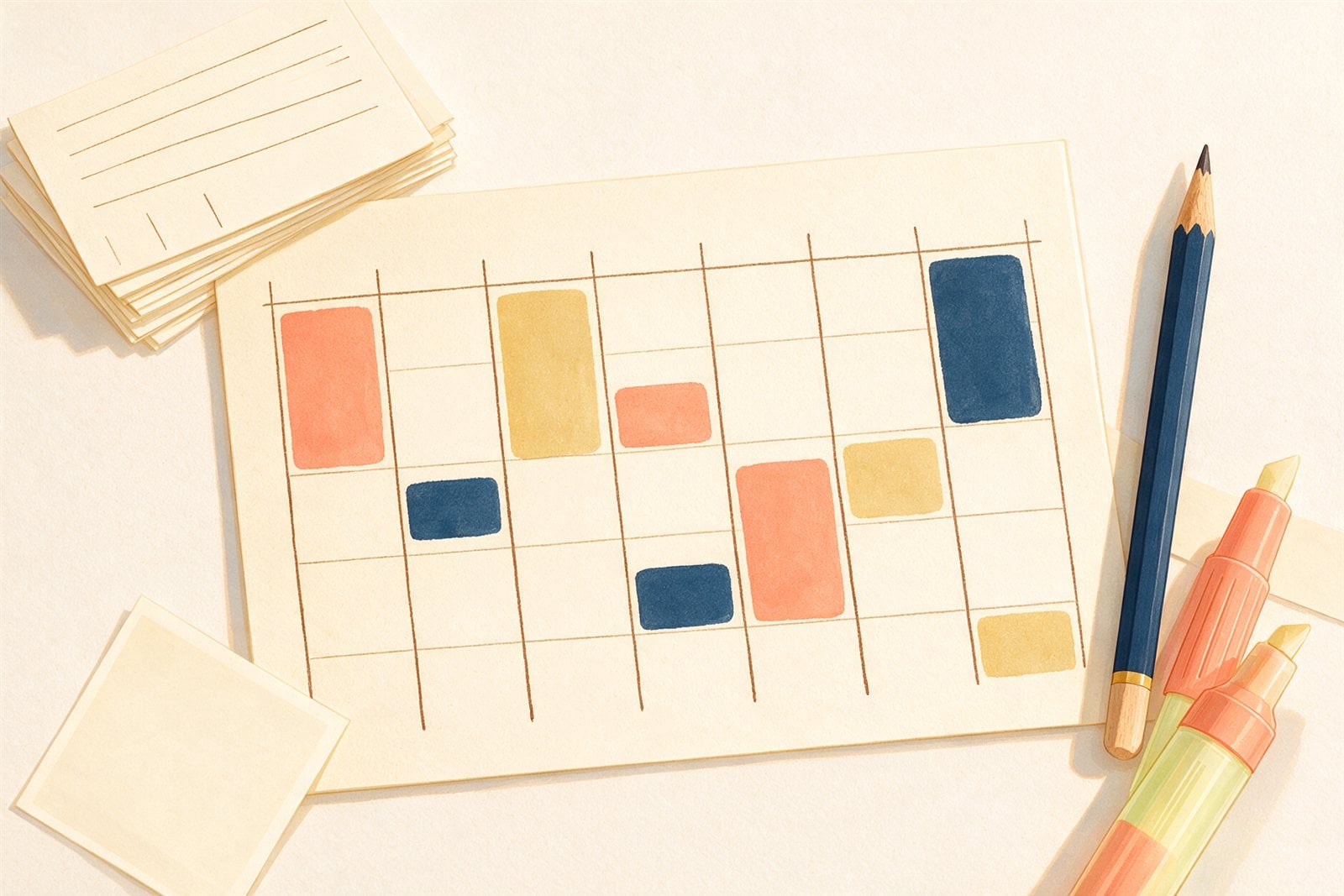
Now draw the calendar: three rows of seven boxes, ending on the day of your last final. Write the date in each box. Then drop every item from your list into its box.
Look at it for a minute. You’re hunting for two things.
- Pile-up days: anywhere two graded things land within 48 hours of each other. Those exams can’t both be studied the night before, so one of them has to be “done” a few days early. Put a star on the earlier one.
- Dead days: days you already know are gone. Thanksgiving, a work shift, a tournament, the drive home. Cross them out now so they can’t surprise you. For most U.S. students the three weeks before December finals include Thanksgiving week, and pretending you’ll study four hours on the Thursday is how the plan dies on day ten.
This is the step people skip, and it’s the one that matters most. The final that goes badly is usually the one that collided with another and only got noticed on Sunday night.
Step 3: Give each day one job, in 15-minute rounds, hardest class first
Here’s the rule that makes the schedule survivable: each day belongs to one class. Not “study for everything,” which turns into studying for nothing. Monday is Econ. Tuesday is Bio. You’ll still glance at other classes, but one class owns the day and gets the real work.
Hand out the days like this:
- The hardest, heaviest class goes first and comes back most often. If Econ is 40 percent and you’re shaky, Econ gets the first day of the plan and shows up every three or four days after that. Spacing beats stacking; you’ll remember more from four short visits than one long one.
- Starred exams (the early ones in a pile-up) get their last full day at least three days before the exam, so the night before is a review, not a first look.
- Papers get their own days, early. An outline day, a draft day, an edit day, all before exam week. A paper written during finals week eats two exams’ worth of study.
- Your “fine” class still gets at least two days. That’s the one that surprises people.
Inside each day, work in 15-minute rounds with the notes closed: pull a topic from memory, check what you missed, fix it, and go again. Three rounds is a solid session. Six is a big day. That’s it. No four-hour reading marathons, because reading feels like studying and tests like nothing. If you want the full method for one hard class, our cumulative exam study plan walks through red-yellow-green rating and how to review old units. This post is the calendar; that one is how to study once the calendar tells you what to study.
Step 4: Write the bad-day version tonight, while things are calm
Somewhere in the next three weeks a day will go sideways. You’ll get sick, a shift will run long, something at home will need you. The schedules that make it to finals aren’t the ones that never break. They’re the ones with a fallback written in advance.
So at the bottom of your page, write the bad-day version: one 15-minute round for whichever class owns today, done anywhere, then the day counts. Reading flashcards on the bus counts. Explaining one concept out loud in the shower counts. The point is that a bad day shrinks the plan instead of ending it, because the thing that kills a finals schedule isn’t a missed day. It’s the second missed day, when you decide the whole plan is already ruined and stop looking at the page.
Then add one rule under it: if you miss a full day, the next day’s class doesn’t move. You don’t “catch up” by doubling. You just rejoin the schedule where it is.
Want the three weeks on one printable page?
Our free Undated Monthly Planner is the blank grid this whole post is built on: print it, write your finals in, and tape it where you’ll see it every morning. No dates printed, so it works for whichever three weeks you’re in.
A filled-in example week, so you can copy the shape
Here’s a real-looking case. Finals run Monday through Friday. The one-page list came out like this, in order of weight:
- Econ final, Friday, 40 percent (shaky)
- History paper, due Wednesday, 35 percent
- Bio final, Monday, 30 percent (starred: it’s first and it’s heavy)
- Stats final, Tuesday, 25 percent (starred: lands the day after Bio)
- Spanish final, Thursday, 20 percent (the “fine” class)
Counting back three weeks, week two is Thanksgiving, so Thursday and Friday of that week are dead days and the paper’s draft has to happen before them. Here’s what the first of the three weeks looks like once every day has one job:
| Day | Owner | What that means |
|---|---|---|
| Monday | Econ | Four 15-minute rounds, first unit from memory, notes closed. Mark what fell apart. |
| Tuesday | Bio | Three rounds on the oldest material, because the final is cumulative and that’s what’s faded. |
| Wednesday | History paper | Outline only. One page, the argument and the five sources. No writing yet. |
| Thursday | Econ | Three rounds, second unit. Redo yesterday’s worst Bio topic for one round at the end. |
| Friday | Stats | Three rounds: one old problem set, timed, then fix every miss. |
| Saturday | Bio | Three rounds on the middle units, then write the miss list for next week. |
| Sunday | Spanish + reset | Two rounds of verbs, then 15 minutes to look at next week’s boxes and move anything that’s already wrong. |
Notice what’s not there. No day says “study everything.” Econ shows up twice because it’s the heaviest and the shakiest. Spanish gets one day, not zero. The paper gets a real day before anyone’s panicking about it. And Sunday ends with a 15-minute look at the next week, which is the single habit that keeps the whole thing alive.
Weeks two and three follow the same shape: every class comes back every three or four days, the starred exams get their last full day early, and the paper is drafted before Thanksgiving. By finals week, each night-before is a review of your miss list, not a first pass.
If you’re in high school, this still works (with two changes)
High school finals are usually bunched into two or three days with multiple exams each day, and you don’t get to pick the order. So the pile-up step matters even more: nearly every exam is starred, which means nearly every class needs its last full day three or four days before the exam, not the night before. And your dead days are set by other people, so build them in first. If you’re after the study side of it, our 15 study tips for high schoolers facing final exams pair well with this calendar.
And if what you really want is a routine that lasts a whole semester rather than a three-week sprint, start with how to build a study routine and come back here when the dates are on the calendar.
If you want it done for you
The Exam Season Survival Kit ($9) is this post as a fill-in system: the triage page for ranking every exam by weight, a backwards-planning grid, the miss list that tells you what to review the night before, and a day-before and day-of checklist so nothing is left to memory on exam morning.
Once finals are behind you, The Study Skills System ($14) is the next step: seven connected Notion tools that turn the one-class-a-day rhythm into how you study every week, not just in December.
Three questions people ask about finals schedules
How many hours a day should I study for finals?
Fewer than you think, more often than you think. Three to six 15-minute retrieval rounds on one class, most days for three weeks, beats a five-hour cram the night before, because retrieval with the notes closed is what moves material into memory. Count rounds, not hours. If you’re still worried, add a day for that class next week, not hours tonight.
What if my finals are less than three weeks away?
Build the same page tonight; just compress it. With two weeks, every class gets two days instead of three or four, and the weight column decides who gets the extra day. With one week, pick the three exams that decide your grade and give them almost everything. Starting tonight with eight days left beats starting Sunday with four.
Should I study for every class every day?
No. A little of everything every day feels thorough and produces shallow, scattered sessions where nothing gets finished. One class owns each day; the others come back on their own days a few days later. That spacing is the whole trick. The only exception is the last two or three days before an exam, when that class gets a short daily review of its miss list alongside whatever else owns the day.
Your next fifteen minutes
You don’t need the whole evening to start. Take fifteen minutes right now and do step 1: one page, every graded thing left this term, with its date and its weight. That page alone tells you which exam gets tonight. The calendar and the one-job-per-day handout can wait for the evening you’ve set aside. The list can’t.
Before you close this tab
A schedule you can’t see is a schedule you won’t follow. Print the free Undated Monthly Planner, fill in your three weeks tonight, and put it on the wall above your desk. One glance each morning tells you who owns today. That’s the whole system.
You don’t need to have it all figured out. You just need the next step. Tonight, the next step is the list.
Rooting for you,
Team Angie