A cumulative exam study plan can make one semester feel like it got dumped on your desk at once. Unlike a final exam study plan, it helps you decide what matters across the course, what to do next, and when to stop. The good news is you don’t need to remember everything tonight.
Cramming may feel productive because you’re busy, but busy and prepared are not the same thing. If time is tight, a five-day study plan gives you a short-term version of the same approach. A steady plan protects older units on your study schedule before panic gets to take over.
This post may contain affiliate links. If you make a purchase through these links, I may earn a small commission at no extra cost to you.
Key Takeaways
- Start with the syllabus and build a master inventory of units, skills, exam dates, and likely question types.
- Rate topics as green, yellow, or red so your study schedule gives more time to weak areas instead of comfortable ones.
- Put realistic study blocks on a calendar and combine new learning, older review, active recall, and spaced practice.
- Use practice questions to find the cause of each mistake, then adjust the next study block instead of following the original plan rigidly.
- Protect sleep, meals, breaks, and other commitments because a sustainable plan works better than a last-minute cram session.
Start your cumulative exam study plan with the syllabus
Your syllabus isn’t background reading that disappears into the bottom of your backpack. For finals, it’s your semester map. Pull it out with your study materials, including a concise study outline of units, skills, and likely question types. Add old quizzes, notes, homework assignments, and any study guide your teacher gave you.
Look for exam dates, grading weights, learning objectives, chapters, unit titles, and topics your teacher repeated in class. Use the learning objectives to decide which broad buckets belong in your inventory. Repeated ideas are rarely random.
Make a master topic inventory
Create one page or spreadsheet with every final exam across the top. Under each class, list the units or major skills that could appear. If the exam is close, this inventory can anchor a five-day study plan.
For example, a biology final may include cell processes, genetics, evolution, and ecology. A history final may cover several eras, source analysis, vocabulary, and essay themes. Don’t write every tiny detail yet. Start with the big buckets.
Then organize your study materials by bucket. You don’t want to lose 20 minutes hunting for a worksheet every time you sit down to study. That is how a “quick review session” turns into staring at your laptop and questioning your life choices.
Turn vague topics into questions
“Review Chapter 8” is not a task. It is a fog cloud wearing a backpack.
Rewrite each topic as something you can answer without your notes:
- “Can I explain the steps of cellular respiration in order?”
- “Can I solve quadratic equations without checking an example first?”
- “Can I connect the causes of the Civil War to its major outcomes?”
- “Can I write a thesis that answers this kind of literature prompt?”
Those questions become the backbone of your study guide. They also make self-testing much less awkward.
Find the weak spots before you schedule everything
Not every chapter deserves the same amount of time. If you spend three hours reviewing your favorite unit because it feels comfortable, you may be avoiding the one that needs you most. We have all done it.
Use your past work as evidence, and compare it with the course’s learning objectives. Review quiz scores, returned tests, homework corrections, class participation, and the topics that made you blank during class.
Use a simple red, yellow, green rating
Mark every topic with one of these labels:
| Rating | What it means | What to schedule |
|---|---|---|
| Green | You can explain it and use it without notes. | Short review sessions and mixed practice. |
| Yellow | You understand part of it but make mistakes. | A focused lesson review, then practice. |
| Red | You cannot explain it or solve problems alone. | Learn it first, then return for repeat practice. |
Be honest, not mean. A red topic isn’t proof that you’re bad at chemistry, algebra, or essay writing. It’s useful information. Now you know where your time belongs.
A topic you avoid because it feels confusing is often the topic that deserves your first 25-minute block.
Balance several finals and avoid burnout
When three exams land in the same week, don’t create three separate plans and hope your brain figures it out. Use one master calendar for your study schedule, including exam dates, difficulty, available hours, work, meals, and sleep.
Externalizing these priorities supports executive function, making it easier to start and switch tasks.
Give each class a priority score based on exam date, grade weight, difficulty, and how much you still need to learn. Semester grades can inform that score, but grade weight is only one factor. A final on Monday with two red topics comes before an exam on Thursday with mostly green topics.
If you have only a few days, let the priority scores set the order of your five-day study plan.
Also block project deadlines and work shifts before adding study sessions. Good time management keeps your plan grounded in actual life, including meals, sleep, commuting, and the occasional distracting text.
Put study blocks on a calendar, not a wish list
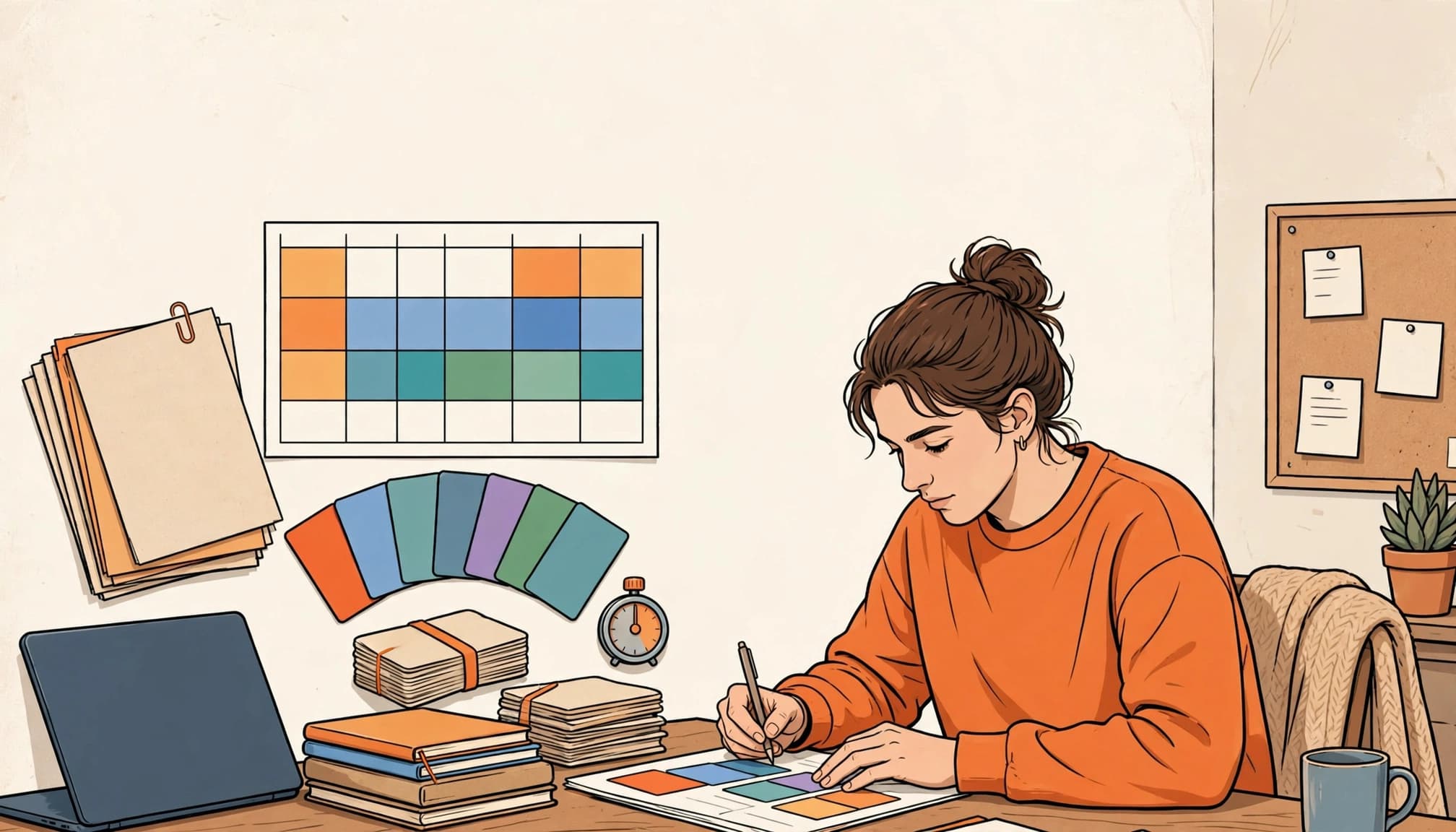
A to-do list tells you what needs attention. A calendar tells you when it will happen. Use both when building a final exam study plan, but only a calendar protects the time.
Start with your fixed commitments: classes, sports, work, appointments, meals, and sleep; then add study blocks around them. Good time management means matching those blocks to your real available time, not squeezing in endless work. If you have two weeks, aim for shorter repeat sessions instead of one giant Saturday marathon.
The UNC Learning Center recommends distributed practice across days and weeks, or spaced repetition: repeated retrieval across days instead of one longer session. Returning to material makes you retrieve it again, rather than mistaking familiar notes for real knowledge.
Use a five-day study plan template
Copy this five-day study plan into a paper planner, Google Calendar, Notion, or whatever you’ll actually open. It turns the template into a study schedule you can see and follow.
| Day | First priority block | Second block | Quick review |
|---|---|---|---|
| Monday | Learn one red topic for 40 minutes | Practice problems for another class | 10 flash cards from last week |
| Tuesday | Review Monday’s red topic from memory | Read and outline an upcoming project | 15-minute formula or vocabulary quiz |
| Wednesday | Timed practice questions | Learn one yellow topic | Explain an old unit out loud |
| Thursday | Correct missed practice questions | Mixed flashcard review | Pack materials for Friday |
| Friday | Short self-test in your earliest exam | Project work or tutoring | Choose weekend priorities |
| Weekend | One longer practice set | Catch-up block | Rest and reset |
The takeaway is simple: each day includes new learning, older review, and retrieval. You aren’t leaving the first half of the semester behind while you work through the last chapter. If work or other commitments change, adjust the five-day study plan rather than abandoning the study schedule.
Keep blocks small enough to start
Try 25 to 50 minutes of focused work, followed by a 5 to 10-minute break. After two or three blocks, take a longer break to eat, move, shower, or do something that isn’t academic.
Set a timer, choose a low-distraction study environment, and put your phone across the room. A visible calendar, clear start time, and single next action reduce the executive function needed to begin. Decide the task before you start and name its learning objectives. “Biology” is too broad. “Draw and label the steps of mitosis from memory” gives your brain somewhere to go.
Treat unfamiliar material differently from old material
A common finals mistake is reviewing everything the same way. But a topic you never understood needs a different plan than a topic you learned in September and haven’t touched since.
Learn weak material before drilling it
For red topics, start with active preparation. Use study materials such as a short reading, your teacher’s recommended lesson, or corrected work, and ask for help in office hours when needed. Your goal is to build a basic explanation.
Then close the material and try a few questions alone. If you still can’t begin, use a concise study outline to support retrieval, not to copy everything. Go back for one small piece of instruction, then try again. Don’t spend two hours rereading because it feels safer.
If you have accommodations, use them. A reduced-distraction space, written directions, extended time, tutoring, or help breaking down large tasks can make finals preparation more workable. You don’t have to wait for a complete academic disaster to ask a teacher for support.
Review older material by retrieving it
The right review strategies depend on the gap: unfamiliar material needs instruction first, while older material benefits from retrieval, teaching, or concept mapping.
Older units usually need active review, not a full re-teach. Cover your notes and write what you remember. Solve a problem. Explain the process to a parent, sibling, friend, pet, or stuffed animal. No judgment here.
UNC’s finals preparation guide suggests activities like teaching information, creating concept maps, and writing your own test questions. Those methods show what you know and expose what has gone missing.
Make active recall and spaced practice your default
Reading highlighted notes can be useful for a quick refresh. It shouldn’t be the whole plan. Recognition feels familiar, but exams usually ask you to produce an answer without your notebook beside you.
Use self-testing that matches the course
Build self-testing into each session. For math, science, accounting, or language classes, solve practice problems without looking at worked examples. Check your answer after attempting the problem, then write down why you missed it. Short practice tests can check one topic, while a full-length test measures recall across the course.
For history, psychology, literature, or other reading-heavy courses, use review strategies such as turning headings into questions, building timelines from memory, creating concept maps, comparing concepts, and practicing short-answer or essay prompts. The UNC Learning Center’s STEM study strategies also emphasizes recall as a way to check your understanding.
Keep a small “missed it” list. Include formulas you forget, vocabulary you mix up, question types that trip you, and steps you skip. Review that list every day. It is much more useful than repeatedly rereading what you already know.
Space and mix your subjects
Try a basic spaced repetition rhythm: study a topic today, test yourself again two or three days later, then return to it the following week. As the final gets closer, mix it into larger review sessions.
That spacing gives you several chances to retrieve the material after some forgetting has happened, strengthening retention. The UNC memory strategies guide recommends gradually increasing the time between review sessions.
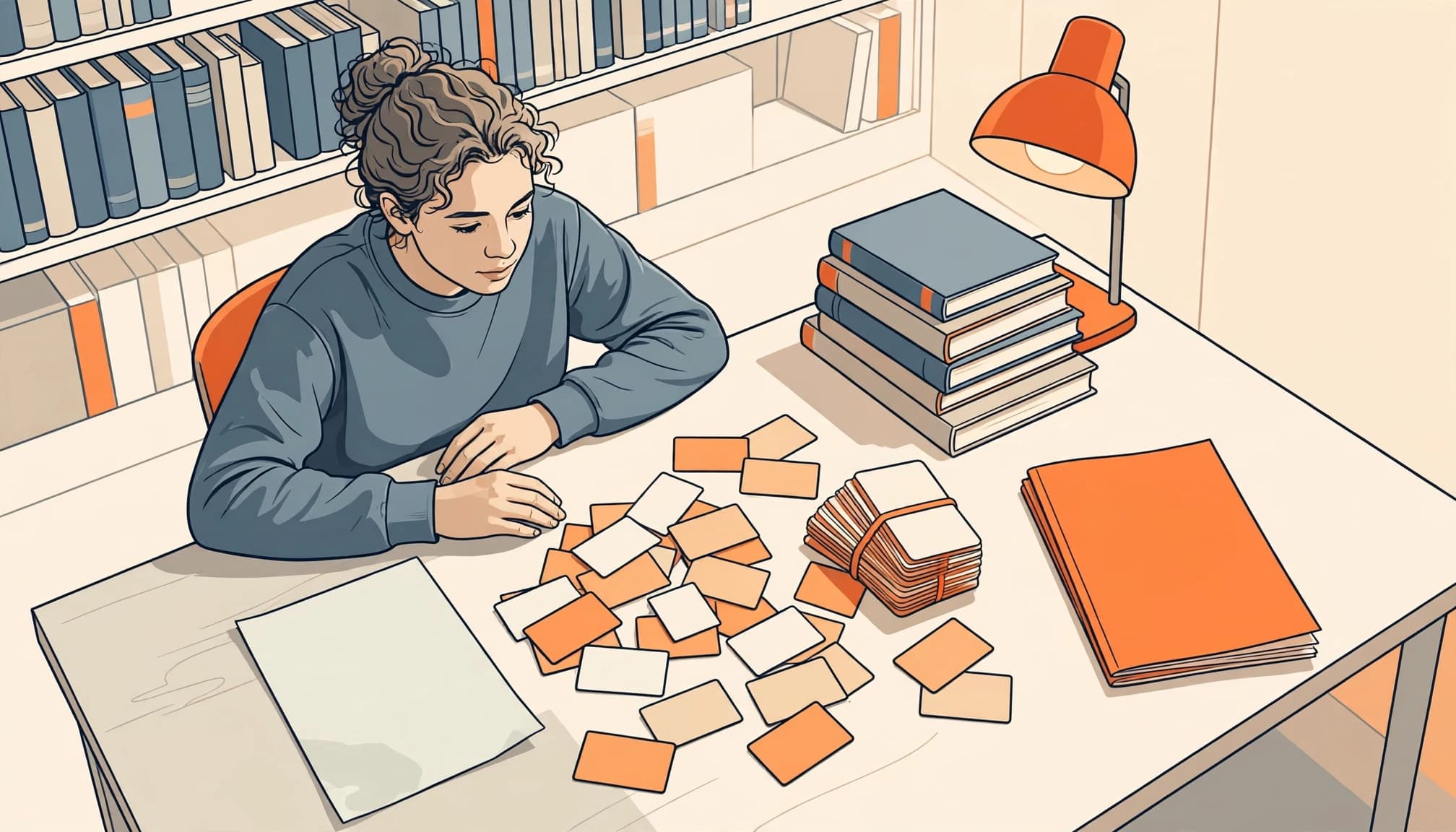
To interleave practice, don’t do 40 identical math problems in a row. Mix several problem types instead, shuffle flash cards from different units, and alternate biology vocabulary with genetics questions. It feels harder because it is harder, but it better resembles deciding what method to use on an actual exam.
Adjust the plan after every practice exam
A study plan is not a contract carved into stone. It is a working draft. Each practice exam gives you data about what needs to change.
Review mistakes before adding more hours
After practice exams, sort mistakes into three groups. Let the results change your next study block, rather than merely produce a score:
- You didn’t know the content yet.
- You knew it but misread the question, rushed, or made a careless error.
- You understood the topic but couldn’t recall it under time pressure.
Each problem has a different fix. Your review strategies should match the problem. Content gaps need a short lesson and fresh practice. Careless errors may need slower checking or a better test routine. Recall problems need repeated retrieval across several days. Some practice should resemble test conditions when time pressure caused the miss, but not at the expense of sleep.
Move your next study block based on what the results showed. You may need to trade one green-topic review for a yellow or red topic. That isn’t failing the plan. That is the plan doing its job.
Protect sleep during crunch week
The night before a final is not the moment for a five-hour rescue mission. Even a five-day study plan may need revision after a practice result. Shift time toward the missed material instead of following the original plan rigidly.
Pack what you need, do a light review, and set alarms. If you use flash cards, stick to familiar, high-value items and don’t introduce new content. Then sleep.
Sleep is part of studying because your brain needs rest to sort and retain what you practiced. Keep breaks in the schedule, drink water, and eat something with actual fuel behind it. Finals week is already dramatic enough. You don’t need to make it worse by running on panic and vending-machine snacks.
Frequently Asked Questions
How far in advance should I start a cumulative exam study plan?
Start as soon as you know the exam dates, even if you can only schedule a few short blocks each week. Earlier planning gives you more chances to revisit older material instead of trying to relearn everything at once.
How should I decide which topics to study first?
Use past quizzes, tests, homework corrections, and learning objectives to rate each topic as green, yellow, or red. Prioritize red and yellow topics, especially when they belong to an earlier exam or carry significant weight.
Is a five-day study plan enough for a cumulative exam?
A five-day plan can organize a short crunch period, but it works best when each day includes new learning, older review, and retrieval practice. Keep the blocks focused and adjust the plan based on practice results rather than trying to cover everything in one marathon session.
What is the best way to review old units?
Older material usually benefits more from active recall than from rereading notes. Solve problems, explain concepts from memory, create your own questions, and return to missed topics after a few days.
Should I study the night before the exam?
Use the night before for a light review of familiar, high-value material and to prepare what you need for the morning. Sleep is part of studying because rest helps your brain retain what you practiced.
Final thoughts on studying for cumulative exams
A solid cumulative exam study plan turns one huge, stressful semester into a series of small, clear decisions. Start with a prioritized study outline, realistic calendar blocks, retrieval practice, and protected time for rest.
You don’t need perfect notes, a color-coded binder worthy of social media, or twelve-hour study days. You need a plan you can begin today, adjust tomorrow, and follow long enough for the material to stick. Choose one small task and schedule it now.
Want a head start? The Exam Season Survival Kit has the study schedule, review sheets and checklists ready to fill in.