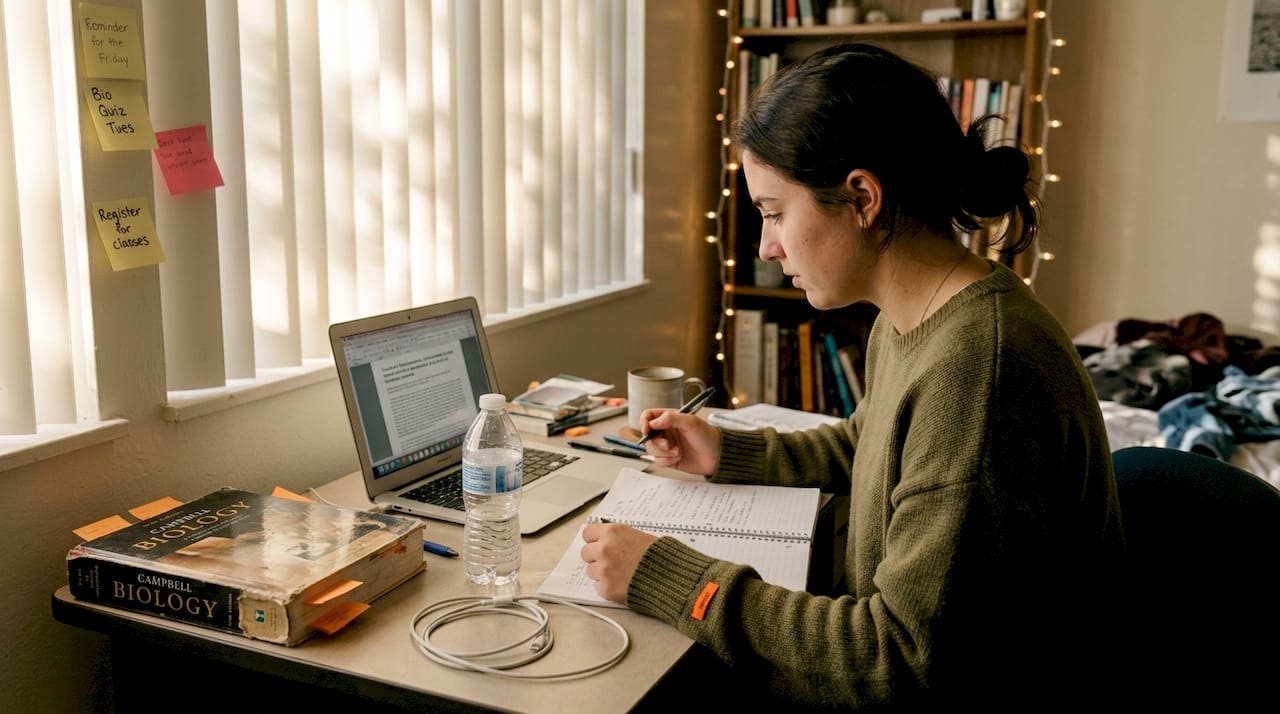
Why organize your workspace: boost focus and grades fast
Most students spend hours picking the right planner or color-coding their notes, but almost no one stops to think about the space where all that studying actually happens. Here’s the thing: your workspace setup has a measurable impact on your grades, your stress levels, and how engaged you feel during study sessions. Task organization correlates with higher GPA and better academic performance. If you’ve ever sat down to study and felt scattered before you even opened a book, your environment might be the reason why. This guide breaks down exactly why workspace organization matters and gives you a clear, practical path to setting yours up for real results.
Key Takeaways
| Point | Details |
|---|---|
| Workspace links to grades | Organizing your study area is proven to boost academic performance and reduce stress. |
| Digital and physical matter | Success comes faster when you organize both your digital files and your physical desk. |
| Consistency beats perfection | Small, regular habits for workspace upkeep lead to the best results—not a flawless setup. |
| Weekly reset is key | A weekly review and tidy-up keeps your space functional and your focus sharp all semester. |
Why an organized workspace matters for students
Let’s be honest: most students assume their workspace is fine. A few sticky notes here, a pile of textbooks there, maybe a half-eaten granola bar on the corner of the desk. It doesn’t feel like a big deal. But your brain notices everything in your environment, even when you think you’re ignoring it.
Clutter creates what researchers call cognitive load, which is basically the mental effort your brain uses just to process your surroundings. When your desk is messy, your brain is quietly working in the background to filter out distractions. That leaves less mental energy for actually understanding what you’re studying. Think of it like running too many apps on your phone at once: everything slows down.
“Organized environments reduce unnecessary cognitive load, freeing up mental resources for learning, problem-solving, and memory retention.”
The research backs this up strongly. Task organization and GPA are directly linked, with students who use organized systems reporting higher grades and more engagement in their coursework. Pairing good workspace habits with solid student time management tips creates a powerful combination that most students overlook.
You’ve probably heard the phrase “creative mess” used to justify a chaotic desk. And while some people genuinely work well with a bit of visual stimulation, the evidence consistently favors tidy, organized spaces for sustained focus and academic performance. The myth of the productive mess is mostly just a comfortable excuse.
Here’s a quick summary of what an organized workspace actually does for you academically:
- Higher grades: Students with organized study habits consistently outperform those without them
- More engagement: A clear space signals to your brain that it’s time to focus
- Less stress: Knowing where everything is reduces pre-study anxiety
- Better retention: Lower cognitive load means more mental bandwidth for learning
- Improved consistency: An inviting, tidy space makes it easier to sit down and actually start
If you want to take this further, exploring productivity hacks for students alongside your workspace upgrades can seriously accelerate your results.
Physical vs. digital workspace: Both matter
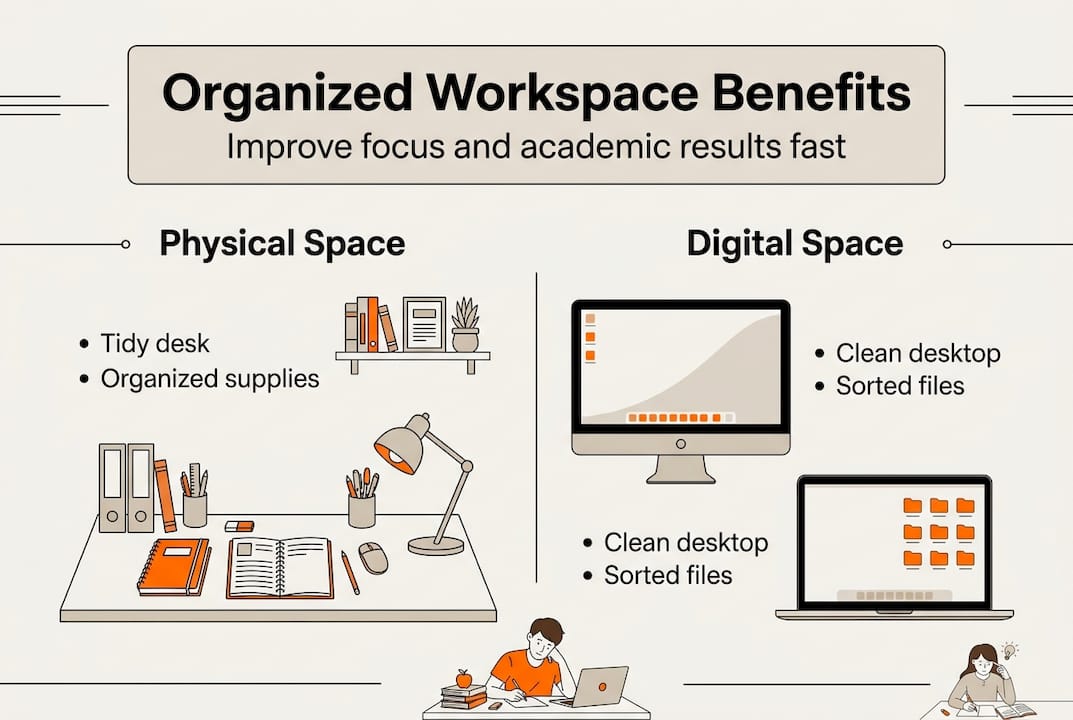
Here’s something a lot of students miss: organizing your physical desk is only half the equation. Your digital workspace, meaning your laptop desktop, file folders, browser tabs, and apps, creates just as much clutter and distraction as a messy room. In 2026, most students live in a blended study environment where both spaces need attention.

Digital organization tools like Trello have been shown to boost assignment submission timing and scores, which means your digital habits directly affect your academic outcomes. Getting both environments under control is essential.
Here’s a side-by-side look at what organizing each space actually involves:
| Area | Physical workspace | Digital workspace |
|---|---|---|
| Storage | Labeled folders, drawer organizers | Named folders, cloud storage |
| Clutter control | Daily 2-minute tidy | Close unused tabs, archive old files |
| Planning tools | Planner, sticky notes, whiteboard | Trello, Google Calendar, note apps |
| Supplies | Pens, highlighters, chargers within reach | Bookmarked resources, pinned links |
| Reset routine | Weekly desk clear-out | Weekly file and download folder review |
The goal is to make both environments feel intentional. When your physical and digital spaces are aligned, you spend less time hunting for things and more time actually studying. Check out this study planner checklist to see how a structured planning system ties both worlds together.
Pro Tip: Once a week, spend five minutes syncing your physical and digital “inboxes.” Move handwritten notes into your note app, clear your downloads folder, and make sure your planner matches your digital calendar. This one habit prevents a surprising amount of chaos.
Here’s a simple 3-step process to keep your digital files matching your real-world needs:
- Name everything clearly. Use a consistent naming system for files (e.g., “Bio_Chapter5_Notes_Oct”) so you can find things instantly.
- Mirror your physical folders digitally. If you have a folder for each class on your desk, create the same structure on your laptop.
- Do a weekly digital reset. Every Sunday, archive completed assignments, delete duplicates, and clear your desktop. This pairs perfectly with exam prep time management routines.
How to build your personal focus-boosting workspace
Now for the fun part: actually setting up your space. The good news is you don’t need an aesthetic Pinterest desk or expensive gear to create a workspace that works. You need the right elements in the right places, and a little bit of intention.
Start by picking your spot. Ideally, this is a dedicated area used only for studying, not eating, gaming, or watching videos. Your brain builds associations with places, so a consistent study spot trains your focus over time. Consistent environmental cues create focus rituals that boost productivity more than any expensive organizer ever could.
Here’s what a well-organized workspace layout looks like across different setups:
| Setup type | Key focus cues | What to prioritize |
|---|---|---|
| Dedicated desk | Lamp, clear surface, supplies tray | Minimize visual clutter |
| Kitchen table | Portable supply kit, noise-canceling headphones | Pack up after each session |
| Shared room | Divider, personal lamp, signal system with roommate | Establish study hours |
| Library/cafe | Consistent seat, same playlist, minimal supplies | Routine and familiarity |
Once you have your spot, build a focus ritual, which is a short sequence of actions you do every time you sit down to study. This signals to your brain that it’s time to concentrate. Here’s what a solid focus ritual includes:
- Turn on your study lamp or adjust lighting to a bright, cool tone
- Put your phone face-down or in another room
- Have a water bottle and a snack ready so you don’t interrupt yourself
- Open only the tabs or materials you need for that session
- Write down your top 3 goals for the study block
Pro Tip: Consistency is everything here. The same seat, the same lamp, the same playlist (if you use one) will condition your brain to focus faster over time. You can explore more about this in our guide to study time management, which pairs beautifully with a strong workspace routine.
How to maintain your organized workspace long-term
Setting up a gorgeous, organized workspace is satisfying. Keeping it that way? That’s where most students struggle. Life gets busy, deadlines pile up, and suddenly your clean desk is buried again. The secret is building maintenance into your routine so it never becomes a big project.
The most effective approach combines small daily habits with a weekly reset. Weekly review and reset routines prevent clutter from creeping back, and when combined with the Pomodoro technique (studying in focused 25-minute blocks), they support better retention and focus all semester long.
“The students who maintain organized spaces aren’t more disciplined by nature. They’ve just built systems small enough to actually stick with.”
Here are 4 essential steps to keeping your workspace organized all semester:
- Daily 2-minute tidy. Before you leave your desk each day, put everything back in its place. Two minutes is all it takes to prevent a week’s worth of mess.
- Weekly reset session. Every Sunday (or whatever day works for you), clear your desk completely, restock supplies, and review your planner for the week ahead.
- One-in, one-out rule. Every time you add something new to your workspace, remove something that doesn’t belong there. This keeps things from accumulating.
- Monthly deep clean. Once a month, go through drawers and folders, toss what you don’t need, and reorganize anything that’s drifted out of place.
If you’re working in a small space or a shared room, these habits matter even more. A portable supply kit (a small box or pouch with your essentials) lets you create a focused workspace anywhere and pack it up quickly. Some creatives thrive in a curated mess, but the evidence strongly favors tidy spaces for sustained focus and academic performance.
Pair these maintenance habits with the student productivity hacks and time management for students resources on this site, and you’ll have a system that actually lasts.
The real secret: Consistency over perfection
Here’s something I want you to hear, because it took me a while to figure it out: the most productive students don’t have the most beautiful workspaces. They have the most consistent ones.
So many students fall into the trap of spending an entire afternoon reorganizing their desk instead of actually studying. They buy new organizers, rearrange their supplies, and feel productive without doing any real work. That’s perfectionism dressed up as productivity, and it’s a trap.
The truth is, a “good enough” workspace that you maintain daily will always outperform a perfect setup that falls apart after two weeks. You don’t need color-coded folders or a matching stationery set. You need a clear surface, your materials within reach, and a consistent habit of resetting. That’s it.
I always say: done is better than perfect, especially when it comes to your study environment. Build a simple system, stick with it, and adjust as you go. Check out these productivity tips for students if you want ideas for keeping your momentum going beyond just your workspace.
Ready to take your productivity further?
Now that you know how to set up and maintain a workspace that actually supports your goals, it’s time to build the habits that go with it. An organized space works best when it’s paired with strong time management and study skills. On Learning with Angie, you’ll find everything you need to increase your productivity, follow a proven time management guide, and explore study skills strategies that make every study session count. Your workspace is the foundation. Now let’s build something great on top of it.
Frequently asked questions
Does a messy desk really hurt my grades?
Organized study habits consistently link to higher GPA, lower stress, and stronger engagement, so yes, a cluttered workspace can quietly hold you back academically.
Is it okay to have some mess if it helps my creativity?
A little visual inspiration is fine, but when it comes to focused studying and problem-solving, tidy spaces outperform messy ones for most students.
What’s one quick habit to keep my workspace organized?
A weekly 10-minute reset is enough to stop clutter from building up and gives your brain a clean, calm starting point for the week ahead, as weekly resets show.
Recommended
- Smart Organization Tips for Students to Ace Academics in 2026
- 7 Smart Productivity Hacks for Students to Succeed Fast
- How Productivity Can Boost Your Grades (Without Making You Miserable!)
- Organizing Your Study Space for Maximum Focus
- Master Mindfulness for Productivity: Achieve Focused Success | Prodcast