The Ultimate Guide to Your College Application Pipeline: Everything You Need to Succeed

Are you feeling buried under a mountain of college brochures and endless tabs of university websites? Does the thought of tracking dozens of deadlines, essay prompts, and financial aid forms make you want to close your laptop and take a permanent nap?
You aren't alone. The college application process is often framed as a high-stakes scavenger hunt where the rules are hidden and the clock is always ticking. But it doesn't have to be that way. At Learning With Angie, we believe that with the right systems, you can turn this chaotic scramble into a streamlined, manageable "pipeline" that leads you straight to your dream school.
Ready to become the most organized version of yourself and tackle senior year with total confidence? Let’s break down exactly how to build your college application pipeline from the ground up.
Build Your College List: The Top of the Funnel
Before you can apply, you need to know where you’re going. Think of your college search as a "funnel." You start with a wide range of possibilities and slowly narrow them down based on what actually matters to you.
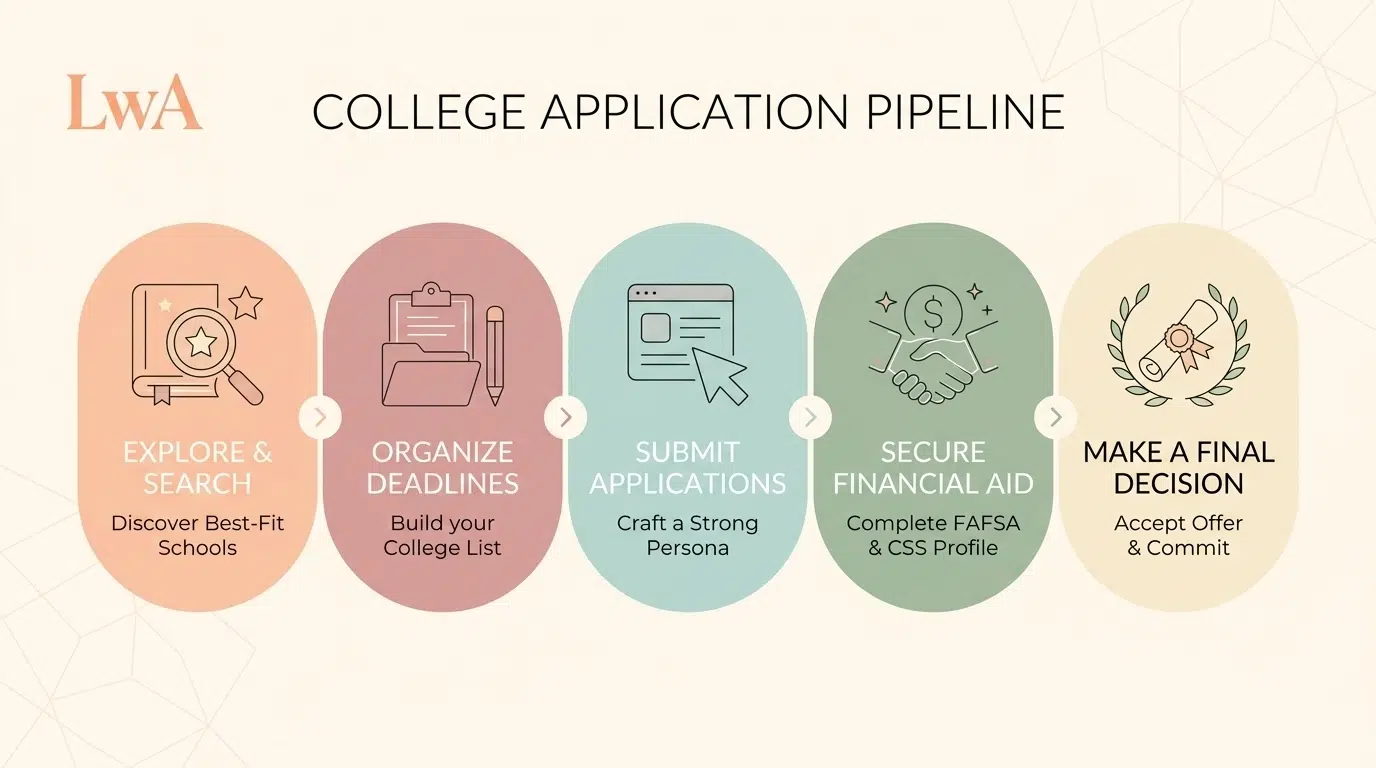
To build an effective list, you need to categorize your schools into three specific buckets:
- Reach Schools: These are your "dream" schools where your stats might be on the lower end of their average, or the acceptance rate is extremely low (below 10%).
- Target Schools: Your GPA and test scores align perfectly with their typical freshman profile. You have a solid chance of getting in.
- Safety Schools: You exceed their typical requirements. These are schools you’d be happy to attend and are almost certain to be accepted by.
Pro Tip: Don't just look at rankings. Use our college study tips to research campus culture, student resources, and specialized programs that fit your unique hobbies and career goals.
Organize Your Deadlines: The Notion Strategy
Once you have your list, the real challenge begins: tracking the data. If you’re still using a messy pile of sticky notes or a random Google Doc, you’re making it harder than it needs to be. You need a centralized "command center."

Using a dedicated tool like our Notion College Search Template allows you to streamline your workflow by:
- Consolidating all links: Keep university portals, essay prompts, and contact info in one place.
- Automating deadlines: Set reminders so you never wake up in a cold sweat wondering if an application was due at midnight.
- Tracking progress: Use visual status bars to see exactly how far along you are with each school (e.g., "Not Started," "In Progress," "Submitted").
If you're new to the platform, check out our Notion productivity guides to learn how to customize your workspace to match your aesthetic.
The Senior Year Roadmap: Your Master Timeline
Timing is everything. To ensure you aren't rushing your personal statement on New Year's Eve, you need to follow a strict (but manageable) chronological pipeline.

Fall (September – November)
This is your essential sprint. Your goal is to get the heavy lifting done before the holiday season.
- Finalize the List: Narrow your funnel to 8-12 schools.
- Request Recommendations: Ask your teachers and counselors early. Give them at least three weeks' notice to write a thoughtful letter.
- Draft the Personal Statement: Start your main essay. Focus on your unique story, not just your resume.
- Submit Early Action (EA) / Early Decision (ED): These deadlines are typically November 1st or 15th.
Winter (December – February)
- Regular Decision Submits: Most of these are due January 1st. Aim to finish them before your winter break starts so you can actually relax.
- FAFSA & CSS Profile: The Free Application for Federal Student Aid (FAFSA) usually opens in late fall or early winter. Complete this as early as possible to secure the best financial aid packages.
Spring (March – May)
- Compare Offers: Once the acceptance letters roll in, it's time to look at the numbers. Compare financial aid award letters side-by-side.
- The Big Decision: You typically have until May 1st (National Decision Day) to put down your deposit.
Mastering the Application Components
A successful pipeline isn't just about dates; it's about the quality of what you’re putting into the system. Here is what you need to enhance your application:
- The Personal Statement: This is your chance to speak directly to the admissions officers. Avoid clichés. Instead, focus on a specific moment of growth or a problem you solved.
- Letters of Recommendation: Choose teachers who know your work ethic, not just the ones who gave you an A. Provide them with a "brag sheet" of your accomplishments to help them write a more detailed letter.
- The Activities List: Quality over quantity. Admissions officers would rather see four years of dedication to one club than one month of participation in ten clubs. Frame your roles using strong, actionable verbs like "coordinated," "developed," or "spearheaded."
If you're looking for help with the academic side of things before you apply, dive into our high school study resources to keep those senior year grades high.
Financial Literacy for Students: FAFSA and Scholarships
One of the most overlooked parts of the pipeline is money management. College is an investment, and part of your success is ensuring you aren't taking on unnecessary debt.
- FAFSA is Non-Negotiable: Even if you don't think you'll qualify for need-based aid, many merit scholarships require a FAFSA on file.
- Scholarship Hunting: Treat scholarship applications like a part-time job. Use search engines like Fastweb or Scholly, but don't ignore local scholarships from your town or school district: these often have much less competition.
- Financial Literacy: Start learning about student loans and interest now. Understanding the difference between subsidized and unsubsidized loans will save you thousands of dollars in the long run.
Focus on Your Growth: Managing Stress
Applying to college is a marathon, not a sprint. If you don't take care of your mental health, your productivity will plummet.

To keep your stress levels low:
- Batch Your Tasks: Dedicate two hours on Sunday afternoons to college apps rather than trying to do 15 minutes every single night.
- Find Your "Offline" Hobby: Balance the digital grind with something tactile. Whether it's mandala coloring or a weekend hike, give your brain a break from screens.
- Celebrate Small Wins: Submitted your first app? Treat yourself to a coffee. Finished your first draft? Take a night off.
Join The Community
You don't have to navigate the college application pipeline alone. At Learning With Angie, we’re building a community of students who are passionate about learning and personal growth.
Ready to get organized and stay ahead of the curve? Join our community by signing up for our biweekly resources. You'll get actionable study tips, exclusive Notion templates, and honest advice delivered straight to your inbox.
[Sign Up For The Learning With Angie Newsletter Here]
Whether you're a high school senior in the thick of it or a parent helping your teen prepare for the future, we have the tools you need to succeed. Let's make this your best year yet!
Want a head start? The All-in-One College Application Organizer in my shop was made for exactly this — it’ll save you a ton of time.