
Goal Setting Step by Step: Achieve Your Dreams
Setting big goals sounds exciting and everyone loves the idea of achievement. Yet over 80 percent of people never reach the targets they set for themselves. So why do so many smart, hard-working people still get stuck or give up halfway? The real difference comes down to a handful of practical skills most people overlook entirely.
Quick Summary
| Key Point | Explanation |
|---|---|
| 1. Clearly define specific goals | Vague goals like “I want to be successful” can hinder progress. Specify what you want to achieve and why it matters. |
| 2. Break down goals into tasks | Divide goals into smaller, manageable tasks. This makes them less overwhelming and easier to tackle progressively. |
| 3. Set realistic deadlines for tasks | Deadlines create a sense of urgency. Assign achievable completion dates for each task to maintain momentum and commitment. |
| 4. Prioritize tasks based on importance | Use methods like the Eisenhower Matrix to identify which tasks will most effectively advance your goals. Focus on high-impact activities first. |
| 5. Regularly track and assess your progress | Implement a system for check-ins to evaluate your advancement. Adjust strategies as needed to stay on course and remain motivated. |
Step 1: Define Your Goals Clearly
Defining your goals clearly is the foundation of successful goal achievement. Think of this step like creating a detailed map before starting a journey. Without a clear destination, you might wander aimlessly and never reach where you want to go.
To define your goals effectively, start by getting specific about what you truly want. Vague goals like “I want to be successful” won’t cut it. Instead, create goals that are precise and measurable. For example, replace “I want to be successful” with “I want to increase my math grade from a B to an A by the end of this semester” or “I want to save $500 from my part time job by December”.
While defining your goals, ask yourself some key questions that will help you gain clarity:
- What exactly do I want to achieve?
- Why is this goal important to me?
- How will I know when I’ve reached this goal?
- What specific steps will help me get there?
According to research in goal-setting psychology, the more precise and personally meaningful your goals are, the higher your motivation and likelihood of success. This means connecting your goals to your deeper values and personal motivations.
Write down your goals in a place where you can see them daily. Use clear, positive language that excites and motivates you. Your written goals should feel like a personal commitment, not just a random task on a to-do list. Consider using a dedicated notebook or digital app where you can track and review your progress regularly.
Remember, goal setting is a skill that improves with practice. Don’t worry if your first attempt isn’t perfect. The most important thing is to start and remain flexible. Your goals can evolve as you grow and learn more about yourself.
Here is a step overview table summarizing each main step of the goal-setting process, along with a key action and main benefit for each stage.
| Step | Key Action | Main Benefit |
|---|---|---|
| 1. Define Goals Clearly | Specify exactly what you want with measurable language | Provides clear direction and motivation |
| 2. Break Into Tasks | Divide goals into smaller, actionable tasks | Reduces overwhelm and increases progress |
| 3. Set Deadlines | Assign realistic completion dates to each task | Maintains motivation and creates urgency |
| 4. Prioritize Strategically | Rank tasks based on importance and impact | Focuses effort on high-value activities |
| 5. Track Progress | Regularly check and review achievements | Enables timely adjustments and builds consistency |
| 6. Celebrate & Adjust | Reward progress and refine goals as needed | Reinforces motivation and fosters growth |
Step 2: Break Goals Into Manageable Tasks
Breaking down your goals into smaller, actionable tasks is like turning a massive mountain into a series of gentle steps. After clearly defining your goal, the next crucial move is to make it feel less overwhelming by creating a roadmap of smaller, achievable actions.
Think of task breakdown like building with LEGO blocks. Each small piece connects to create something bigger. Instead of staring at a huge goal that seems impossible, you create a series of tiny, manageable tasks that gradually build toward your ultimate objective. For instance, if your goal is to improve your math grade, your tasks might include reviewing one chapter per week, doing 30 minutes of practice problems daily, and meeting with your teacher for extra help once a month.
To effectively break down your goals, start by working backward from your final destination. Ask yourself: “What steps do I need to take to reach this goal?” Write these steps down in a logical sequence. Each task should be specific, time-bound, and realistic. Avoid creating tasks that are too broad or vague. Instead of writing “study math,” write “Complete algebra practice problems 5-10 in textbook chapter 3 for 25 minutes.”
Consider using planning tools that can help you track these tasks. Learn more about productivity strategies that can support your goal-setting journey. Digital apps like Trello, Asana, or even a simple spreadsheet can help you organize and track your progress.
According to research on task decomposition, breaking goals into smaller tasks not only makes them less intimidating but also increases your motivation. When you complete each small task, you get a boost of confidence that propels you forward.
Remember to build flexibility into your task breakdown. Some tasks might take longer than expected, or you might discover more efficient ways to reach your goal. The key is to stay adaptable while maintaining consistent progress toward your ultimate objective.
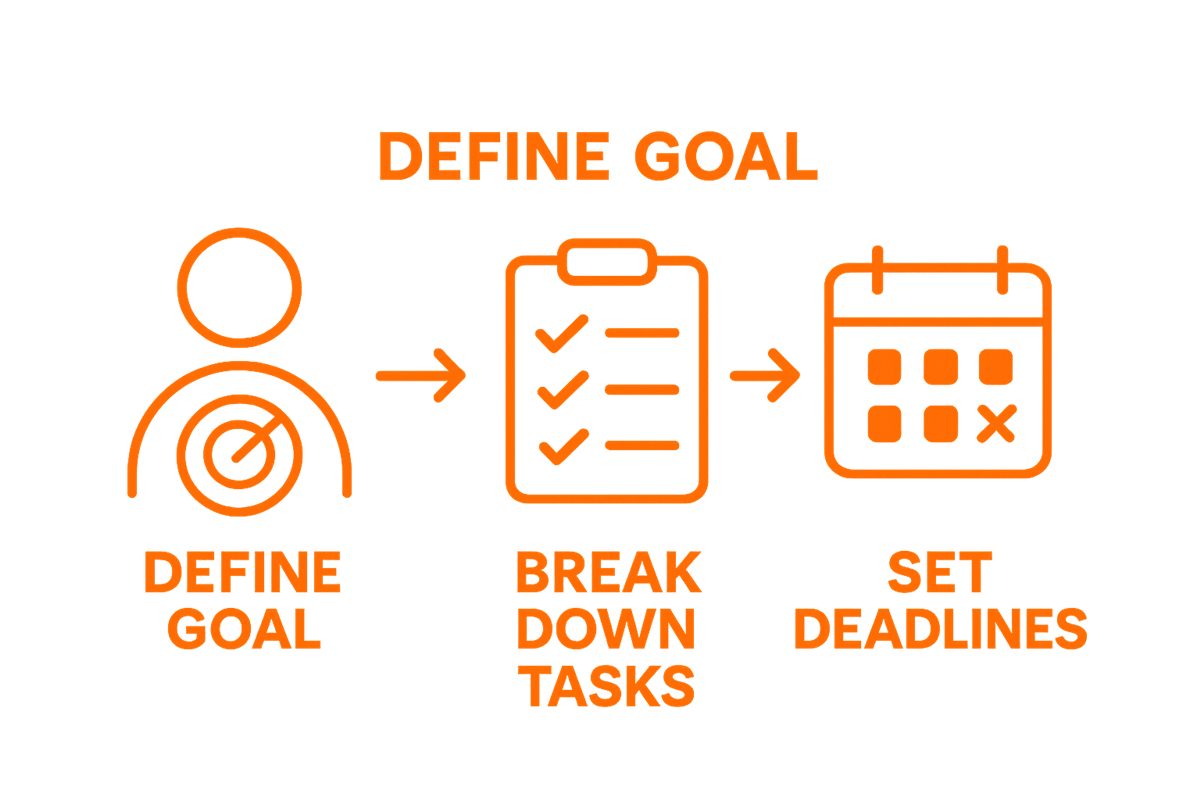
Step 3: Set Deadlines for Each Task
Deadlines transform your goals from wishful thinking into actionable plans. Without specific time frames, tasks can drift endlessly, losing momentum and urgency. Setting deadlines is like giving your goals a heartbeat – they create rhythm, direction, and a sense of commitment.
Start by looking at each task you broke down in the previous step and assign a realistic completion date. Be honest with yourself about how much time you genuinely need. Avoid setting impossible deadlines that will crush your motivation. If you’re studying for a math exam and have five chapters to review, don’t expect to master everything in two days. Instead, allocate appropriate time for each chapter, maybe one week per chapter with buffer days for comprehensive review.
According to research on goal setting, effective deadlines should be specific, challenging yet achievable. For each task, ask yourself: “When exactly do I need to complete this?” Write down not just the date, but potentially the specific time. Instead of “finish math homework this week,” write “Complete algebra homework by Thursday at 8 PM.”
Consider using visual tools to track your deadlines. A physical calendar, digital planner, or apps like Trello can help you stay organized and track your progress. Color-code your tasks. Use green for on-track tasks, yellow for those needing attention, and red for tasks falling behind.
Built into your deadline planning should be flexibility and grace. Life happens, and sometimes tasks take longer than expected. If you miss a deadline, don’t abandon your entire goal. Reassess, adjust your timeline, and keep moving forward. The key is consistent progress, not perfection.
As a practical tip, create a “deadline buffer” for each task. If you think a task will take five days, schedule seven. This extra time accounts for unexpected challenges and reduces stress. When you complete tasks ahead of schedule, you’ll feel a sense of accomplishment that boosts your motivation for the next goal.
Step 4: Prioritize Your Tasks Strategically
Prioritizing tasks is like being the director of your own success movie. Not all tasks are created equal, and understanding which ones deserve your immediate attention can make the difference between achieving your goals and getting lost in busy work.
The secret to strategic prioritization is understanding task impact. Some tasks move you closer to your goal much faster than others. Imagine you’re preparing for a math exam. Reviewing complex algebra concepts will likely have more impact than reorganizing your study notes for the hundredth time.
One powerful method for prioritization is the Eisenhower Matrix, which helps you categorize tasks based on their urgency and importance. Ask yourself two key questions for each task: How critical is this task? How time-sensitive is it? Tasks can be divided into four categories:
- Urgent and important (do immediately)
- Important but not urgent (schedule dedicated time)
- Urgent but not important (delegate if possible)
- Neither urgent nor important (eliminate)
According to research on self-regulation skills, strategic task prioritization significantly improves goal achievement. If you want more strategies for effective weekly planning, consider developing a consistent review system where you assess your tasks weekly.
When prioritizing, also consider your energy levels. Some tasks require more mental effort, so schedule your most challenging tasks during times when you’re most alert and focused. If you’re a morning person, tackle complex algebra problems early. If you’re more of a night owl, save challenging tasks for later in the day.
Remember that prioritization isn’t about being perfect but about being strategic. Some days won’t go exactly as planned, and that’s okay. The goal is progress, not perfection. Regularly review and adjust your priorities, staying flexible while keeping your ultimate goal in sight. Think of prioritization as a dynamic process, not a rigid set of rules.
Step 5: Track Your Progress Regularly
Tracking your progress is like being the captain of your own success ship. Without regular check-ins, you might drift off course without even realizing it. Progress tracking transforms your goals from distant dreams into tangible realities.
Set up a consistent tracking system that works for you. This could be a weekly review where you sit down and honestly assess how close you are to completing your tasks. Some people love spreadsheets, while others prefer a simple journaling method for self-reflection. Choose a method that feels natural and doesn’t become another chore.
According to research on goal achievement, regular progress monitoring significantly increases your chances of success. Create a visual representation of your progress. This might look like:
- Checkboxes you mark when tasks are complete
- A color-coded chart showing task completion
- A digital tracker that shows your progress percentage
- A physical wall chart you update weekly
Be brutally honest during your progress checks. If you’re falling behind, don’t beat yourself up. Instead, ask why. Are the tasks too complex? Are your deadlines unrealistic? Are external factors getting in the way? Each check-in is an opportunity to adjust your approach, not a moment for self-criticism.
Consider using technology to your advantage. Many apps can help you track goals across different areas of your life. Some allow you to set reminders, log progress, and even provide motivational nudges when you’re falling behind. The key is finding a tracking method that feels supportive, not punitive.
Remember that progress isn’t always linear. Some weeks you’ll make huge leaps, others might feel like you’re barely moving. What matters is consistent effort and the willingness to keep showing up. Celebrate small wins, learn from setbacks, and keep your ultimate goal in sight. Your tracking system is a tool of empowerment, not a weapon of judgment.

Step 6: Celebrate Achievements and Adjust Goals
Celebrating your achievements is like giving yourself a high-five for all the hard work you’ve put in. Too many people skip this crucial step, moving quickly from one goal to another without pausing to acknowledge their progress. This approach can lead to burnout and diminish your motivation.
When you complete a task or reach a milestone, take a moment to truly recognize your effort. This doesn’t mean throwing a massive party every time you finish a homework assignment. Small celebrations can be incredibly powerful. Maybe treat yourself to your favorite coffee, spend an extra hour playing a video game, or simply write down your accomplishment in a journal.
According to research on psychological motivation, celebrating achievements helps reinforce positive behavior and keeps you motivated. If you want to develop stronger habits of success, recognizing your progress is key.
Goal adjustment is equally important. Your initial goals might have been perfect when you first set them, but life changes. Be flexible and willing to modify your objectives based on what you’ve learned. If you discover that a particular approach isn’t working, it’s not a failure – it’s valuable information.
Here are some ways to celebrate and adjust your goals:
- Take a moment to reflect on what worked well
- Identify specific skills you’ve developed
- Write down lessons learned from your journey
- Reward yourself in a meaningful way
- Adjust your next set of goals based on your experiences
Remember that goal setting is a dynamic process. Some goals might take longer than expected, while others might be completed faster. The key is maintaining a positive, growth-oriented mindset. Treat each goal as a learning opportunity, not a pass or fail scenario.
The following checklist table helps ensure you have set yourself up for success at each stage by verifying completion of important goal-setting steps.
| Completion Step | Description | Verify (✓/✗) |
|---|---|---|
| Goals Written Down | Are your goals specific, measurable, and documented? | |
| Tasks Identified | Have you broken your goal into actionable steps? | |
| Deadlines Assigned | Did you set a realistic date for each key task? | |
| Tasks Prioritized | Have you identified and focused on high-impact actions? | |
| Progress Tracking System | Do you have a method to regularly review progress? | |
| Celebrate & Adjust | Have you planned to reward achievements and adjust as needed? |
Finally, don’t be too hard on yourself if everything doesn’t go perfectly. Goal achievement is rarely a straight line. Celebrate the effort, learn from the process, and keep moving forward. Your willingness to adapt and persist is what truly matters in the long run.
Ready to Turn Your Goals Into Reality?
You have learned how breaking big dreams into small steps, setting deadlines, and tracking progress can help you achieve your goals. Still, many students struggle to stay motivated, manage time, or find reliable strategies that actually work. If you want extra support and practical tools to keep your momentum strong, discover student-friendly resources curated for every stage of your self-growth journey in our Books – Learning With Angie section. Elevate your plan with guides designed to teach you daily routines, study aesthetics, and productivity tips that match what you just read.
Why wait to make real progress? Visit Learning With Angie for more solutions that fit your student lifestyle. Take the next step by exploring our resources and unlock your full potential starting today.
Frequently Asked Questions
How do I define my goals clearly?
To define your goals clearly, get specific about what you want to achieve using precise and measurable language. Replace vague phrases with concrete objectives, such as ‘I want to increase my math grade from a B to an A by the end of this semester.’ Reflect on why the goal is important to you and how you will measure success.
What are some effective methods to break goals into tasks?
Effective methods to break goals into tasks include working backward from your main goal and creating a logical sequence of smaller, actionable steps. Make sure each task is specific, realistic, and time-bound to ensure progress feels manageable.
Why is it important to set deadlines for each task?
Setting deadlines transforms goals into actionable plans and adds a sense of urgency. Realistic deadlines help you stay focused and accountable, preventing tasks from dragging on indefinitely.
How often should I track my progress toward my goals?
It’s beneficial to track your progress regularly, ideally on a weekly basis. This allows for honest assessments of your achievements and helps you adjust your approach if you’re falling behind, ensuring consistent effort toward your ultimate goal.
Recommended
- How to Build Habits That Stick: 4 Failproof Steps I Follow
- Newsletter – Learning With Angie
- From Classroom to Career: Student Success Strategies that Work
- Inspiring Quotes for Hard Work and Success!
- 7 Essential Tips for Setting Personal Goals in Life – Tariq Juneja
- Feeling Stuck? Here’s How to Motivate Yourself and Achieve Your Goals | Navigating Through Quicksand
Want a head start? The Goal Planner takes you from the big goal down to this week’s steps, with room to check in as you go.