How to organize notes for better learning and grades
TL;DR:
- Organized notes with consistent review improve recall and exam confidence.
- Match note-taking methods to your learning style and subject type for best results.
- Regular active review and maintenance are crucial for long-term retention and effective studying.
You’re sitting down the night before a big exam, flipping through pages of scattered bullet points, half-finished outlines, and color-coded highlights that somehow make no sense anymore. Sound familiar? Most students spend more time searching for information than actually studying it. The good news is that good note taking skills are not some talent you’re born with. They’re a system you build. In this guide, I’ll walk you through evidence-based strategies to transform your notes from chaotic to clear, so you can study smarter, retain more, and actually feel confident walking into that exam.
Key Takeaways
| Point | Details |
|---|---|
| Match method to style | Choose a note organization method that fits your subject and how you learn best for optimal results. |
| Structure beats chaos | Using a structured system like Cornell consistently improves recall, grades, and study speed. |
| Review boosts memory | Review your notes within 24 hours and each week for the highest retention and understanding. |
| Digital and analog work together | Hybrid strategies let you combine memory benefits of handwritten notes and easy digital search. |
Assessing your current note organization habits
Now that we’ve set the stage for why organized notes matter, let’s look at how to honestly assess where you currently stand.
Most students keep notes in a mix of places: binders, apps, loose papers, or rushed outlines typed during class. The problem isn’t effort. It’s structure. When notes live in five different places with no clear system, you end up with redundant information, missed connections between ideas, and a whole lot of frustration when test time comes.
Understanding the importance of note-taking starts with seeing what’s actually going wrong in your current setup. Ask yourself these questions honestly:
- Can you find any specific piece of information in under two minutes?
- Do your notes connect ideas across topics or just list facts?
- Are you reviewing your notes within 24 hours of class?
- Do you have a consistent format, or does it change every session?
- Are your notes complete enough that you could study from them a month later?
If you answered no to most of those, that’s completely okay. It just means there’s real room to grow. Research shows that structured notes improve recall significantly more than unstructured ones, and reviewing within 24 hours is one of the highest-impact habits you can build.
Once you’ve done this honest self-check, set one specific goal. Maybe it’s “I will use the same format for every class this week” or “I will review my notes every evening before bed.” Small, clear goals make a big difference when you’re building a new habit.
Choosing the right note organization method for you
With a clearer sense of your current system, it’s time to pick a note organization method that truly supports your learning.
There is no single perfect method for everyone. Research confirms there is no universal best approach. The key is matching your method to your subject and your learning style. Here’s a quick comparison to help you decide:
| Method | Best for | Learning style |
|---|---|---|
| Cornell | Lectures, science, history | Structured, detail-oriented |
| Outline | Sequential topics, English | Linear thinkers |
| Mind Map | Brainstorming, connections | Visual learners |
| Zettelkasten | Research, long-term projects | Networked, analytical |
| Hybrid/Digital | Any subject | Flexible, tech-savvy |
Not sure which one fits you? Follow these steps:
- Identify your subject type. Is it heavy on facts and dates (history, science)? Go structured. Is it concept-heavy (philosophy, literature)? Try mind mapping.
- Think about how you process information. Do you like lists and order? Outline or Cornell. Do you think in webs and connections? Mind maps or Zettelkasten.
- Try one method for two full weeks before deciding it doesn’t work. Give it a real chance.
- Adjust as needed. You can use Cornell for biology and mind maps for your creative writing class.
You can explore essential note-taking techniques in more depth to see examples of each method in action. If you’re curious about a specific approach, there’s also a detailed outline method instructions guide and a mind mapping guide that walk you through setup step by step.
Pro Tip: Use structured formats like Cornell or Outline for your core classes where exams are heavy on recall. Save more experimental formats like mind maps for electives where creative thinking matters more.
Step-by-step: Setting up and using the Cornell method
Once you’ve selected your primary note organization method, here’s a practical step-by-step using one of the most effective approaches: the Cornell Method.
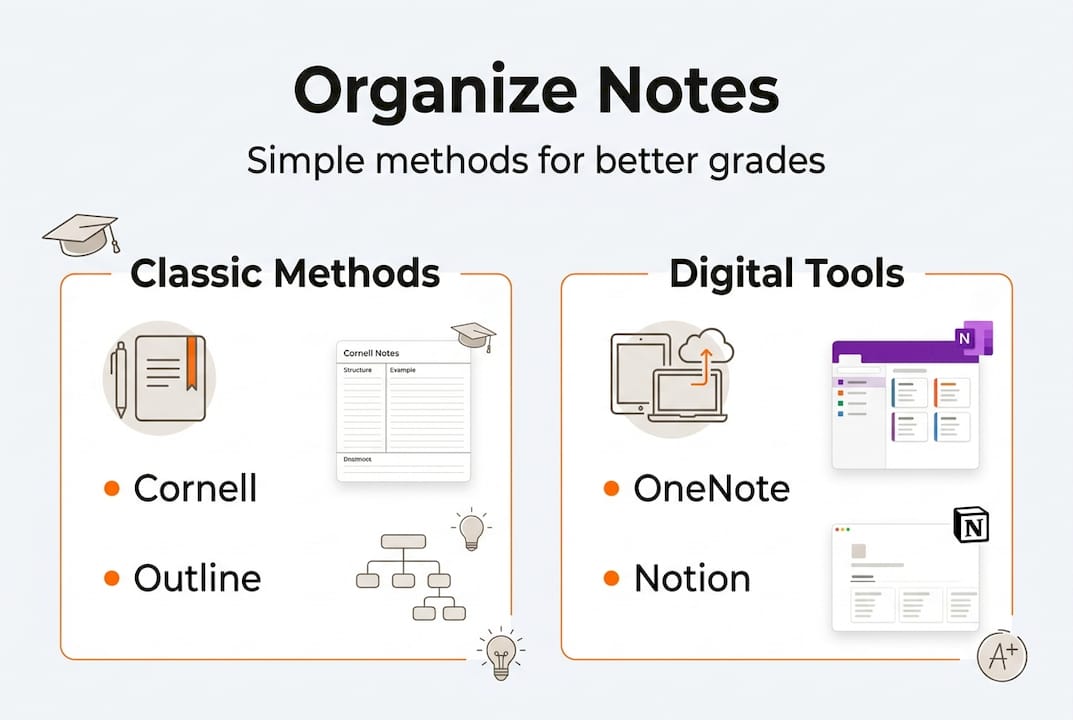
The Cornell note-taking method divides your page into three sections: a narrow left column for cues, a wide right column for your main notes, and a summary box at the bottom. It sounds simple, and it is. But that structure is exactly what makes it so powerful.
Here’s how to set it up and use it:
- Draw your page layout. Use about 2.5 inches on the left for the cue column, the rest for notes, and about 2 inches at the bottom for your summary.
- During class, fill the right column. Write key ideas, definitions, examples, and explanations. Don’t try to copy everything word for word.
- After class, fill the left column. Write questions or keywords that relate to each section of your notes. These become your self-quiz prompts.
- Write your summary at the bottom. Condense the entire page into 3 to 5 sentences in your own words.
- Review using the cue column. Cover your notes, read the cues, and try to recall the information.
Empirical evidence shows the Cornell method improves academic performance measurably. Here’s a look at what studies have found:
| Outcome | Improvement with Cornell |
|---|---|
| Recall accuracy | Up to 45% better |
| Review speed | Up to 37% faster |
| Test scores | Consistently higher |
“Students using the Cornell method showed up to 45% better recall and 37% faster review times compared to unstructured note-takers.”
Pro Tip: Write your summary within 24 hours of class. That’s the window where your brain is still processing the information, and a quick summary locks it in before the forgetting curve kicks in.
You can find more good note taking techniques that pair well with Cornell for an even stronger study routine.
Advanced organization: Digital tools and hybrid strategies
The Cornell Method isn’t the only approach. Today’s students can blend digital convenience with classic note-taking science.

Apps like OneNote, Notion, and Google Docs are fantastic for organizing notes by class, tagging topics, and searching instantly. iPad apps like Notability or GoodNotes let you handwrite notes digitally, which is a great middle ground. But every tool has trade-offs. Digital apps can become cluttered fast if you don’t have a naming system. Notifications are a constant distraction. And typing without structure often leads to passive, low-retention note dumps.
That’s where hybrid strategies shine. Hybrid systems handle real-world scenarios better than any single approach, especially for students who move between devices or have heavy reading loads.
Here are some hybrid ideas that actually work:
- Handwrite your in-class notes, then photograph or scan them into a cloud folder organized by subject and date.
- Use a digital tool for research and readings, but keep a handwritten summary card for each chapter or article.
- Create a master folder system in Google Drive or Notion with one folder per class, subfolders for weeks or units, and a running review document.
- Tag everything consistently. Use the same labels every time (like “lecture,” “reading,” “quiz prep”) so you can search and filter fast.
The digital note-taking advantages are real, especially for backup and accessibility. But don’t abandon handwriting entirely. Research consistently shows that writing by hand boosts retention, even if you digitize your notes afterward.
Pro Tip: Name your files with a consistent format like “SUBJ_Week#_Topic” (for example, BIO_Week3_CellDivision). It takes five extra seconds and saves you twenty minutes of searching later.
Maintaining and maximizing your organized notes
No organization system works unless you maintain it. Here’s how to ensure your notes keep working for you long after that study session.
Active processing beats passive re-reading every time. That means turning your notes into questions, writing summaries in your own words, and building concept maps that show how ideas connect. Weekly review sessions prevent the forgetting curve from wiping out everything you worked hard to capture.
Here’s a simple maintenance checklist to follow:
- Review within 24 hours of each class session.
- Do a weekly sweep every Sunday to fill in gaps and connect ideas across the week.
- Convert notes to questions using the cue column or a separate review sheet.
- Summarize each unit before a test rather than re-reading everything.
- Archive old notes at the end of each semester so your active folders stay clean.
And here are some advanced tips to get even more from your system:
- Share notes with a study group and compare what each person captured. You’ll catch things you missed.
- Color-code by theme across subjects. For example, use one color for definitions, another for examples, and another for key dates.
- Use proven note review techniques like spaced repetition to schedule your review sessions strategically.
- Don’t let notes pile up unreviewed. Even five minutes a day keeps your memory sharp.
The biggest mistake students make is building a gorgeous system and then never going back to it. Your notes are only as useful as the time you spend actively engaging with them.
What most students get wrong about organizing notes
You’ve got the step-by-step strategies, but here’s the reality check that separates top students from the rest.
I see this all the time. Students spend hours making their notes look beautiful, switching between apps, and testing every new method they find online. And then they wonder why their grades aren’t improving. Here’s the truth: pretty notes and the latest app are not the point. Consistent structure and regular review are.
The research is clear that no universal method works for everyone. Linear formats like Cornell or Outline suit detail-oriented learners. Visual formats like mind maps work better for big-picture thinkers. Networked systems like Zettelkasten are powerful for research-heavy work. The mistake is copying someone else’s system without asking whether it actually fits how your brain works.
Personally, I think the most underrated habit is revision. Not re-reading. Actual revision, where you rewrite, reorganize, and question your notes. That’s where the learning happens. You can explore making notes useful without sacrificing the substance that actually moves your grades.
Experiment. Adjust. Stick with what works. That’s the real secret.
Take your study skills to the next level
Mastering note organization is honestly one of the best investments you can make in your academic life. But it’s just the beginning. Once your notes are working for you, the next step is pairing them with study strategies that match how you learn best.
If you’re a visual learner, check out these study techniques for visual learners that pair beautifully with mind maps and color-coded systems. When exam season hits, these study techniques for exams will help you use your organized notes to their full potential. And if you want a full picture of what strong academic habits look like right now, the study skills 2026 guide covers everything from time management to productivity in one place. You’ve got this!
Frequently asked questions
What is the most effective system for organizing class notes?
The Cornell method is highly effective due to its proven impact on recall and review speed, though the best system is always the one that matches your personal learning style.
Should I type or handwrite my notes for better memory?
Handwriting aids memory more than typing does, but using structured digital tools can also support strong retention if you stay consistent with your format.
How often should I review my notes for best results?
Reviewing within 24 hours of class and then weekly review sessions are the two habits that most reliably prevent forgetting and maximize long-term retention.
Can I combine digital and handwritten notes effectively?
Absolutely. Hybrid systems let you keep the memory benefits of handwriting while enjoying the search, backup, and organization features that digital tools offer.
Recommended
- Smart Organization Tips for Students to Ace Academics in 2026
- The Art of Aesthetic Note-Taking: How to Make Your Notes Pretty AND Useful
- Note Taking Techniques to Boost Academic Success in 2026
- Assignments, Habits, and Budgets: 4 Notion Template Ideas Every Student Needs
- Effective ways to organise A Level maths exam questions