
How to Set Study Goals You’ll Actually Stick To
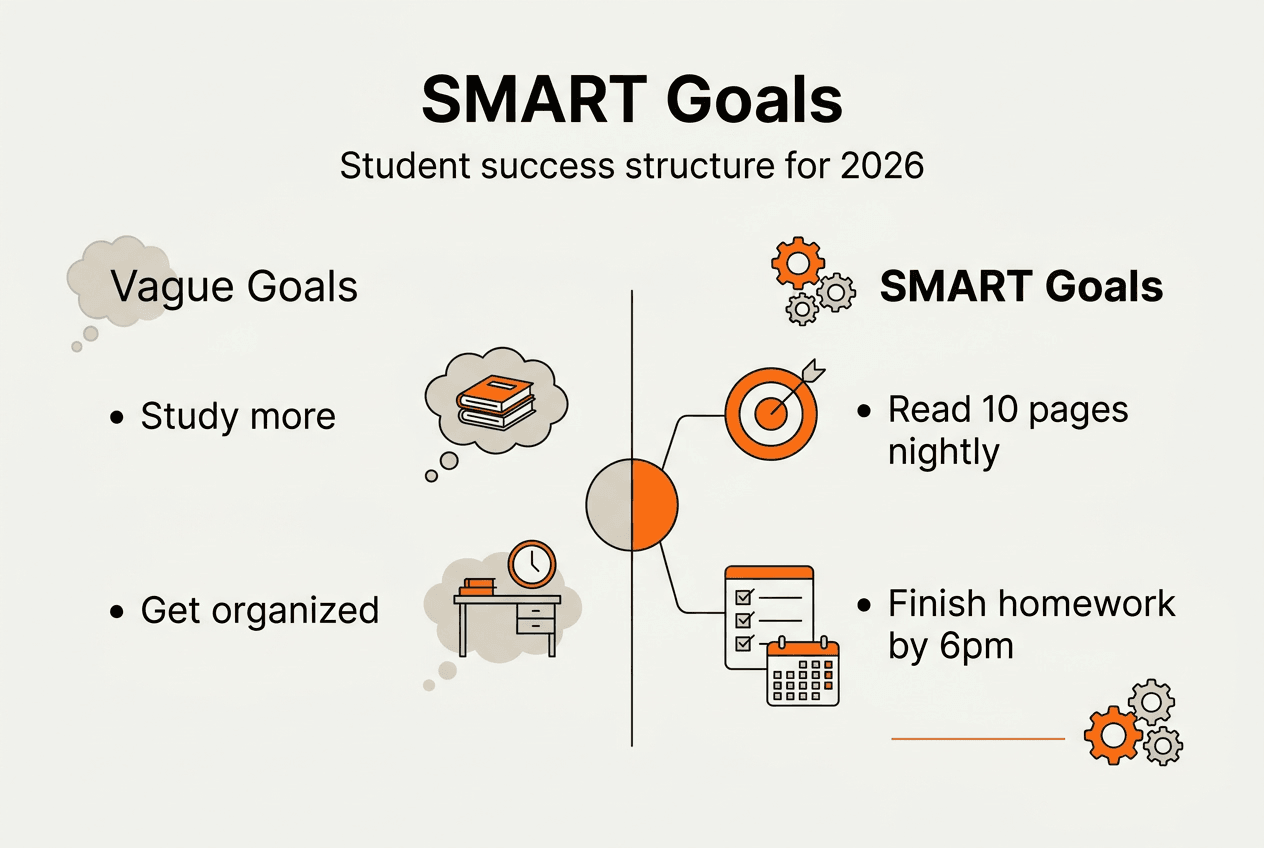
Many students believe setting vague goals like ‘do better in school’ or ‘get organized’ will magically lead to success. The reality? Fuzzy goals create confusion, frustration, and stalled progress. Without clear direction, measuring achievement becomes impossible, and motivation fades quickly. This guide cuts through the confusion by showing you exactly what defining goals means and how to do it effectively. You’ll discover practical frameworks like SMART goals, learn to balance goals across life areas, and see how pairing goal-setting with time management transforms academic performance. Clear, well-defined goals aren’t just helpful, they’re essential for turning your ambitions into real achievements.
Key takeaways
| Point | Details |
|---|---|
| Balanced goals reduce stress | Spreading goals across academic, personal, and social areas improves satisfaction and prevents burnout. |
| SMART goals boost achievement | Using the SMART framework increases success rates by 30-40% compared to vague goals. |
| Specificity drives progress | Measurable, time-bound goals make tracking progress concrete and achievable. |
| Clarity builds motivation | Well-defined goals enhance learning motivation and self-efficacy for students. |
| Frameworks meet values | Effective goal-setting combines structured methods with personal priorities and passions. |
What does it mean to define goals?
Defining goals means transforming vague wishes into precise, actionable targets you can measure and achieve. Vague goals like ‘do better in school’ are ineffective because they lack direction and clear success criteria. When goals remain fuzzy, you can’t track progress or know when you’ve succeeded. Well-defined goals answer specific questions: What exactly do I want? How will I measure it? When will I achieve it?
Consider the difference between these approaches. A vague goal says ‘improve my grades.’ A well-defined goal states ‘raise my biology grade from B to A by the end of this semester by attending weekly tutoring sessions and completing all lab reports two days before deadlines.’ The second version gives you a roadmap. You know your starting point, destination, timeline, and specific actions.
Clear, challenging goals improve individual performance by creating accountability and focus. When you define goals precisely, you create measurable milestones that show whether you’re moving forward or need to adjust your approach. This clarity eliminates guesswork and builds confidence as you track tangible progress.
Understanding the role of goal setting in academic success reveals why definition matters so much. Students who define their goals clearly report higher motivation, better time management, and greater academic achievement. The act of defining forces you to think critically about what you truly want and why it matters.
Pro Tip: Start every goal by asking ‘Why does this goal matter to me?’ Understanding your personal motivation creates emotional investment that sustains effort when challenges arise.
Here’s what separates defined goals from vague intentions:
- Defined goals include specific numbers, dates, or observable outcomes
- They identify concrete actions you’ll take to achieve results
- They connect to your larger values and academic priorities
- They create clear criteria for measuring success
- They establish realistic timelines that create urgency without overwhelm
When you invest time in defining goals properly, you’re building a foundation for success. Clarity transforms abstract wishes into achievable targets that guide daily decisions and actions.
Using the SMART framework to define effective goals
The SMART framework has been a cornerstone of strategic planning since 1981, and it remains the gold standard for goal-setting because it works. SMART stands for Specific, Measurable, Achievable, Relevant, and Time-bound. Each element addresses a critical component that transforms vague intentions into concrete plans. Research shows SMART goals improve goal attainment with 30-40% increased success rates for students.
Let’s break down each SMART component and why it matters for your academic success.
Specific goals eliminate ambiguity by answering who, what, where, when, and why. Instead of ‘study more,’ a specific goal states ‘complete 50 practice calculus problems from chapter 7 each Tuesday and Thursday evening.’ This precision tells you exactly what action to take.
Measurable goals include quantifiable indicators that prove progress. You need numbers, percentages, or observable milestones. ‘Improve writing skills’ becomes ‘write three 500-word essays per month and increase my average grade from C+ to B+ by May.’
Achievable goals stretch your abilities without setting you up for failure. They balance ambition with realism based on your current resources, time, and skills. Aiming to raise your GPA from 2.5 to 4.0 in one semester isn’t achievable, but targeting 3.0 is.
Relevant goals align with your broader academic priorities and personal values. A goal matters when it connects to your larger aspirations. If you’re pursuing a biology major, mastering organic chemistry is relevant. Learning advanced pottery might be interesting but less relevant to your core path.
Time-bound goals increase likelihood of completion by 20-30% because deadlines create urgency and accountability. ‘Finish my research paper’ lacks power. ‘Submit my 10-page history research paper by March 15’ creates a concrete target.
Follow these steps to write effective SMART goals:
- Start with your desired outcome and make it specific
- Add measurable criteria so you can track progress
- Assess whether the goal is achievable given your resources
- Confirm the goal aligns with your priorities and values
- Set a clear deadline with milestone dates
- Write your goal down using the complete SMART format
Pro Tip: Use the ‘Because I want to…, I need to…’ framework to connect goals with concrete actions. Example: ‘Because I want to attend veterinary school, I need to maintain a 3.7 GPA in all science courses this year.’
Avoid these common pitfalls. Setting too many goals simultaneously dilutes your focus and energy. Limit yourself to three to five SMART goals at a time. Skipping the ‘why’ behind your goal removes emotional motivation. Always connect your goal to a deeper purpose. Check out these SMART goals practical tips for additional strategies.
| Vague Goal | SMART Goal |
|---|---|
| Get better grades | Raise my math grade from 78% to 85% by final exams through weekly tutoring |
| Read more books | Read one classic novel per month and write a 300-word reflection for each |
| Be more organized | Use a planner daily to track all assignments and check it every morning and evening |
| Improve fitness | Exercise for 30 minutes four times weekly and track workouts in my fitness app |
Explore goal setting steps for success and the ultimate goal setting checklist to build a complete goal-setting system that drives results.
Balancing goals across life areas to reduce stress and improve satisfaction
Focusing exclusively on academics while neglecting other life areas creates burnout, resentment, and diminished overall well-being. Balanced goal setting leads to higher satisfaction and lower stress by ensuring you develop as a complete person, not just a student. Categorizing goals across key life areas helps you maintain perspective and prevents any single domain from consuming all your energy.
Consider these five essential life areas for student goals:
- Academic: course grades, test scores, study habits, research projects, skill development
- Extracurricular: clubs, sports, volunteer work, creative pursuits, leadership roles
- Personal growth: mental health, physical fitness, hobbies, mindfulness, skill-building outside school
- Social and relational: friendships, family connections, networking, community involvement
- College and career planning: applications, internships, resume building, career exploration
Research shows goal-setting positively affects student learning motivation and self-efficacy. When you set goals across multiple areas, you create a support system where success in one area fuels motivation in others. Achieving a fitness goal builds confidence that transfers to tackling challenging coursework.

Here are examples from each category to inspire your planning. For academics, aim to ‘complete all calculus homework within 24 hours of assignment and attend office hours twice monthly.’ For extracurricular, try ‘attend debate club meetings weekly and compete in two tournaments this semester.’ Personal growth might include ‘practice meditation for 10 minutes daily and journal three times weekly.’ Social goals could be ‘schedule one meaningful conversation with a friend each week.’ Career planning examples include ‘research five potential internships and submit three applications by April.’
| Imbalanced Approach | Balanced Approach |
|---|---|
| Five academic goals, zero personal or social goals | Two academic, one fitness, one social, one career goal |
| All goals focus on grades and test scores | Goals span learning, health, relationships, and growth |
| No time allocated for rest or recreation | Scheduled downtime and hobby development included |
| Goals create constant pressure and anxiety | Goals support overall well-being and life satisfaction |
Prioritize goals by reviewing them monthly and asking which areas need more attention. If you’ve neglected fitness for three months while crushing academic targets, shift focus slightly. Balance doesn’t mean equal time in each area, it means intentional attention to what matters most right now.
Pro Tip: Don’t overload yourself. Limit to one or two key goals per life area to maintain focus and prevent overwhelm. Quality beats quantity every time.
Explore areas of goal-setting for students for more detailed examples and learn about balancing academics and lifestyle to create sustainable success patterns.
Applying goal setting with time management for academic success
Even perfectly defined goals fail without effective time management to support them. Implementing goal-setting with time management leads to significant improvements in efficiency, confidence, and academic outcomes for university students. When you pair clear goals with smart scheduling and prioritization, you transform plans into consistent action and measurable results.
Time management amplifies goal achievement by ensuring you allocate sufficient hours to activities that matter most. Without deliberate scheduling, urgent but less important tasks consume time that should go toward your defined goals. A goal to ‘raise my chemistry grade to A’ requires dedicated study blocks, not just good intentions.
Key time-management techniques pair naturally with goal-setting. Time blocking involves scheduling specific hours for goal-related activities in your calendar. If your goal is completing 50 practice problems weekly, block Tuesday and Thursday evenings for focused math work. Prioritization using frameworks like the Eisenhower Matrix helps you distinguish between urgent and important tasks, ensuring goal-related work gets attention before it becomes a crisis.
Create daily and weekly plans that directly reflect your defined goals. Start each week by reviewing your SMART goals and identifying which actions move you closer to achievement. Break larger goals into daily micro-tasks. If your monthly goal is reading four books, your daily task is reading 20 pages. Schedule these tasks during your peak energy hours when focus comes naturally.
Research confirms goal setting is a foundational requirement for high-level academic accomplishment. Combining it with time management creates a powerful system that reduces procrastination and builds momentum.
Here are practical time management tips that support goal achievement:
- Review your goals every Sunday and plan the week’s priorities accordingly
- Use a planner or digital calendar to schedule goal-related tasks as appointments
- Apply the two-minute rule: if a task takes less than two minutes, do it immediately
- Batch similar tasks together to minimize context switching and maximize efficiency
- Build buffer time between activities to handle unexpected delays without derailing plans
- Track how you spend time for one week to identify waste and reallocate hours
- Protect your most productive hours for your most important goal-related work
Students who implement these strategies report improved academic results and reduced stress. When you know exactly what to work on and when, decision fatigue disappears. You stop wondering ‘What should I do now?’ and simply follow your plan.
Pro Tip: Regularly review your progress each week and adjust plans to stay on track. If a strategy isn’t working, pivot quickly rather than persisting with ineffective methods.
Dive deeper into time management tips for busy students and explore the student productivity workflow to build systems that turn goals into consistent achievements.
Explore study and time management resources to boost your success
You’ve learned how to define goals effectively using the SMART framework, balance them across life areas, and pair them with time management for maximum impact. Now it’s time to take the next step by exploring specialized resources designed specifically for students like you. Learning with Angie offers comprehensive guides on effective study techniques for exams that complement your goal-setting efforts perfectly. These techniques help you study smarter, not harder, turning your academic goals into tangible results. The time management step by step guide walks you through creating systems that support consistent progress. Understanding the productivity workflow for students reveals how to optimize your daily routines for peak performance. These resources transform theory into practice, giving you actionable strategies that fit your unique schedule and learning style. Start exploring today and watch your goals become achievements.
Frequently asked questions
What are some examples of well-defined goals for students?
Well-defined student goals include specific outcomes, measurable criteria, and deadlines. Examples: ‘Increase my history grade from B to A by semester end through weekly study groups and completing all readings two days early,’ or ‘Submit five scholarship applications by March 1 with personalized essays for each.’ Each goal clearly states what success looks like and how to achieve it.
How many goals should a student set at one time?
Limit yourself to three to five total goals across all life areas to maintain focus and prevent overwhelm. Setting too many goals dilutes your energy and makes tracking progress difficult. Prioritize goals that align with your most important current priorities, achieve them, then set new ones. Quality and completion matter more than quantity.
How often should students review and adjust their goals?
Review your goals weekly to track progress and monthly to assess whether they still align with your priorities. Weekly reviews keep you accountable and help you adjust tactics if something isn’t working. Monthly reviews allow bigger-picture evaluation of whether goals need to be modified, abandoned, or replaced based on changing circumstances or new information.
Can goal-setting really improve academic performance?
Yes, research consistently shows goal-setting significantly improves academic outcomes. Students who set specific, challenging goals demonstrate higher motivation, better time management, and improved grades compared to those with vague or no goals. The key is using structured frameworks like SMART goals and pairing them with consistent action and regular progress reviews.
What’s the difference between short-term and long-term goals for students?
Short-term goals span days to months and focus on immediate actions like ‘complete this week’s chemistry lab report by Thursday.’ Long-term goals extend across semesters or years, such as ‘graduate with honors’ or ‘gain admission to veterinary school.’ Effective students set both types, using short-term goals as stepping stones toward larger long-term aspirations. Both should follow SMART criteria.
Recommended
- 7 Areas of Goal-Setting for Student Success
- Goal Setting Steps for Achieving Success in School
- Create Your Success: Ultimate Goal Setting Checklist
- Study Skills in 2025: The Essential Guide
- Effective Goal Setting for Students: Achieve Your Dreams – Optio Station: Best Project Management App for Prioritization