
Ultimate Exam Preparation Checklist for Success
Getting ready for an exam can feel overwhelming, especially when nearly 60 percent of students admit they do not have a structured study plan. Most people think cramming for hours the night before will do the trick, or they grab random notes and hope for the best. But what if the real secret to exam success is less about working harder and more about building the right habits from the very start?
Quick Summary
| Key Point | Explanation |
|---|---|
| 1. Assess your current knowledge | Start with a self-assessment to identify strengths and weaknesses, guiding focused study efforts. |
| 2. Create a structured study schedule | Map out available study time and prioritize based on knowledge assessments to cover materials effectively. |
| 3. Gather and organize study materials | Collect all necessary course materials and additional resources, ensuring they’re easy to access and relevant. |
| 4. Regularly review and practice | Engage in spaced repetition and varied practice methods to solidify understanding and increase retention. |
| 5. Simulate exam conditions for practice | Create realistic testing scenarios to assess preparedness and identify areas needing improvement before the actual exam. |
Step 1: Assess Your Current Knowledge
Knowing exactly where you stand academically is the first critical step in creating an effective exam preparation strategy. Think of this stage as creating a detailed personal learning roadmap that helps you target your study efforts precisely where they are most needed.
Starting your exam preparation requires an honest self-assessment of your current knowledge and skill levels. This means carefully reviewing your past performance, understanding your strengths, and identifying knowledge gaps that need focused attention. You can accomplish this through several strategic methods.
Begin by gathering all relevant materials from previous coursework, including past tests, quizzes, homework assignments, and class notes. Spread these out and review them systematically. Look for patterns in your performance. Are there specific topics where you consistently struggle? Do certain question types challenge you more than others? These insights will become your targeted study focus areas.
Next, create a knowledge tracking worksheet where you can honestly rate your comprehension level for each major topic covered in your upcoming exam. Use a simple scale like:
- Completely confident
- Somewhat understand
- Need significant review
- No understanding
This self-evaluation provides a clear visual representation of where you need to concentrate your study efforts. Check out our guide on self-assessments for more detailed strategies in tracking your academic progress.
To validate your self-assessment, consider taking a practice diagnostic exam or asking your teacher for a pre-test review. These external evaluations can help confirm or challenge your own perception of your current knowledge level. They provide an objective benchmark against which you can measure your subsequent study progress.
Remember, the goal of this initial assessment isn’t to discourage you but to empower you. By understanding exactly where you are right now, you can create a laser-focused study plan that maximizes your preparation time and increases your chances of exam success. Your honest self-reflection is the foundation of an effective study strategy.
Step 2: Create a Study Schedule
A strategic study schedule transforms random study sessions into a powerful, organized learning system. Your schedule becomes the blueprint that guides your exam preparation, ensuring you cover all necessary material while preventing last minute panic and burnout.
Begin by understanding your total available study time. Pull out your current calendar and map out all existing commitments such as classes, work shifts, extracurricular activities, and family obligations. This gives you a realistic view of the study windows you can actually use. Pro tip: Look for smaller time blocks throughout your day that can be leveraged for focused learning, not just long marathon sessions.
Next, prioritize your subjects based on your knowledge assessment from the previous step. Allocate more study time to subjects or topics where you identified significant knowledge gaps. For instance, if your self-assessment revealed you struggle with math formulas, that subject should receive more dedicated study time compared to areas where you feel more confident.
When designing your schedule, incorporate these critical principles:
- Alternate challenging subjects with easier topics
- Include short 5-10 minute breaks between study blocks
- Schedule study sessions during your peak energy times
- Plan buffer time for unexpected interruptions
Learn more about creating an effective study schedule to maximize your learning potential. Consider using digital tools like Google Calendar or specialized study planning apps that allow you to color code subjects and track your progress.
Remember to build flexibility into your schedule. Rigid plans often fail because life is unpredictable. If you miss a planned study session, don’t beat yourself up. Simply reschedule and stay committed to your overall learning goals. The key is consistent effort, not perfect execution.
Verify your schedule’s effectiveness by reviewing it weekly. Are you actually following the plan? Are you seeing improvements in your understanding of difficult subjects? Be willing to adjust your approach based on what works best for your unique learning style and life circumstances.
Step 3: Gather Study Materials
Gathering your study materials is like preparing your toolkit before a big project. The right resources can make the difference between a stressful study experience and a smooth, efficient preparation process. This step transforms scattered information into a comprehensive learning arsenal.
Start by collecting all official course materials directly from your instructor. This includes syllabi, textbooks, class notes, handouts, practice worksheets, and any recommended supplementary resources. Pro tip: Request a comprehensive list of exam topics from your teacher to ensure you’re not missing any critical information. Digital or physical copies both work well, so choose the format that helps you study most effectively.
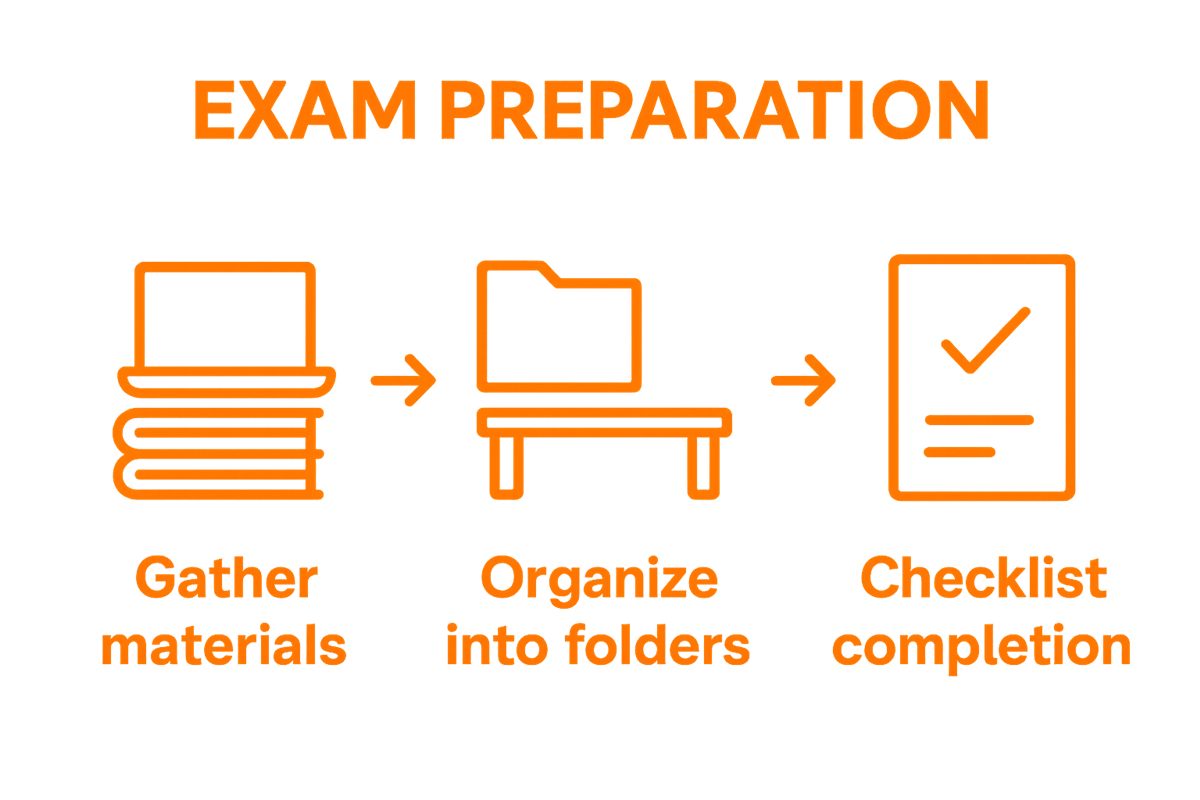
Organization is key when assembling your study materials. Create a dedicated study space or folder where everything is easily accessible. Learn practical strategies for organizing your study materials to streamline your preparation process. Consider using color-coded folders or digital organization tools that help you quickly locate specific resources.
Beyond traditional materials, expand your resources strategically. Look for additional study aids like:
- Online practice exams
- Video tutorials
- Subject-specific study guides
- Recommended reference books
- Digital flashcard sets
Don’t just collect materials randomly. Evaluate each resource’s quality and relevance. Not all study materials are created equal. Cross-reference recommended resources with your instructor’s guidance and your own learning assessment from earlier steps.
Technology can be a powerful ally in gathering study materials. Explore educational platforms, academic websites, and digital libraries that offer free or low-cost study resources. Many institutions provide online access to additional learning materials that can supplement your existing resources.
Verify your material collection by creating an inventory checklist. Go through each subject and confirm you have comprehensive coverage of all exam topics. This final review ensures you haven’t overlooked any crucial study resources and gives you confidence that your preparation toolkit is complete and ready for action.
Below is a table summarizing essential study materials and resources mentioned in the article, along with their primary purpose to help streamline your preparation process.
| Study Material/Resource | Purpose |
|---|---|
| Textbooks and Class Notes | Core content review |
| Syllabi and Handouts | Identify exam scope |
| Practice Worksheets | Skill development and reinforcement |
| Online Practice Exams | Simulate test conditions |
| Video Tutorials | Clarify difficult concepts |
| Subject-Specific Study Guides | Targeted topic review |
| Digital Flashcard Sets | Quick recall and repetition |
| Reference Books | In-depth explanations |
Step 4: Review and Practice Regularly
Regular review and practice transform passive learning into active mastery. This step is about turning your study materials into a dynamic learning experience that builds confidence and deepens understanding. Think of it like training for a marathon – consistent, focused effort builds your academic muscle memory.
Consistency is the secret weapon of effective studying. Instead of marathon cramming sessions, break your review into shorter, more frequent practice periods. According to learning science research, spaced repetition helps your brain retain information more effectively than last-minute intense study sessions.
Develop a systematic review approach that cycles through your study materials. Start by creating practice tests that mimic your actual exam format. If you’re studying math, solve problems without looking at solutions. For humanities, practice writing sample essays. Learn how to build study habits that stick to make your review process more sustainable.
Your practice routine should include these key elements:
- Timed practice sessions
- Self-assessment after each review
- Tracking improvement areas
- Adjusting study strategies based on performance
Utilize multiple practice methods to keep your brain engaged. Mix up your review techniques by using flashcards, online quizzes, study groups, and teaching concepts to others. Each method reinforces learning differently and helps identify knowledge gaps you might have missed.
Track your progress meticulously. Create a simple progress journal where you record practice test scores, time spent studying, and areas that challenge you. This isn’t about perfection but about seeing your incremental improvements. Celebrate small victories and use moments of struggle as opportunities to refine your study approach.
Verify your review effectiveness by periodically comparing your practice test results. Are your scores improving? Are you feeling more confident with challenging topics? Your growing comfort and increasing accuracy are clear signs that your regular review strategy is working. Remember, the goal isn’t just to memorize information, but to truly understand and apply your knowledge.
Step 5: Test Your Understanding
Testing your understanding is the critical checkpoint that transforms passive study into genuine learning. It’s like a diagnostic tool that reveals the true depth of your knowledge, showing you exactly where you need to focus your remaining preparation time.
Simulate real exam conditions as closely as possible when testing yourself. This means creating an environment that mimics your actual test setting – quiet space, limited distractions, and timed practice. According to research on learning effectiveness, self-testing helps you identify knowledge gaps more accurately than simply reviewing materials.
Start by creating comprehensive practice tests that cover all topics from your study materials. These can be from textbook resources, online practice platforms, or past exam papers. Explore our ultimate exam preparation strategies to refine your testing approach.
Your self-testing strategy should include these essential elements:
- Timed practice tests matching exam duration
- Questions that cover all major subject areas
- Mix of multiple-choice and open-ended questions
- Immediate self-evaluation after completing tests
Don’t just take practice tests passively. After completing each test, conduct a thorough review. Analyze every question you got wrong. Understand not just the correct answer, but why your original response was incorrect. This reflective process transforms mistakes into powerful learning opportunities.
Utilize diverse testing methods to challenge your understanding. Mix traditional paper tests with digital quizzes, oral explanations to an imaginary audience, and even teaching concepts to study partners. Each method engages different parts of your brain, reinforcing learning from multiple angles.
Verify your understanding by tracking your progress across multiple practice tests. Look for trends in your performance. Are your scores consistently improving? Are you making fewer mistakes in specific subject areas? Gradual improvement and increased confidence are clear indicators that your testing strategy is working effectively.
 Remember, the goal isn’t perfection, but continuous, measurable learning.
Step 6: Finalize Preparation and Relax
The final stage of exam preparation is about strategic consolidation and mental preservation. This crucial step transforms your intense study efforts into confident, calm readiness. Think of it as the calm before the academic storm – a deliberate approach to entering your exam with maximum mental clarity and minimal stress.
Preparation is not just about studying harder, but smarter. In the last 24-48 hours before your exam, focus on light review and mental preparation rather than frantic last-minute cramming. Explore our expert last-minute study strategies to fine-tune your final preparation approach.
Create a compact review sheet that summarizes key concepts, formulas, and critical information. This shouldn’t be a comprehensive rehash of all your study materials, but a targeted snapshot of the most important points. Use visual techniques like color coding, mind mapping, or bullet point summaries to make information quickly digestible.
Your final preparation checklist should include these essential elements:
- Organize all required exam materials
- Confirm exam location and time
- Prepare a comfortable, appropriate outfit
- Pack necessary supplies like pencils, calculator, water bottle
- Plan your pre-exam meal and sleep schedule
Prioritize your physical and mental well-being in these final hours. Get adequate sleep – aim for 7-8 hours the night before your exam.
Use this final exam preparation checklist table to ensure you have everything organized and ready for test day, helping you minimize last-minute stress and maximize readiness.
| Checklist Item | Description | Completion Status |
|---|---|---|
| Organize all required exam materials | Gather admission ticket, ID, supplies | |
| Confirm exam location and time | Double-check the official details | |
| Prepare comfortable, appropriate outfit | Choose suitable clothes for test conditions | |
| Pack necessary supplies | Prepare pencils, calculator, water bottle | |
| Plan pre-exam meal and sleep schedule | Ensure sleep of 7-8 hours, healthy meal | |
| Implement relaxation techniques | Practice deep breathing, stretching | |
| Do final mental and physical check | Review readiness and maintain calm |
Implement relaxation techniques to manage pre-exam anxiety. Deep breathing exercises, short meditation sessions, or gentle stretching can help calm your nervous system. Visualize yourself performing confidently during the exam, using positive mental imagery to boost your self-assurance.
Verify your readiness by doing a final mental and physical check. Are your materials prepared? Do you feel relatively calm and focused? Remember, you’ve put in the work. Trust your preparation, believe in yourself, and approach the exam with quiet confidence. Your thorough preparation has equipped you with the tools to succeed.
Transform Your Study Challenges into Lasting Success
Feeling overwhelmed by scattered notes, endless materials, and a packed exam checklist? You are not alone. Many students struggle to stay organized and productive when it matters most. The strategies in this article, like creating a knowledge tracking worksheet and systematic review blocks, are your first step. But to truly master exam prep and maintain confidence, you need the right tools and support every day.
Take the next step toward stress-free studying. Explore our expert tips and resources on Organization and Productivity to upgrade your routines. Ready for a real change? Visit Learning With Angie now and discover solutions designed to help you achieve your academic goals. Start building your foundation for exam success—today is the best day to take action.
Frequently Asked Questions
What are the first steps in creating an effective exam preparation strategy?
The first critical step is to assess your current knowledge through self-evaluation, reviewing past performances, and identifying knowledge gaps that need targeted attention.
How can I create a study schedule that maximizes my preparation time?
Start by understanding your available study time, prioritize subjects based on your knowledge assessment, and incorporate breaks while ensuring flexibility to adapt as needed.
What types of study materials should I gather for effective exam preparation?
Collect all official course materials, supplementary resources like online practice exams and study guides, and consider digital tools for organization, ensuring you have comprehensive coverage of all exam topics.
How often should I review and practice my study materials?
Regular review is crucial; aim for shorter, consistent practice sessions instead of cramming, utilizing spaced repetition to enhance retention and mastering the material effectively.