
Academic goal-setting tips that actually get results
Most students have written down a goal like “get better grades” or “study more” at some point, only to abandon it within two weeks. Sound familiar? The problem is not a lack of motivation. It is a lack of structure. Without a clear framework, even the most ambitious student ends up spinning their wheels. In this guide, I am walking you through evidence-based strategies for academic goal-setting and time management that actually move the needle. Whether you are in high school or college, these tools will help you set goals you can track, manage your time with confidence, and finish each semester feeling genuinely accomplished.
Key Takeaways
| Point | Details |
|---|---|
| SMART goals work | Using the SMART framework makes academic goals clearer and more attainable. |
| Limit your focus | Stick to 2-3 major academic goals at a time for the best results. |
| Prioritize learning goals | Focusing on learning strategies yields deeper long-term academic success than performance alone. |
| Use time management | Planning, prioritizing, and organizing are essential for meeting academic objectives. |
| Avoid common pitfalls | Steer clear of vague, overly ambitious, or numerous goals to maintain motivation and progress. |
Why goal-setting matters for academic success
Goal-setting is not just a feel-good exercise. It is one of the most powerful tools you have for improving your academic performance. When you set clear goals, you give your brain a target to aim for, and that focus changes how you study, plan, and prioritize.
The research backs this up. Time management moderately correlates with learning outcomes in college students, meaning students who plan their time well consistently perform better. And it is not just about grades. Time management training improves self-regulation and reduces procrastination, two of the biggest obstacles students face.
Here is a quick look at what structured goal-setting actually does for you:
| Without goals | With structured goals |
|---|---|
| Studying feels random and stressful | Studying has clear direction and purpose |
| Hard to measure progress | Progress is visible and motivating |
| Easy to procrastinate | Built-in accountability keeps you on track |
| Time slips away fast | Time is planned and protected |
The core benefits of academic goal-setting include:
- Sharper focus on what actually matters each week
- Stronger motivation because you can see progress
- Better time use by knowing what to prioritize
- Reduced anxiety because tasks feel manageable
- Measurable progress that builds real confidence
“Students who set specific academic goals are more likely to stay engaged and less likely to give up when challenges arise.”
If you want to go deeper on the foundational steps, check out these goal-setting steps for success that break the process down even further. The bottom line is this: goal-setting is not optional if you want to grow academically. It is the foundation everything else is built on.
How to set SMART academic goals
You have probably heard of SMART goals before, but let me show you how to actually use them for school. SMART stands for Specific, Measurable, Achievable, Relevant, and Time-bound. Each element plays a real role in making your goals stick.
SMART goals are supported by educational research as one of the most effective frameworks for academic goal-setting. Here is what each piece means in practice:
- Specific: Instead of “study more,” say “review my chemistry notes for 30 minutes every Tuesday and Thursday.”
- Measurable: Track your progress. “Raise my GPA from 2.8 to 3.2 by the end of the semester” gives you a number to aim for.
- Achievable: Be honest about your schedule. A goal that requires 6 hours of daily studying when you work part-time is not realistic.
- Relevant: Your goal should connect to something you actually care about, like getting into a specific program or passing a required class.
- Time-bound: Set a deadline. “By midterms” or “within four weeks” creates urgency.
Here is a comparison to make this concrete:
| Vague goal | SMART goal |
|---|---|
| “Do better in math” | “Score 80% or higher on the next two math tests by studying 45 minutes daily for three weeks” |
| “Read more” | “Finish one assigned chapter per day, Monday through Friday, before 8 PM” |
| “Turn in assignments on time” | “Submit all assignments 24 hours early for the next four weeks” |
To apply this yourself, follow these steps:
- Identify one area where you want to improve.
- Write a goal using all five SMART elements.
- Break the goal into weekly action steps.
- Set a check-in date to review your progress.
- Adjust if needed, without guilt.
Pro Tip: Aim for 2 to 3 key goals at a time. More than that and your focus gets scattered. Quality beats quantity every time. Pair your goals with strong organization tips for students to keep everything running smoothly.
Choosing the right types of goals: Learning vs. performance
Not all goals are created equal. There are two main types you should know about: learning goals and performance goals.

A learning goal focuses on building skills and understanding. For example, “I want to understand how to solve quadratic equations” or “I want to improve my essay structure.” A performance goal focuses on outcomes. For example, “I want to get an A on my next essay” or “I want to make the honor roll.”
Both have a place in your academic life, but learning goals outperform pure performance goals when it comes to long-term academic growth. Why? Because when you focus on the process, the results tend to follow naturally.
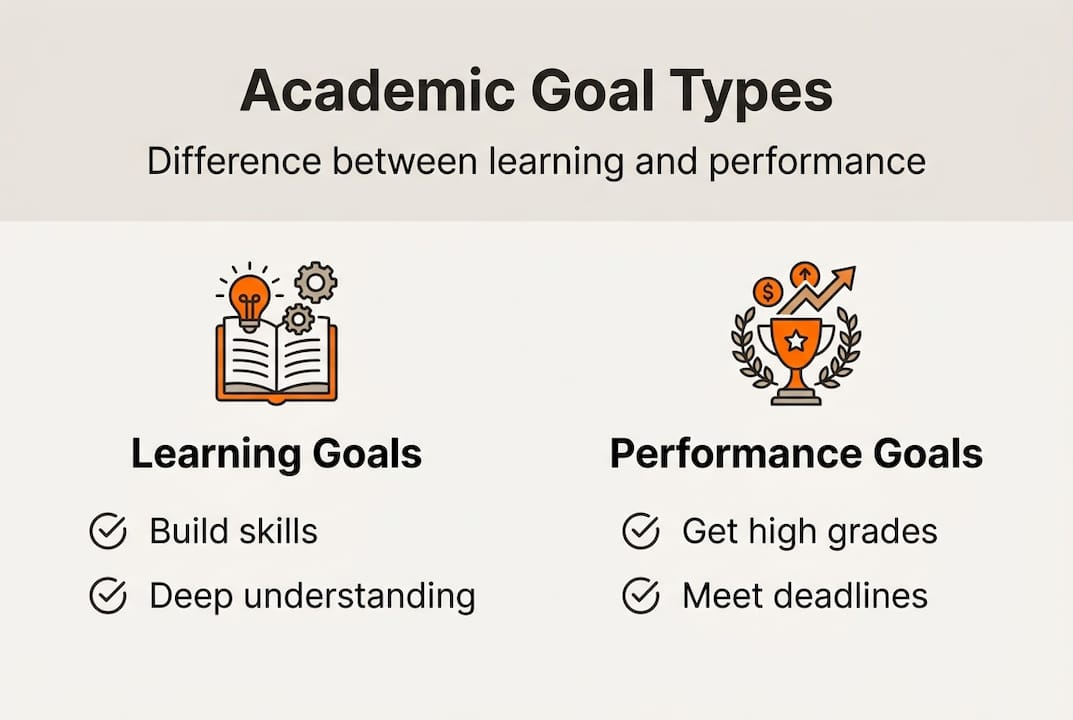
Here are common examples of each:
Learning goals:
- Master the steps of the scientific method
- Improve reading comprehension by summarizing each chapter
- Learn how to cite sources correctly in APA format
Performance goals:
- Earn a B or higher on the next history exam
- Finish all homework before 9 PM each night
- Raise your semester GPA by 0.3 points
“Process-focused students tend to bounce back faster from setbacks because their identity is not tied to a single grade.”
The smartest approach is to blend both types. Use a performance goal as your destination and a learning goal as your roadmap. For example, pair “earn a B+ in biology” with “spend 20 minutes each night reviewing that day’s lecture notes.”
Pro Tip: When you hit a rough patch, lean into your learning goals. They keep you moving forward even when grades feel discouraging. Revisit these steps for achieving goals to stay grounded in the process.
Top time management strategies for reaching your goals
Setting great goals means nothing if your schedule is a mess. Time management is the bridge between intention and action. Here are the strategies that actually work.
Planning, prioritization, and task organization are the top evidence-based time management strategies for students. Let me break down how to use each one.
Core tactics to build into your routine:
- Weekly planning: Every Sunday, map out your week. List all assignments, tests, and commitments.
- Prioritization: Use a simple system. Urgent and important tasks go first. Everything else gets scheduled.
- Task chunking: Break big projects into smaller steps. “Write essay” becomes “outline on Monday, draft on Wednesday, edit on Friday.”
- Time blocking: Assign specific time slots to specific tasks. Protect those blocks like appointments.
Here is a numbered system you can start using this week:
- Write down every task due in the next 7 days.
- Rank them by deadline and importance.
- Assign each task to a specific day and time.
- Do a 10-minute review every Friday to check your progress.
- Adjust next week’s plan based on what worked and what did not.
“Students who review their weekly progress consistently outperform those who only plan at the start of the semester.”
For more detailed time management tips and ways to overcome procrastination, I have full guides that walk you through each step. You can also explore student organization tips to keep your workspace and schedule aligned.
Pro Tip: Apps like Google Calendar or Notion are great, but do not spend more time organizing than actually studying. Keep your system simple enough that you will actually use it every day.
Common goal-setting mistakes (and how to avoid them)
Even motivated students fall into the same traps. Knowing what to watch out for can save you weeks of frustration.
Common pitfalls include setting vague goals, taking on too many goals at once, ignoring whether goals are relevant, and skipping timelines or accountability. Here is what these look like in real student life:
- Vague goals: “I want to do better” gives you nothing to act on. You need specifics.
- Too many goals: Trying to improve in five subjects simultaneously leads to burnout, not breakthroughs.
- Irrelevant goals: Setting a goal to read 10 books when your real problem is passing calculus wastes your energy.
- No timeline: Without a deadline, goals become wishes. “Someday” is not a due date.
- No accountability: Keeping goals only in your head makes it easy to quietly give up.
“A goal without a deadline is just a dream. Students who set specific timeframes are far more likely to follow through.”
Here is how to fix each one:
- Write your goals down and post them somewhere visible.
- Pick 2 to 3 goals maximum per semester.
- Set a check-in every two weeks to review and adjust.
- Tell a friend, classmate, or parent about your goal. Accountability is powerful.
- Anticipate obstacles. Ask yourself, “What might get in the way?” and plan for it.
Pro Tip: Build in a “reset” moment every month. If a goal is not working, you are allowed to revise it. Flexibility is not failure. It is smart planning. For more support, check out how to manage time for academic success with a system that keeps you consistent.
What most students miss about academic goal-setting
Here is something I genuinely believe: most students do not fail because they are lazy. They fail because they confuse being busy with making progress. Setting five goals and grinding through them without ever pausing to reflect is not a strategy. It is just exhausting.
The students who actually grow are not the ones with the longest to-do lists. They are the ones who set fewer, better goals and check in on them regularly. They ask, “Is this still working? Do I need to adjust?” That kind of reflection is rare, and it is incredibly powerful.
I also think students underestimate how much consistency matters over intensity. Studying for 30 focused minutes every day beats a 4-hour cramming session every weekend. Your goals should reflect that. Build habits, not heroics.
If you feel like you keep restarting from scratch every semester, the issue is probably not your goals themselves. It is the lack of a review system. Revisit your goal-setting wisdom regularly, treat your goals as living documents, and give yourself credit for the small wins along the way.
Take your goal-setting and study habits further
You now have a solid foundation for setting goals that actually work and managing your time with intention. But knowing the framework is just the beginning. The real magic happens when you apply these strategies consistently, and that is exactly what I am here to help you do.
At Learning With Angie, I have put together practical guides on everything from study techniques for exams to time management tools that fit a student’s real schedule. Whether you are just getting started or looking to level up, you will find resources that are approachable, actionable, and genuinely useful. Browse all the Learning With Angie resources and find the tools that match where you are right now.
Frequently asked questions
What is the SMART goal framework for students?
SMART goals are Specific, Measurable, Achievable, Relevant, and Time-bound objectives that help students stay organized and focused while tracking progress toward academic targets.
How many academic goals should I set at once?
Most research recommends focusing on 2 to 3 well-defined goals at a time to avoid overload, maintain motivation, and give each goal the attention it deserves.
Do time management skills really impact grades?
Yes. Time management correlates with academic achievement, showing a moderate positive relationship based on a meta-analysis of over 13,000 college students.
What’s the difference between learning and performance goals?
Learning goals focus on building skills and strategies, while performance goals target specific outcomes like grades. Learning goals outperform pure performance goals for long-term academic growth, though blending both types works best.
Recommended
- Goal Setting Steps for Achieving Success in School
- 7 Areas of Goal-Setting for Student Success
- Learning Motivation Tips for Achieving Study Goals
- How Productivity Can Boost Your Grades (Without Making You Miserable!)
- Examples of SMART goals to boost academic success – Optio Station: Best Project Management App for Prioritization