
What is the study of aesthetics? A comprehensive 2026 guide
You’ve probably heard someone dismiss aesthetics as just deciding whether art is good or bad. That’s a misconception. Aesthetics is actually the philosophical study of beauty, art, and taste across all experiences, from a sunset to a smartphone interface. It explores how we perceive and value beauty, why certain things move us, and how culture shapes our judgments. This guide will unpack what aesthetics truly is, trace its philosophical roots, examine cultural influences, reveal its modern impact across design and media, and show you how to apply these ideas in your own life and studies.
Key takeaways
| Point | Details |
|---|---|
| Aesthetics studies beauty and art philosophically | It examines the nature of beauty, art, and taste in all experiences, not just traditional art forms. |
| It’s a branch of philosophy | Aesthetics focuses on how we perceive and value beauty, exploring sensory and emotional responses. |
| Cultural and personal factors shape judgments | Biology, history, belief systems, and class all influence what we find beautiful or valuable. |
| Modern aesthetics expands beyond art | It now applies to design, media, advertising, software, medicine, and everyday consumer products. |
| Understanding aesthetics enriches appreciation | It helps you critique art meaningfully and recognize aesthetic value in daily life. |
Understanding what aesthetics is and why it matters
Aesthetics is the philosophical study of beauty and art, but it reaches far beyond museum walls. Defining study aesthetics means recognizing that this field examines how we experience and value beauty in everything from nature to fashion to food. You encounter aesthetics when you choose an outfit, scroll through social media, or feel moved by a song. It’s not about declaring what’s objectively good or bad. Instead, aesthetics investigates why certain experiences resonate with us, how artists create meaning, and how audiences respond emotionally and intellectually.
The philosophy of aesthetics asks fundamental questions about value and perception. What makes a painting beautiful? Why does a particular melody evoke nostalgia? How do we distinguish art from non-art? These questions matter because they shape how we interpret the world around us. Aesthetics also explores the relationship between form and content, the role of intention in artistic creation, and the subjective nature of taste. By studying aesthetics, you develop a richer vocabulary for discussing what you see, hear, and feel.
Consider these everyday aesthetic experiences:
- The visual harmony of a well-designed website that makes navigation intuitive and pleasant
- The emotional impact of a film score that amplifies tension or joy without a single word
- The tactile satisfaction of holding a well-crafted object, like a ceramic mug or leather-bound book
- The way a cityscape at dusk creates a sense of wonder through light, shadow, and architecture
- The pleasure of tasting a dish where flavors balance perfectly, creating a memorable sensory moment
“Aesthetics is not confined to the realm of fine arts but extends to everyday experiences, shaping how we perceive and interact with the world.”
Pro Tip: Start noticing aesthetic choices in your daily routine. Ask yourself why a brand logo feels trustworthy or why a room’s color scheme affects your mood. This awareness deepens your appreciation and sharpens your critical thinking.
Philosophical foundations and cultural diversity in aesthetics
To grasp aesthetics fully, you need to distinguish it from related concepts. Aesthetics overlaps with ethics and metaphysics but focuses specifically on sensory value and beauty. Ethics concerns moral judgments about right and wrong. Asceticism involves self-discipline and renunciation of worldly pleasures. Aesthetics, by contrast, celebrates and analyzes the experience of beauty itself. This distinction matters because confusing these fields leads to misunderstanding what aesthetics actually studies.
Philosophers have debated core aesthetic questions for centuries. What is beauty? Is it objective or subjective? What makes art valuable? Immanuel Kant argued that beauty is subjective but claims a kind of universal validity because we expect others to share our judgments. David Hume emphasized the role of taste and the importance of cultivating refined sensibilities through experience. Arthur Danto explored how context and theory transform ordinary objects into art. These thinkers shaped how we understand aesthetic experience today.
Key philosophical approaches include:
- Formalism: Beauty resides in an object’s form, structure, and composition, independent of content or context.
- Expressivism: Art’s value lies in its ability to express and evoke emotions authentically.
- Institutionalism: Something becomes art when recognized by the art world’s institutions and practices.
- Phenomenology: Aesthetic experience emerges from the direct, lived encounter between perceiver and object.
- Pragmatism: Art’s meaning and value develop through its use and effects in real-world contexts.
Aesthetic values vary significantly across cultures, reflecting different worldviews and priorities:
| Cultural Tradition | Aesthetic Emphasis | Key Values |
|---|---|---|
| Indian | Spiritual and sensory richness | Rasa (emotional flavor), transcendence, ornamentation |
| Chinese | Harmony and natural balance | Simplicity, restraint, integration with nature |
| Islamic | Geometric and abstract beauty | Pattern, unity, avoidance of figurative representation |
| Christian | Symbolic and moral significance | Iconography, light as divine, narrative clarity |
Multiple factors influence judgment, including biology (innate preferences for symmetry or certain colors), history (artistic movements and traditions), belief systems (religious or philosophical frameworks), and class (access to education and cultural capital). Your background shapes what you find beautiful, but exposure to diverse aesthetic traditions can expand your sensitivity. Understanding study aesthetics importance means recognizing these influences and questioning your assumptions.
“Aesthetic judgment is never purely individual. It is always shaped by the cultural, historical, and social contexts in which we live.”
Pro Tip: When encountering unfamiliar art or design, resist immediate judgment. Research its cultural context and intended meaning. This practice builds aesthetic flexibility and prevents ethnocentric bias.
Modern expansions and practical influence of aesthetics
Aesthetics has evolved far beyond philosophy seminars and art galleries. The rise of modern industry led to applied aesthetics in fields like product design, medicine, transportation, and software development. Today, companies employ aesthetic principles to create user experiences that feel intuitive and satisfying. A well-designed app interface doesn’t just function well. It also provides visual pleasure and emotional comfort. Hospitals use color theory and spatial design to reduce patient anxiety. Car manufacturers balance aerodynamics with visual appeal to create vehicles that look fast even when stationary.
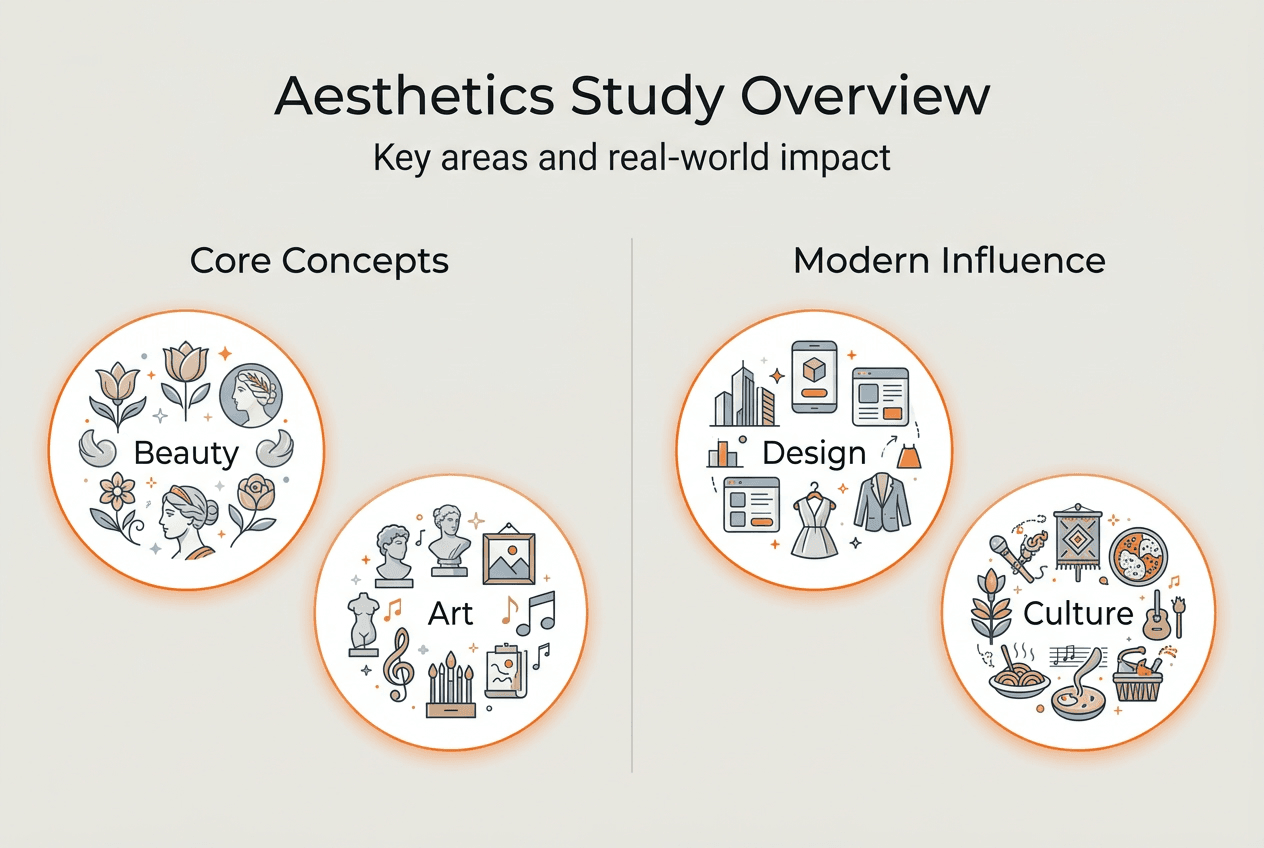
Advertising uses aesthetics as a persuasion tool, often disconnected from a product’s actual meaning or function. A perfume commercial might feature abstract imagery of ocean waves and desert landscapes, creating an emotional association without explaining what the fragrance smells like. Fast food brands use warm colors and rounded shapes to evoke comfort and approachability. Political campaigns employ visual symbols and music to trigger specific emotional responses. Understanding these tactics helps you recognize when aesthetics is being used to manipulate rather than inform.
Modern fields where aesthetics plays a vital role:
- User experience (UX) design: Creating digital interfaces that feel natural and enjoyable to navigate
- Environmental design: Shaping public spaces to promote well-being, social interaction, and accessibility
- Fashion and branding: Communicating identity, values, and lifestyle through visual and material choices
- Film and media production: Using cinematography, sound design, and editing to evoke specific moods and meanings
- Architecture: Balancing functional needs with visual impact, cultural context, and environmental sustainability
Comparing traditional and modern aesthetic applications:
| Traditional Focus | Modern Multidisciplinary Applications |
|---|---|
| Fine arts (painting, sculpture, music) | Product design, software interfaces, virtual reality |
| Philosophical inquiry into beauty | Empirical research on perception, neuroscience of aesthetics |
| Elite cultural institutions (museums, opera) | Popular culture, social media, gaming, streaming platforms |
| Permanent, physical artworks | Ephemeral, digital, interactive, and participatory experiences |
“Aesthetics today is not just about contemplating beauty. It’s about engineering experiences that shape how billions of people interact with technology, consume products, and navigate their environments.”
Learning aesthetic note-taking tips and exploring aesthetic study websites can help you apply these principles to your own academic work. When your notes are visually organized and pleasant to review, you retain information better and feel more motivated to study.
Challenges and methodologies in the contemporary study of aesthetics
Studying aesthetics rigorously presents unique challenges. The Perspectival Pluralism Problem describes how multiple valid interpretations of aesthetic phenomena can coexist without a single correct answer. A painting might be analyzed through feminist, Marxist, formalist, or psychoanalytic lenses, each revealing different truths. This plurality enriches understanding but complicates efforts to build systematic knowledge. Traditional epistemology struggles with aesthetic ambiguity and context dependence because beauty resists reduction to simple formulas.

Philosophers employ various methodologies to navigate this complexity. The hermeneutic circle, associated with Martin Heidegger, involves iteratively interpreting parts in light of the whole and vice versa until a coherent understanding emerges. Analytic aesthetics uses necessity and sufficiency conditions to define concepts precisely, asking what features are required for something to count as art or beauty. Empirical approaches draw on psychology and neuroscience to study how people actually respond to aesthetic stimuli. Historical analysis traces how aesthetic values evolve across time and cultures.
Key research methodologies in aesthetics:
- Conceptual analysis: Clarifying definitions and logical relationships between aesthetic concepts like beauty, sublimity, and elegance
- Phenomenological description: Capturing the lived, subjective quality of aesthetic experiences without reducing them to external causes
- Empirical psychology: Measuring physiological and behavioral responses to art, design, and natural beauty using experiments and surveys
- Historical and comparative study: Examining how aesthetic theories and practices develop and differ across periods and cultures
- Critical interpretation: Applying theoretical frameworks (feminist, postcolonial, queer theory) to reveal hidden meanings and power dynamics
Aesthetics employs diverse methods because no single approach captures the full complexity of aesthetic experience. Philosophy’s traditional tools (logical argument, thought experiments, conceptual distinctions) remain valuable despite the field’s interpretive openness. You can make progress by carefully defining terms, testing claims against examples, and building coherent theories even when absolute certainty remains elusive.
“The methods of philosophy are evident in aesthetics, even if the field sometimes appears insecure about its foundations. Rigor and openness to multiple perspectives are not contradictory but complementary.”
Understanding study aesthetics methodologies helps you approach complex texts and ideas systematically. When reading aesthetic theory, identify the author’s method. Are they analyzing concepts, describing experiences, or critiquing ideologies? Recognizing the approach clarifies what kind of claims are being made and how to evaluate them.
Pro Tip: Embrace multiple perspectives when analyzing art or design. Instead of seeking one correct interpretation, explore how different frameworks reveal distinct insights. This intellectual flexibility strengthens your critical thinking across all subjects.
Boost your learning with effective study strategies
Mastering aesthetics and other complex subjects requires more than passive reading. You need strategic approaches that enhance understanding and retention. Our comprehensive guides on effective learning strategies provide proven techniques for active engagement, spaced repetition, and metacognitive reflection. These methods help you move beyond memorization to genuine comprehension.
Visual learners especially benefit from tailored approaches. Explore visual learning techniques that use diagrams, color coding, and spatial organization to make abstract concepts concrete. Creating visual summaries of aesthetic theories or mapping connections between philosophers can deepen your grasp of the material.
Key study resources include:
- Active recall practices that force retrieval and strengthen memory pathways
- Elaborative interrogation that asks why and how questions to build deeper connections
- Interleaved practice mixing different topics to improve discrimination and transfer
When exam time approaches, consult our test taking strategies to manage anxiety, allocate time wisely, and demonstrate your knowledge effectively. Strategic studying transforms challenging material into manageable, even enjoyable, learning experiences.
Frequently asked questions about the study of aesthetics
What differentiates aesthetics from art criticism?
Aesthetics is a philosophical discipline that investigates fundamental questions about beauty, art, and taste using systematic reasoning and conceptual analysis. Art criticism, by contrast, evaluates specific artworks, offering interpretations and judgments about their quality, meaning, and cultural significance. Aesthetics provides the theoretical framework critics often use, but criticism focuses on particular cases rather than universal principles.
How does culture influence what we consider beautiful?
Culture shapes aesthetic preferences through shared values, historical traditions, religious beliefs, and social practices that teach us what to notice and appreciate. For example, Western cultures often prize individualism and innovation in art, while many Eastern traditions emphasize harmony, restraint, and continuity with the past. Exposure to diverse cultural aesthetics can expand your sensitivity and challenge assumptions about universal beauty standards.
Can aesthetic experiences be measured scientifically?
Neuroscience and psychology can measure physiological responses to beauty, such as brain activity, heart rate, and pupil dilation, revealing patterns in how we process aesthetic stimuli. However, the subjective, qualitative dimension of aesthetic experience resists complete reduction to objective measurements. Scientific approaches complement but don’t replace philosophical and interpretive methods that capture meaning and personal significance.
Why is aesthetics important beyond art and beauty?
Understanding study aesthetics importance extends to everyday decision making, critical thinking, and cultural literacy. Aesthetics helps you recognize how design influences behavior, how media manipulates emotions, and how environments affect well-being. It develops your ability to analyze visual arguments, appreciate diverse perspectives, and make thoughtful choices about the objects and experiences you value.
How can students apply aesthetics in daily life and studies?
You can apply aesthetic principles by curating your study environment for focus and comfort, organizing notes visually for better retention, and analyzing media critically to understand persuasive techniques. Notice how color, layout, and design affect your mood and productivity. Practice describing what you find beautiful and why, building a richer vocabulary for aesthetic judgment. This awareness enhances both academic performance and quality of life.