
What about time management: strategies for student success in 2026
You set goals, make schedules, and promise yourself this semester will be different. Yet deadlines still sneak up, assignments pile high, and stress builds. Many students work hard but struggle with time management, wondering why their efforts fall short. The truth is, generic advice rarely works. This guide cuts through confusion to reveal evidence-backed strategies that genuinely improve academic performance. You’ll discover practical techniques proven to reduce procrastination, boost productivity, and help you succeed. Parents will also find actionable ways to support their students’ learning journey.
Key takeaways
| Point | Details |
|---|---|
| Time management boosts grades | Effective strategies correlate with higher GPA and less procrastination across all student levels. |
| Proven techniques work | Methods like Pomodoro, time blocking, and the Eisenhower Matrix increase productivity by 10 to 30 percent. |
| Self-regulation matters | Students who master planning and prioritization achieve better academic outcomes in every subject. |
| Gender differences exist | Male students show stronger grade improvements while females benefit through better attitudes and fewer failures. |
| Parental support helps | Parents play a crucial role in helping students develop and maintain effective time management habits. |
Why time management is vital for academic success
Your ability to manage time directly shapes your academic trajectory. Research confirms that effective time management strategies correlate with higher GPA and reduced procrastination among college students. When you control your schedule instead of letting it control you, grades improve and stress decreases. This connection isn’t coincidental. Students who plan effectively complete assignments on time, study thoroughly, and retain information better.
Self-regulated learning strategies, including time management, predict success across all subjects. You become an active participant in your education rather than a passive recipient. This shift matters especially during the transition from high school to college. Suddenly, no one tells you when to study or how to structure your day. The freedom feels liberating until deadlines arrive and you realize structure was your safety net.
Poor time management creates a cascade of problems. Missed deadlines damage grades. Rushing through assignments compromises quality. Late nights studying harm sleep and health. Stress builds as you fall further behind. Breaking this cycle requires understanding how to manage time for academic success through proven methods.
Consider these warning signs of ineffective time management:
- Regularly pulling all-nighters before exams
- Submitting assignments at the last possible minute
- Feeling overwhelmed by your workload despite working constantly
- Missing social activities because you’re always catching up
- Forgetting about assignments until they’re due
“The key to successful time management isn’t working harder. It’s working smarter by applying strategies that match how your brain actually functions.”
The transition to college presents unique challenges. High school provided structure through bells, mandatory attendance, and teacher reminders. College demands self-direction. You choose when to attend lectures, when to study, and how to allocate time between academics and social life. Students who master this transition early gain a significant advantage. Those who struggle often see grades suffer in their first semester.
Understanding why time management matters sets the foundation. Next, you need specific strategies that actually work. Generic advice like “make a schedule” fails because it lacks actionable detail. 7 effective time management tips provide concrete methods you can implement immediately.
Understanding key time management strategies and their impact
Three techniques stand out for their proven effectiveness: the Pomodoro Technique, time blocking, and the Eisenhower Matrix. Each addresses different aspects of productivity and suits different learning styles. Understanding how they work helps you choose the right approach for your needs.
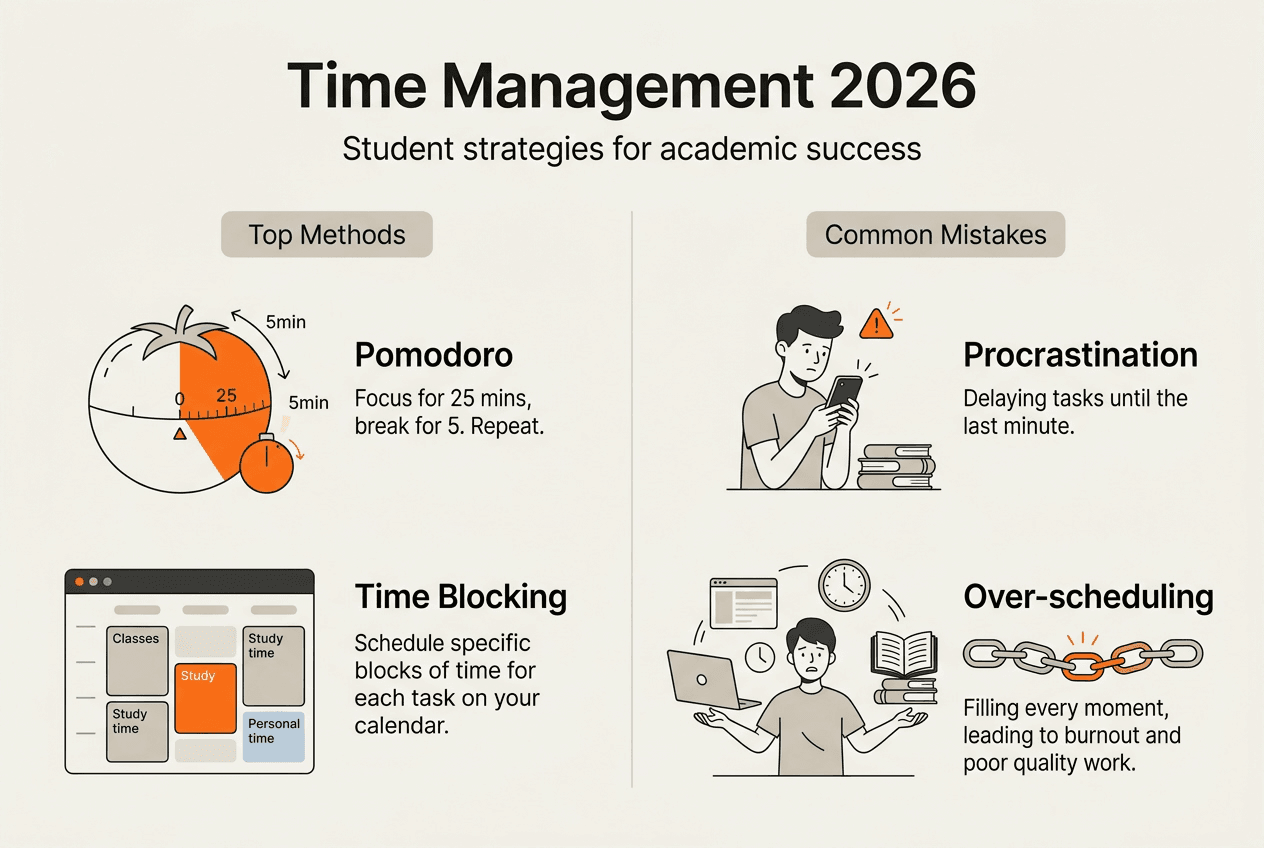
The Pomodoro Technique breaks work into focused intervals. You study intensely for 25 minutes, then take a five-minute break. After four cycles, take a longer 15 to 30 minute break. This method leverages how your brain maintains focus. Studies show the Pomodoro Technique can increase productivity by 20 to 30 percent by preventing mental fatigue. The regular breaks refresh your mind and maintain high-quality focus throughout study sessions.

Time blocking assigns specific tasks to dedicated time slots in your calendar. Instead of a vague “study tonight” plan, you schedule “Biology Chapter 5, 7 to 8 pm” and “Math problem set, 8:15 to 9:30 pm.” This specificity creates accountability. Research indicates time blocking reduces procrastination by 15 to 25 percent and improves task completion rates. You’re less likely to postpone work when you’ve committed to a specific time.
The Eisenhower Matrix categorizes tasks by urgency and importance. Divide your to-do list into four quadrants: urgent and important, important but not urgent, urgent but not important, and neither urgent nor important. Focus most energy on important tasks before they become urgent. Data shows using the Eisenhower Matrix improves study time allocation by 10 to 20 percent by eliminating time wasted on low-value activities.
Here’s how these strategies compare:
| Strategy | Key Feature | Primary Benefit | Productivity Impact |
|---|---|---|---|
| Pomodoro Technique | 25-minute focused intervals with breaks | Maintains mental freshness and prevents burnout | 20 to 30 percent increase |
| Time Blocking | Scheduled slots for specific tasks | Creates accountability and reduces procrastination | 15 to 25 percent reduction in delays |
| Eisenhower Matrix | Prioritization by urgency and importance | Improves focus on high-value activities | 10 to 20 percent better time allocation |
Pro Tip: Combine these methods for maximum impact. Use the Eisenhower Matrix to prioritize your weekly tasks, time blocking to schedule them, and Pomodoro intervals to execute focused study sessions.
Choosing the right technique depends on your specific challenges. If you struggle with maintaining focus, try Pomodoro. If procrastination is your enemy, time blocking provides structure. If you’re busy but unproductive, the Eisenhower Matrix reveals where your time actually goes.
Explore additional time management tools and techniques to build a personalized system. The time blocking method for students offers detailed implementation guidance. Remember, even the best strategy fails if distractions derail your focus. Learn how to stop getting distracted while studying to protect your productive time.
Challenges, common mistakes, and gender differences in time management
Even with solid strategies, students make predictable mistakes that undermine their efforts. Over-scheduling ranks among the most common errors. You fill every hour with tasks, leaving no buffer for unexpected events or mental rest. When anything goes wrong, your entire schedule collapses. Build flexibility into your plans by scheduling only 70 to 80 percent of available time.
Ignoring the reality of task duration causes chronic lateness. Most students underestimate how long assignments actually take. A “quick” essay becomes a three-hour project. Research for a presentation expands beyond your one-hour estimate. Track how long tasks actually require for a week. Use this data to create realistic schedules going forward.
Failure of self-regulation drives much academic procrastination. Studies confirm that failure of self-regulation negatively affects academic success by creating cycles of delay and rushed work. You know what needs doing but can’t force yourself to start. Breaking this pattern requires understanding your personal triggers and building systems that work with your tendencies, not against them.
Research reveals surprising gender differences in how time management affects academic outcomes. Data shows time management skills significantly improve academic results for male students while female students benefit through improved attitudes and fewer course failures. Both genders gain from better time management, but the benefits manifest differently. This finding suggests one-size-fits-all approaches miss important nuances.
Common time management pitfalls include:
- Treating all tasks as equally important
- Failing to account for energy levels throughout the day
- Skipping breaks to “save time” then burning out
- Not reviewing and adjusting your system regularly
- Copying someone else’s method without customizing it
Pro Tip: Schedule your most challenging tasks during your peak energy hours. If you’re sharpest in the morning, tackle difficult subjects then. Save routine tasks like organizing notes for low-energy periods.
“Time management isn’t about filling every minute with work. It’s about making intentional choices that align your actions with your goals.”
Another frequent mistake involves confusing busy with productive. You spend hours “studying” but retain little because you’re multitasking or working without clear objectives. Quality matters more than quantity. Focused 90-minute sessions with specific goals outperform vague four-hour marathons every time.
Discover effective productivity hacks that address common pitfalls. Smart productivity hacks for students offer targeted solutions for specific challenges. Refine your approach with insights from the time blocking method for students to avoid scheduling errors.
Practical steps for mastering time management and supporting students
Transforming time management knowledge into consistent practice requires a systematic approach. Follow these steps to build effective habits that stick:
- Conduct a time audit for one week, tracking how you actually spend each hour.
- Identify your three most important academic goals for the semester.
- Choose one primary time management technique that matches your learning style.
- Create a weekly template that includes classes, study blocks, and personal time.
- Break large projects into specific, manageable tasks with individual deadlines.
- Review and adjust your system every Sunday based on what worked and what didn’t.
Research confirms that time management planning and perceived instrumentality predict academic achievement in students across education levels. When you believe your planning actually helps, you’re more likely to maintain the habit. This perception builds through small wins. Complete one well-planned week and notice the reduced stress. That success motivates continued effort.
Breaking projects into smaller tasks makes overwhelming assignments manageable. Instead of “Write research paper,” create specific steps: choose topic, find five sources, create outline, write introduction, draft body paragraphs, revise, edit. Studies show breaking academic projects into specific tasks reduces procrastination and improves completion rates. Each small task feels achievable, building momentum toward the larger goal.
Prioritization separates successful students from struggling ones. Use the Eisenhower Matrix weekly. List all tasks, then categorize them. Focus most effort on important but not yet urgent items. This prevents last-minute crises. Important tasks include studying for upcoming exams, working on major projects with distant deadlines, and building foundational knowledge in challenging subjects.
Parents play a vital role in supporting student time management without micromanaging:
- Help create a dedicated study space free from distractions
- Discuss weekly goals and plans without imposing your own system
- Celebrate small wins when your student completes planned tasks
- Model effective time management in your own work and home life
- Provide accountability through regular check-ins, not constant monitoring
Buffer time prevents schedule collapse when unexpected events occur. Build 15 to 30 minute gaps between major tasks. This breathing room accommodates tasks that run long, provides mental transitions, and reduces stress when plans change. Realistic scheduling acknowledges that life rarely follows perfect plans.
Pro Tip: Create weekly self-tests covering material you’ve studied. Testing yourself reveals gaps in understanding while they’re still fixable and dramatically improves retention compared to passive review.
Master the fundamentals with a comprehensive guide on time management step by step. Apply these principles using proven methods for managing time effectively for success. Explore various time management tools and techniques to find what works best for your unique situation.
Enhance your learning with expert time management resources
You’ve learned why time management matters and discovered proven strategies that boost academic performance. Now take the next step by exploring comprehensive resources designed specifically for students like you. Our step-by-step time management guide walks you through building a personalized system from scratch. Discover the best time management tools and techniques to match your learning style and schedule demands. Access 7 effective time management tips you can implement immediately for quick wins. These resources transform knowledge into action, helping you achieve the grades and balance you deserve while reducing stress and building skills that serve you beyond school.
What about time management? frequently asked questions
How can students overcome procrastination when managing time?
Start with the smallest possible step to build momentum. If writing an essay feels overwhelming, commit to just writing one sentence. Use the Pomodoro Technique to make focused work feel less daunting. Address the emotional reasons behind procrastination, like fear of failure or perfectionism, rather than just fighting the behavior.
Are there different time management approaches for high school vs. college?
High school students benefit from more structured systems with parental support and daily check-ins. College students need greater flexibility and self-direction since they control their own schedules. The core principles remain the same, but college demands more personal responsibility and sophisticated prioritization as workload complexity increases.
How can parents effectively support their student’s time management?
Focus on teaching principles rather than controlling every decision. Help your student identify their goals and create systems that work for them. Provide accountability through weekly conversations about what’s working and what needs adjustment. Resist the urge to solve problems for them, instead guide them toward their own solutions.
What is the best time management technique for exam preparation?
Time blocking combined with spaced repetition yields the strongest results. Schedule specific study sessions for each subject weeks before exams, not just days. Review material multiple times with increasing intervals between sessions. Use the Eisenhower Matrix to prioritize subjects based on exam weight and your current mastery level.
How do breaks and buffer times improve study productivity?
Breaks prevent mental fatigue that degrades focus and retention. Your brain needs recovery time to consolidate information and maintain peak performance. Buffer times reduce stress by accommodating the reality that tasks often take longer than estimated. Together, they create sustainable study habits that prevent burnout while maintaining high-quality work.