
Stop Wasting Time on Distractions: 5 Steps to Build Your Personal Student “Focus Ecosystem”
How many times have you sat down to study, only to realize forty-five minutes have passed and you’ve done nothing but scroll through TikTok or rearrange your highlighters?
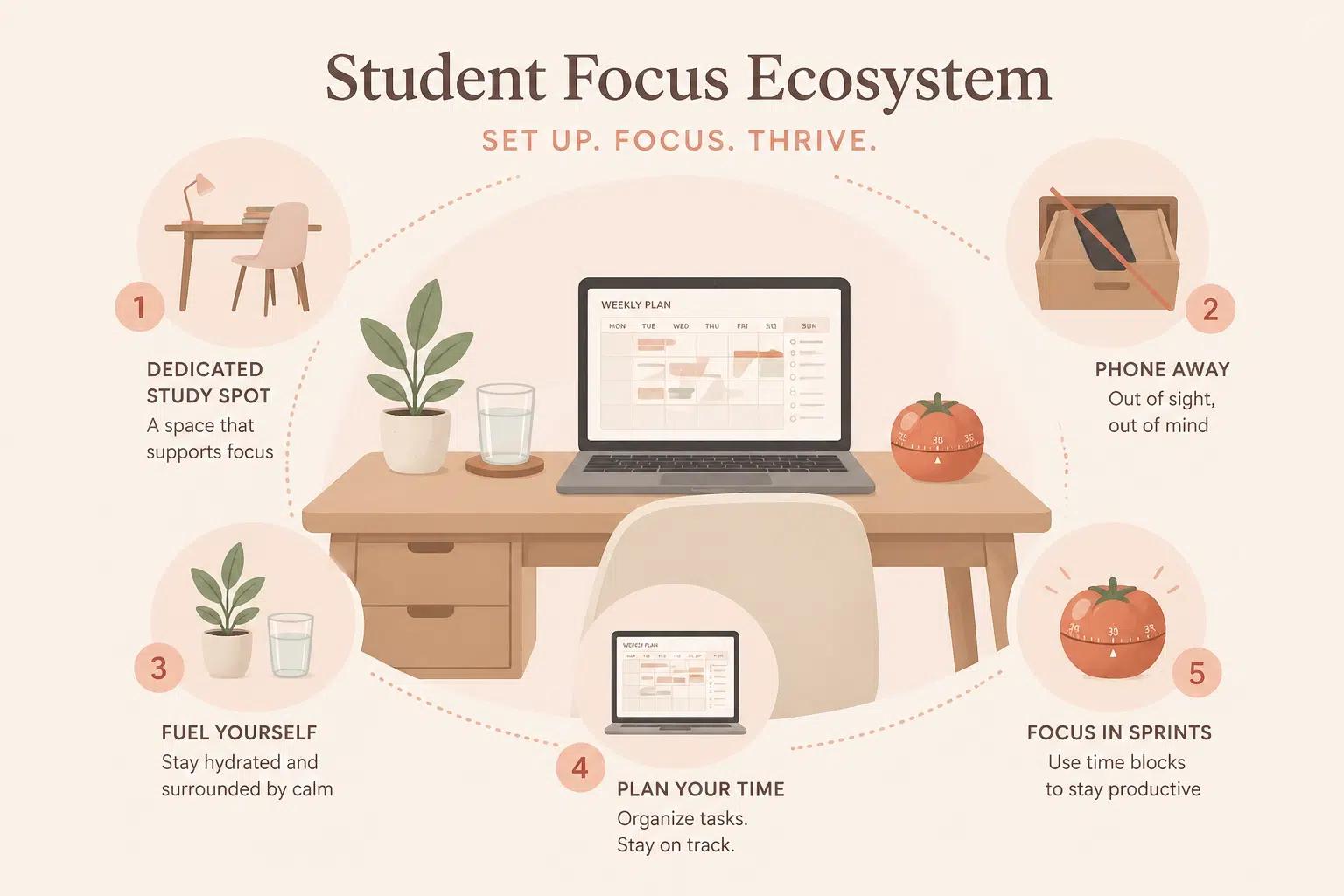
Do you feel like your brain is constantly fighting against your environment? You aren’t alone. Most students treat focus like a fluctuating emotion: something that either "hits" them or doesn't. But the truth is that high-level concentration is a designed outcome. To stop wasting time, you need to stop relying on willpower and start building a Focus Ecosystem.
A Focus Ecosystem is a combination of your physical space, digital boundaries, and mental routines that work together to make deep work the path of least resistance. When your environment is optimized, you don't have to choose to focus; your surroundings choose it for you.
Ready to become the most productive version of yourself? Here are five essential steps to build a system that protects your time and enhances your grades.
Step 1: Designate Your Power Zone
Your brain is a master of association. If you study in bed, your brain thinks it's time to sleep. If you study at the kitchen table while your family chats, your brain thinks it's time to socialize. To trigger an immediate state of flow, you must create a dedicated Power Zone.
This doesn't require a home office. It just requires consistency and environmental cues. When you enter this specific space, your brain should receive a signal that says, "It’s time to work."
- Establish a "Single-Use" Space: Use a specific desk or even a specific chair at the library that is reserved only for deep work. Never browse social media or eat meals here.
- Curate Your Sensory Input: Use natural lighting whenever possible to keep your energy levels high. If you're working in a noisy environment, use noise-canceling headphones or brown noise to create an auditory barrier.
- Optimize Your Visual Field: Clear the clutter. A messy desk creates "visual noise" that competes for your attention. Keep only the essentials: your laptop, your Notion organizer, and a glass of water: within your immediate sight.
- Leverage Color Psychology: Did you know that certain colors can actually improve your concentration? Incorporating soft blues or greens into your workspace can promote calm and focus. You can learn more about how to use these in our guide on color psychology for students.

Step 2: Neutralize Digital Interference
We often think of distractions as something that happens to us, but most digital distractions are invited. Your smartphone is a masterpiece of engineering designed to steal your attention. To build a true focus ecosystem, you have to create a friction-filled path between you and your apps.
If you can see your phone, you are losing cognitive power. Research shows that even having a smartphone on the desk: even if it's turned off: reduces your brain's ability to solve problems because a portion of your mind is actively working to ignore it.
- Implement the "Out of Sight" Rule: Place your phone in another room or inside a drawer. If you don't have to see it, you won't feel the "phantom" urge to check it.
- Use App Blockers Strategically: Tools like the Forest App can turn focus into a game. By "planting" a virtual tree that dies if you leave the app, you create a tangible consequence for distraction. Check out our detailed walkthrough on how to use the Forest App for studying.
- Close Non-Essential Tabs: Before starting a session, close every browser tab that isn't directly related to the task at hand. If you find a "rabbit hole" article you want to read later, save it to a "Read Later" list rather than leaving it open as a distraction.
- Disable All Desktop Notifications: Your laptop shouldn't be allowed to interrupt you. Turn on "Do Not Disturb" mode to ensure that text messages or email alerts don't break your concentration mid-sentence.
Step 3: Implement A Rhythmic Workflow
Focus is a muscle, and like any muscle, it gets tired. You cannot expect yourself to maintain 100% concentration for four hours straight. Instead of trying to "power through," you should work with your brain’s natural rhythms using a Pulse Method.
The most effective way to do this is the Pomodoro Technique. By breaking your work into intense bursts followed by short, scheduled breaks, you prevent burnout and keep your "focus stamina" high throughout the day.
- Set a Hard Timer: Use a physical or digital timer for 25 minutes of uninterrupted work. During this time, your only goal is the task in front of you.
- Take "Active" Breaks: When the timer goes off, get up. Move your body, stretch, or grab a snack. Avoid checking your phone during these 5-minute breaks, as "digital resets" often lead to unintentional 30-minute scrolling sessions.
- Batch Your Tasks: Group similar activities together. For example, do all your math practice problems in one Pomodoro block and all your essay outlining in another. This prevents the "context switching" tax that drains your mental energy.
- Track Your Progress: Keep a log of how many "focus pulses" you complete each day. Seeing a visual representation of your work helps build momentum and makes the process feel rewarding.
Step 4: Systematize Your Workflow With Digital Tools
The biggest killer of focus is ambiguity. If you sit down at your desk and have to spend twenty minutes figuring out what you're supposed to be doing, you've already exhausted your initial wave of motivation. A Focus Ecosystem requires a centralized "Source of Truth" where all your tasks, deadlines, and notes live.
This is where digital organization becomes your best friend. Instead of scattered sticky notes, use a system that streamlines your thinking and keeps your priorities front and center.
- Use a Dynamic Planner: A digital planner allows you to map out your week in advance. When you know exactly what is happening at 2:00 PM on a Tuesday, you eliminate the "decision fatigue" that leads to procrastination.
- Leverage Notion Templates: Our Notion College Search Template + Timeline is designed to take the guesswork out of complex projects. By having a pre-built structure for your tasks, you can jump straight into the work instead of the organizing.
- Digitize Your Notes: Moving toward an aesthetic, digital note-taking system allows you to search for information instantly. This reduces the frustration of looking for lost papers, which is a major "focus leak."
- Centralize Your Deadlines: Use a master calendar that integrates your academic life with your personal growth goals. This holistic view helps you see where you have "white space" for deep work and where you need to scale back.

Step 5: Conduct A Weekly Focus Audit
Your Focus Ecosystem isn't a "set it and forget it" project. As your classes get harder or your schedule changes, your system will need to evolve. To maintain high performance, you must become a scientist of your own productivity.
Every Sunday, take ten minutes to review your previous week. What worked? Where did you lose focus? What was the biggest time-waster?
- Identify Your Peak Energy Times: Are you a morning lark or a night owl? Schedule your most difficult tasks (like essay writing or high-level problem solving) during your natural energy peaks.
- Refine Your Environment: If you found yourself getting distracted by the window, move your desk. If your chair is making your back ache, find a better solution. Minor physical adjustments can lead to major productivity gains.
- Audit Your Distractions: Write down the top three things that pulled you away from your work last week. Is it a specific app? A specific friend? A specific habit? Create a proactive plan to neutralize those specific triggers next week.
- Celebrate Your Wins: Productivity isn't just about doing more; it's about feeling better. Acknowledge when you’ve successfully guarded your time. This positive reinforcement makes it easier to stick to the system long-term.

Join The Community
Building a focus ecosystem is easier when you don't do it alone. At Learning With Angie, we provide the tools, templates, and tested advice to help you navigate the full student experience: from acing your finals to managing your first budget.
Ready to enhance your workflow and reclaim your time? Join the community today by signing up for our biweekly resources. We’ll send practical tips, study techniques, and exclusive digital freebies straight to your inbox to keep you on track.
Don't let another day slip away into a blur of distractions. Start small, build your ecosystem, and watch your potential unlock. Ready to become the student you’ve always wanted to be? Let's get to work!
Want a head start? The Ultimate Student Planner in my shop was made for exactly this — it’ll save you a ton of time.