
Why reviewing notes boosts learning and academic success
Most students believe rereading notes is the best way to study, but research reveals a surprising truth: passive review creates an illusion of knowledge without genuine retention. Active review strategies outperform passive rereading by up to 50%, transforming how your brain stores and retrieves information. Understanding why and how to review notes effectively can dramatically improve your grades and long-term learning. This guide reveals proven techniques that turn note review from wasted time into your most powerful study tool.
Key Takeaways
| Point | Details |
|---|---|
| Active recall boosts retention | Retrieving information without notes strengthens memory far more than passive rereading. |
| Handwritten notes outperform typed | Reviewing handwritten notes yields stronger recall than reviewing typed notes. |
| Avoid passive rereading | Rereading creates familiarity without building genuine retrieval strength. |
| Structured review boosts scores | Structured review methods raise retention by 30 to 50 percent and improve exam scores. |
Why passive rereading falls short
You sit down with your notes, read through them carefully, and feel confident you understand the material. The content looks familiar, the concepts make sense, and you close your notebook feeling prepared. Then test day arrives, and you struggle to recall what seemed so clear during your review session. This frustrating experience reveals the fundamental problem with passive rereading: it creates familiarity without building genuine retrieval strength.
Passive rereading tricks your brain into confusing recognition with recall. When you see information again, your mind registers it as known, generating a false sense of mastery. This illusion feels productive but does nothing to strengthen the neural pathways required for independent retrieval during exams. Your brain essentially says “I’ve seen this before” without proving it can produce the information when prompted.
The inefficiency runs deeper than just wasted time. Passive review promotes surface-level learning where you grasp main ideas without understanding connections, applications, or nuances. You might recognize a concept when you see it but cannot explain it, apply it to new situations, or distinguish it from similar ideas. This shallow processing leaves you vulnerable when test questions require analysis, synthesis, or application rather than simple recognition.
Active recall works differently by forcing your brain to retrieve information without cues. This effortful process strengthens memory pathways far more effectively than passive exposure. When you quiz yourself or explain concepts without looking at your notes, you engage in retrieval practice that fundamentally changes how information is stored. The struggle to remember actually builds stronger, more accessible memories.
Common mistakes compound these problems:
- Rereading entire notebooks without pausing to test yourself on key concepts
- Highlighting or underlining during review instead of generating content from memory
- Reviewing in the same order every time, allowing position cues to substitute for genuine recall
- Skipping difficult sections because they feel uncomfortable, leaving knowledge gaps unaddressed
As one researcher notes: “The effort required for retrieval practice is precisely what makes it effective. Easy review feels productive but builds weak memories.”
How active note review improves retention and grades
Active review strategies fundamentally change how your brain processes and stores information from your notes. When you engage in retrieval practice by testing yourself on material, you force your brain to reconstruct knowledge rather than simply recognize it. This reconstruction process strengthens neural connections and makes future retrieval easier and more reliable. Structured review methods improve retention by 30-50% and increase academic scores by 17% compared to passive study approaches.

Spaced repetition takes this benefit further by scheduling reviews at increasing intervals. Instead of cramming all review into one marathon session, you revisit material after one day, then three days, then a week, then two weeks. Each successful retrieval strengthens the memory and extends how long you can go before needing another review. This approach aligns with how your brain naturally consolidates information, fighting the forgetting curve efficiently.
The medium matters as much as the method. Handwritten notes reviewed lead to higher achievement than typed notes because the physical act of writing engages different cognitive processes. When you write by hand, you must process and synthesize information rather than transcribing verbatim. This initial deeper processing creates richer memory traces that active review can then strengthen. Typing often becomes automatic, bypassing the cognitive engagement that makes review effective.
Pro Tip: Schedule three review sessions for each set of notes: same day within 24 hours, after 2-3 days, and after one week. This spacing pattern maximizes retention while minimizing total study time.
The data clearly shows the performance difference between review approaches:
| Review Method | Retention After 1 Week | Retention After 1 Month | Test Score Improvement |
|---|---|---|---|
| Passive rereading | 35-40% | 15-20% | Minimal (2-5%) |
| Active recall with self-quizzing | 70-80% | 50-60% | Significant (15-20%) |
| Spaced repetition with retrieval practice | 85-90% | 70-75% | Substantial (20-25%) |
| Combined handwritten notes + active review | 90-95% | 75-85% | Maximum (25-30%) |
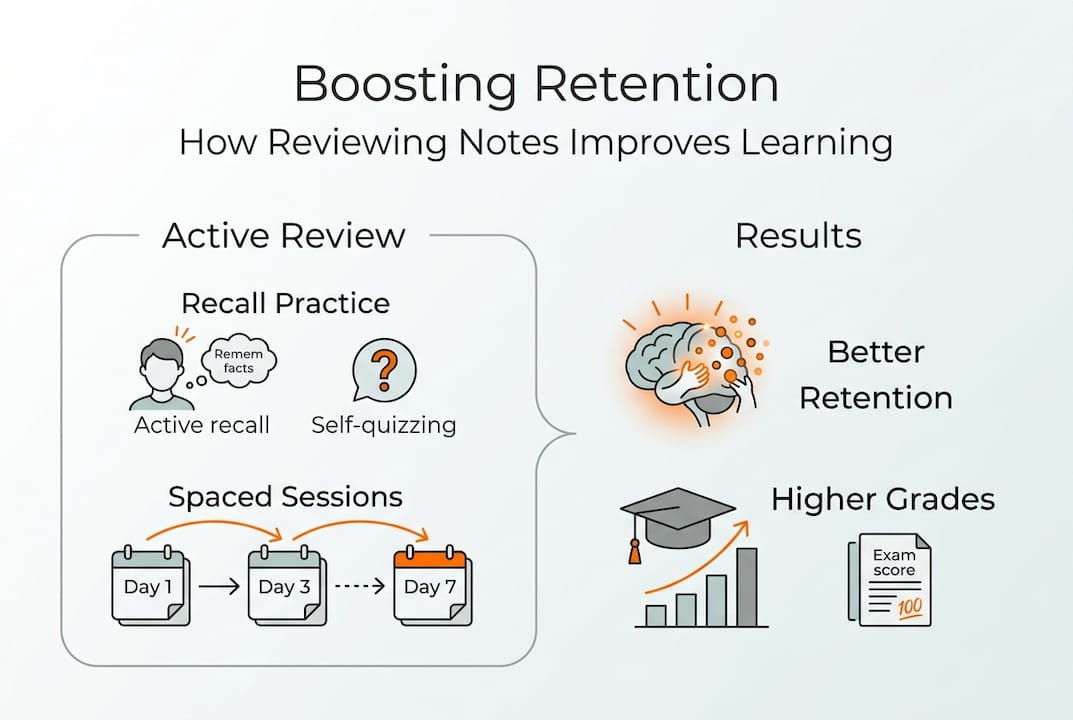
These improvements translate directly to academic performance. Students who implement effective note taking techniques combined with active review consistently outperform peers who rely on passive methods. The grade difference often spans a full letter grade or more, particularly in courses requiring conceptual understanding rather than pure memorization.
Active review also builds metacognitive awareness about what you actually know versus what feels familiar. When you test yourself and struggle with a concept, you identify exactly where to focus additional study effort. This targeted approach prevents wasting time reviewing material you already know while leaving gaps in your understanding. The self-assessment component makes your study time dramatically more efficient and effective.
Techniques to review notes effectively
Transforming your note review from passive to active requires specific strategies that force retrieval and deepen understanding. These proven techniques work across subjects and learning styles:
-
Self-quizzing without looking at notes: Cover your notes and write out everything you remember about a topic. Then check your notes to identify what you missed or got wrong. Focus your next review session on those gaps.
-
The Feynman technique: Explain concepts aloud as if teaching someone with no background knowledge. Use simple language and analogies. When you get stuck or use jargon you cannot explain, that reveals incomplete understanding requiring deeper review.
-
Cornell method recall column: If you took notes using the Cornell system, cover the main notes and use only the cue column to trigger retrieval. Write or speak full explanations of each cue before checking your detailed notes.
-
Question generation: Turn your notes into questions, then answer them days later without looking. Create questions at different cognitive levels: recall facts, explain processes, apply concepts to new scenarios, and compare related ideas.
-
Concept mapping from memory: Draw diagrams showing how ideas connect without referencing your notes. Include relationships, hierarchies, and examples. Compare your map to your notes to find missing connections.
Pro Tip: After self-testing, immediately drill the concepts you missed or struggled with. Research shows focused practice on weak spots produces faster improvement than reviewing everything equally.
Different review strategies work better for different learning goals and course types:
| Review Strategy | Best For | Strengths | Time Investment |
|---|---|---|---|
| Self-quizzing | Factual recall, definitions, formulas | Quick, identifies gaps, flexible | Low to medium |
| Feynman technique | Conceptual understanding, complex processes | Deep comprehension, reveals weak spots | Medium to high |
| Spaced flashcards | Vocabulary, dates, formulas, quick facts | Efficient long-term retention | Medium |
| Practice problems | Math, science, analytical courses | Application skills, procedural fluency | High |
| Summary writing | Essay courses, reading-heavy subjects | Synthesis, main idea extraction | Medium |
Your motivation and the course type significantly affect which methods work best. Active recall with self-quizzing and the Feynman technique outperforms passive study across most subjects, but courses requiring problem-solving skills benefit more from practice problems than pure recall exercises. Match your review method to your learning goals for maximum efficiency.
Adapt these techniques to your schedule and preferences. Some students prefer longer, less frequent review sessions while others benefit from daily 15-minute reviews. The key is consistency and active engagement, not the specific schedule. Experiment to find what maintains your motivation while building genuine understanding. Combining multiple techniques often produces better results than relying on a single approach, as different methods strengthen different aspects of memory and understanding.
For comprehensive skill development, explore best note taking techniques and understand the role of note taking in your overall learning strategy.
Practical tips for maintaining a successful note review habit
Building an effective review routine requires more than knowing the right techniques. You need systems that fit your schedule, maintain motivation, and adapt to different courses. Start by creating a review calendar that aligns with your course demands and assignment deadlines. Block specific times for note review just as you would for attending class, treating these sessions as non-negotiable appointments with your academic success.
Different courses require different review frequencies and intensities. Math and science courses with cumulative content benefit from daily brief reviews that keep problem-solving skills sharp. Reading-heavy courses like history or literature work better with longer weekly sessions that allow for synthesis and connection-making. Adjust your schedule based on upcoming exams, with review frequency increasing as test dates approach.
Digital tools can enhance handwritten note review without replacing its cognitive benefits. Use flashcard apps like Anki or Quizlet to create self-tests based on your handwritten notes. These platforms use spaced repetition algorithms that automatically schedule reviews at optimal intervals. The combination gives you the deep processing of handwriting with the efficiency of digital spacing.
Pro Tip: After each study session, spend five minutes creating digital quiz questions from that day’s handwritten notes. This immediate processing strengthens initial encoding while building your review tool for later.
Regularly identify and target weak areas to make review time more efficient. After each self-test, mark concepts you struggled with and create a priority list for your next session. Spend 70% of your review time on difficult material and 30% on easier content to maintain it. This targeted approach produces faster improvement than reviewing everything equally, as motivation is a key predictor of retention and seeing progress in weak areas boosts motivation.
Key habits for sustainable review routines:
- Start review sessions within 24 hours of taking notes while information is still fresh
- Use a mix of techniques to prevent boredom and engage different memory systems
- Track your progress to maintain motivation and identify patterns in what works
- Study in varied locations to prevent environmental cues from becoming memory crutches
- Form study groups for occasional collaborative review that exposes you to different perspectives
- Take breaks during longer sessions using the Pomodoro technique (25 minutes focused work, 5-minute break)
AI-assisted tools are emerging as powerful supplements to traditional review. ChatGPT and similar platforms can generate practice questions from your notes, explain concepts you find confusing, or quiz you on material. Use these tools to augment rather than replace active recall. The technology works best when you first attempt retrieval yourself, then use AI to fill gaps and deepen understanding.
Maintaining consistency matters more than perfection. Missing a scheduled review session occasionally will not derail your learning, but abandoning the routine will. When life gets busy, do a shorter review rather than skipping entirely. Even 10 minutes of active recall provides significantly more benefit than passive rereading or no review at all. Build flexibility into your system so it survives the inevitable disruptions of student life.
Explore resources to master your study skills
Reviewing notes effectively represents just one component of academic success. The techniques you have learned here work best when integrated into a comprehensive approach to learning that includes strategic planning, effective test preparation, and collaborative study. Expanding your skill set across multiple dimensions creates synergies where each practice reinforces the others, multiplying your academic results.
Our site offers detailed guides that complement your note review practice. Discover effective learning strategies that help you absorb material faster and retain it longer. When exam season arrives, our test taking strategies guide shows you how to apply your reviewed knowledge under pressure for maximum performance. Collaborative learning amplifies individual study through creating study groups that provide accountability, diverse perspectives, and social support.
These resources work together to transform your academic performance. Start with one area that challenges you most, implement the strategies, then expand to other skills as you build confidence and see results.
FAQ
How often should I review my notes to maximize retention?
Review notes in spaced intervals for best retention: same day within 24 hours, then after one day, three days, one week, and two weeks. Frequent early reviews reduce forgetting by catching information before it fades from memory. This spacing pattern aligns with your brain’s natural consolidation process, strengthening memories each time you successfully retrieve them.
Is handwriting notes really better than typing them?
Handwriting enhances conceptual understanding and memory consolidation compared to typing because it requires processing information rather than transcribing verbatim. The physical act of writing engages different brain regions and forces you to synthesize ideas in real time. Typing can be faster for capturing lecture content but often results in superficial processing that makes later review less effective.
What are simple active review techniques I can start using right now?
Use self-quizzing by covering your notes and writing what you remember, then checking for gaps. Summarize concepts aloud in your own words without looking at your notes, or teach material to a peer using the Feynman technique. These note taking methods and best note taking techniques start small but produce significant memory gains when practiced consistently.