What is note taking with examples: a 2026 student guide
Note taking transforms how students learn and succeed academically. It actively engages your brain, helping encode information for better recall during exams and assignments. Many students struggle with ineffective methods that limit retention despite hours of effort. This guide defines note taking, explains its cognitive benefits, and provides proven techniques with examples to help you and your parents support stronger study habits and higher grades.
Key takeaways
| Point | Details |
|---|---|
| Definition and purpose | Note taking actively records key information from lectures and materials to boost memory and comprehension. |
| Cognitive benefits | Active note taking improves retention by 30-34% compared to passive listening. |
| Effective methods | Cornell, mapping, and charting methods suit different learning styles and subjects. |
| Common mistakes | Verbatim transcription and failing to review notes undermine learning potential. |
| Parental support | Parents can boost student GPA by 0.3 to 0.5 points through structured study support. |
Introduction to note taking: definition and importance
Note taking means actively recording essential concepts, facts, and connections from lectures, textbooks, or videos. It differs from passive listening by forcing your brain to process and organize material in real time. This cognitive engagement transforms information into memory traces you can retrieve later.
Understanding the role of note taking reveals why this skill matters for academic success. Research shows that note taking engages cognitive processes that improve retention and exam scores by strengthening neural pathways. You encode information more deeply when writing or typing compared to passive activities like highlighting or rereading.
The distinction between transcription and active note taking determines your learning outcomes. Transcription copies words without processing meaning, while active note taking summarizes, connects ideas, and creates your own organizational structure. This mental work builds understanding and memory simultaneously.
Effective note taking acts as a bridge between hearing information and truly understanding it, creating pathways for future recall.
Consider these benefits:
- Enhanced focus during class by giving your brain a concrete task
- Personalized study materials reflecting your understanding and learning gaps
- Improved exam performance through repeated exposure and active processing
- Reduced study time by creating organized, accessible reference materials
Students who master note taking gain confidence and control over their learning journey. Parents notice improved grades, better study habits, and reduced academic stress when their children develop these skills.
How note taking supports learning and memory
Your brain encodes information more effectively when you actively process it during note taking. This happens through three cognitive stages: encoding, storage, and retrieval. Writing forces you to select important points, translate them into your words, and organize them logically.
Encoding occurs when you decide what matters and how to capture it. This decision making strengthens memory formation compared to passive listening. Your brain creates multiple connections by linking new information to existing knowledge as you write.
Storage improves through organization and structure. Notes create external memory aids you can revisit, reinforcing neural pathways through repetition. Active note taking boosts retention by 30-34% because it engages working memory and attention systems simultaneously.
Retrieval becomes easier when you review notes regularly. Each review session reactivates memories, moving information from short term to long term storage. This process, called consolidation, happens more efficiently with structured notes than scattered highlights or vague recollections.
The act of writing itself creates motor memory traces that complement verbal and visual memory systems, giving you multiple retrieval pathways.
Maximize these benefits by:
- Taking notes in your own words rather than copying verbatim
- Reviewing within 24 hours to reinforce encoding
- Summarizing key points after class to consolidate learning
- Testing yourself using notes to practice retrieval
Scientific evidence from studies on note taking effectiveness confirms that students who actively engage with material through note taking outperform passive learners. This advantage compounds over time, creating stronger foundations for advanced coursework and standardized tests.
Common note taking methods with detailed examples
Choosing the right method matches your learning style and subject matter. Different techniques offer unique advantages for organizing and retaining information. Experimenting helps you discover what works best for each class.
The Cornell method divides pages into three sections: a narrow left column for cues, a wide right column for notes, and a bottom section for summaries. During lecture, write main ideas and details in the notes column. Afterward, create questions or keywords in the cue column. Summarize the entire page at the bottom. This structure supports active review and self testing, improving exam performance through built in retrieval practice.

Mapping or concept mapping creates visual diagrams showing relationships between ideas. Start with a central concept in the middle, then branch out to related topics and subtopics. Use arrows, colors, and spatial arrangement to show connections. Research indicates mapping improves recall accuracy by 20% compared to linear notes by leveraging visual memory. This method excels for complex subjects like biology, literature analysis, or historical cause and effect relationships. Learn more about various methods of note taking to expand your toolkit.
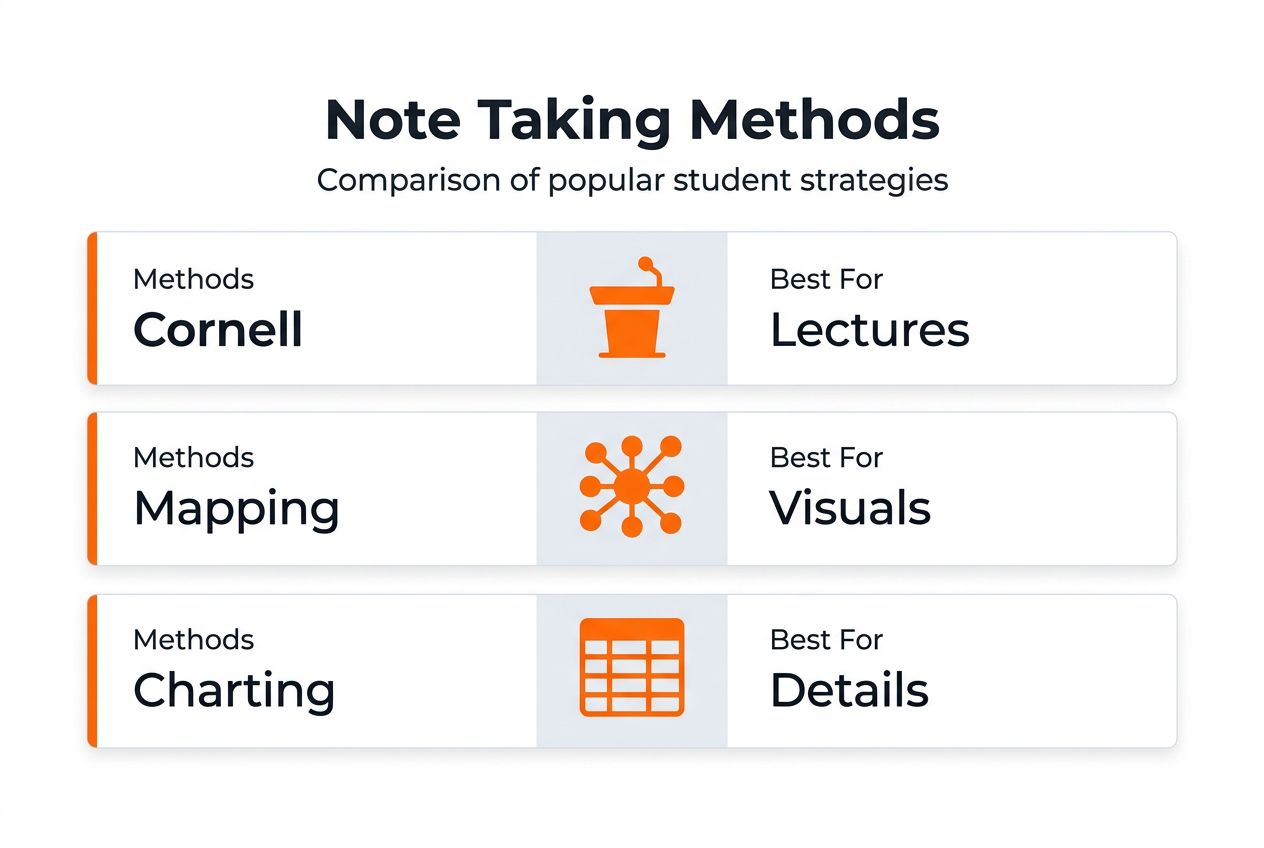
The charting method organizes information into table format with columns for categories and rows for examples or details. This works brilliantly for comparing historical periods, scientific classifications, or literary characters. Create column headers before class if you know the topic, then fill cells during lecture. Charts make patterns visible and simplify review.
| Method | Best For | Key Benefit |
|---|---|---|
| Cornell | Lecture heavy courses | Structured review and self testing |
| Mapping | Complex relationships | Visual memory and connections |
| Charting | Comparative information | Pattern recognition and organization |
| Outlining | Hierarchical content | Logical flow and prioritization |
Handwritten notes engage motor memory and reduce digital distractions, but digital notes offer search functions and easy reorganization. Many students combine both: handwriting during class for better encoding, then digitizing for long term storage and searchability.
Pro Tip: Match your note taking method to the subject structure. Use mapping for interconnected concepts, charting for factual comparisons, and Cornell for lecture based courses requiring frequent review.
Common misconceptions and mistakes in note taking
Many students believe writing every word improves learning, but this misconception undermines comprehension. Verbatim transcription occupies your brain with copying rather than understanding. Research shows verbatim note takers score 25% lower on application questions compared to students who summarize in their own words.
The transcription trap happens when laptops enable fast typing without thinking. Your fingers move quickly, but your brain processes minimally. This creates extensive notes with shallow understanding, leaving you unprepared despite pages of content.
Another critical mistake involves taking notes without reviewing them. Notes lose value when left untouched until exam week. Regular review transforms notes from documentation into learning tools by reinforcing memories and revealing gaps in understanding.
Common errors include:
- Copying slides or textbooks verbatim without processing meaning
- Failing to organize notes by topic or priority
- Skipping post class summaries that consolidate learning
- Neglecting to test yourself using your notes
- Using note taking as a substitute for active engagement during class
Poor time allocation compounds these problems. Students spend hours creating beautiful notes but minimal time reviewing or applying them. This imbalance wastes effort on low value activities while neglecting high impact strategies.
Explore good note taking techniques to avoid these pitfalls. Understanding what not to do matters as much as learning effective methods.
Pro Tip: After each class, spend five minutes writing a three sentence summary of the main points without looking at your notes. This active recall strengthens memory far more than passive rereading.
Practical applications: how to review, organize, and use notes
Transforming notes into study tools requires systematic review and organization. Active review techniques significantly outperform passive rereading by engaging retrieval processes. Data suggests active reviewing can double information retention compared to simple rereading.
Implement this numbered process for effective note use:
- Review notes within 24 hours while memory remains fresh
- Organize by themes, highlighting connections between topics
- Create summary sheets condensing key concepts onto single pages
- Generate practice questions from your notes
- Test yourself regularly without looking at answers
- Identify weak areas requiring additional study
Organizing notes by priority helps focus limited study time on high value material. Color code by importance, create separate sections for definitions versus applications, and link related concepts across different lectures. This structure makes review sessions more efficient and targeted.
| Review Technique | Retention Impact | Time Investment |
|---|---|---|
| Passive rereading | Low (10-20% improvement) | High |
| Summarizing | Medium (30-40% improvement) | Medium |
| Self testing | High (50-70% improvement) | Medium |
| Teaching others | Very high (80-90% improvement) | High |
Self testing using your notes builds exam readiness by simulating test conditions. Cover answers and quiz yourself on definitions, processes, or applications. This retrieval practice strengthens memory more than any other study method.
For exam preparation, create condensed review sheets from your organized notes. These one page summaries force you to identify truly essential information and provide quick reference materials before tests. The creation process itself enhances learning through active synthesis.
Discover comprehensive strategies in our study skills 2025 guide covering note organization, review schedules, and application techniques. Effective notes become powerful when combined with proven study methods.
How parents can support students in developing better note taking skills
Parents play a crucial role in establishing effective note taking habits. Your involvement significantly impacts academic outcomes, with studies showing parental support can raise student GPA by 0.3 to 0.5 points through structured study assistance. This support works best when focused on building independence rather than micromanaging.
Start by providing appropriate tools and environments. Ensure your student has quality notebooks, pens, or devices suited to their note taking preferences. Create a dedicated, quiet study space free from distractions where note review becomes routine. Physical environment shapes study habits more than most parents realize.
Encourage regular review sessions by building them into daily schedules. Ask your student to explain concepts from their notes, which reinforces learning through teaching. This accountability helps establish consistency without feeling punitive.
Effective parental strategies include:
- Discussing note taking methods to find what fits your student’s learning style
- Modeling organized record keeping in your own work or household management
- Celebrating improvements in note quality and study habits
- Providing gentle reminders about review schedules without nagging
- Connecting note taking skills to long term success and independence
Avoid taking over the process. Your role involves guiding, not doing the work. Review good note taking examples together to illustrate effective techniques, then let your student develop their own system. Autonomy builds confidence and ownership.
Set reasonable expectations based on age and academic level. High school students need more sophisticated organizational systems than middle schoolers. Adjust your support as skills develop, gradually reducing involvement as independence grows.
Explore resources on good note taking techniques and the role of digital note taking for students to understand modern approaches. Technology offers both opportunities and challenges parents should recognize.
Pro Tip: Schedule a weekly note review session where your student teaches you something they learned. This combines accountability, retrieval practice, and quality time while strengthening academic skills.
Enhance your learning with proven study skills resources
Mastering note taking represents just one component of academic success. Our comprehensive study skills 2025 guide expands beyond note taking into time management, exam strategies, and productivity techniques tailored for modern students. These resources help you build complete learning systems rather than isolated skills.
Discover effective learning strategies that complement your note taking practice. Understanding how memory works, applying spaced repetition, and developing metacognitive awareness transforms average students into confident learners. These evidence based approaches deliver measurable grade improvements.
Our detailed guides on good note taking techniques provide additional examples, templates, and troubleshooting advice. Access these free resources to refine your skills and overcome specific challenges you face in different courses.
FAQ
What is the best method of note taking for visual learners?
Visual learners benefit most from mapping or concept mapping methods that use diagrams, colors, and spatial organization to show relationships between ideas. These techniques leverage visual memory systems, making recall easier through mental images of note layouts. Explore specific study techniques for visual learners to optimize your approach.
How often should students review their notes for best retention?
Students should review notes within 24 hours after class to reinforce initial encoding, then schedule weekly reviews to maintain long term retention. Spacing review sessions over time moves information into long term memory more effectively than cramming. This spaced repetition creates stronger, more durable memories.
Are handwritten notes better than digital notes for studying?
Handwritten notes improve memory through active motor engagement and reduce digital distractions, but digital notes offer superior organization and searchability. Research suggests handwriting enhances encoding, while digital formats excel for storage and review. Learn more about the role of digital note taking for students to make informed choices.
Can note taking methods work for all subjects equally?
Different subjects benefit from tailored note taking approaches based on content structure. Math and science often require problem solving notes with worked examples, while humanities benefit from conceptual maps showing themes and relationships. Adapting your method to subject demands maximizes effectiveness and retention.
How can students fix poorly organized notes from earlier in the semester?
Reorganize existing notes by creating summary sheets that consolidate key concepts by theme rather than chronological order. This reorganization process itself enhances learning through active review and synthesis. Add connections between topics, fill gaps with textbook references, and create self test questions from the reorganized material.