How to Build Study Habits for Success in 2025
Most students make big study plans for a new year but never see real improvement. The wild part is that tracking your habits for just one week often reveals more about your learning struggles than an entire semester of grades. Surprised? It turns out the secret to academic success in 2025 is not just studying harder, but getting brutally honest about your routine before you even set a single goal.
Table of Contents
- Step 1: Assess Your Current Study Routine
- Step 2: Set Clear and Achievable Study Goals
- Step 3: Create a Structured Study Schedule
- Step 4: Develop Engaging Study Techniques
- Step 5: Monitor and Adjust Your Study Habits
- Step 6: Reflect on Your Achievements and Set New Goals
Quick Summary
| Key Point | Explanation |
|---|---|
| 1. Assess Your Current Study Routine | Track your study behaviors for a week to gain insights into your habits and distractions. |
| 2. Set Clear and Achievable Study Goals | Break down larger academic targets into realistic, measurable goals using the SMART framework. |
| 3. Create a Structured Study Schedule | Develop a weekly study schedule that aligns with your commitments and personal energy levels. |
| 4. Develop Engaging Study Techniques | Implement active learning strategies to make studying interactive and enjoyable for better retention. |
| 5. Monitor and Adjust Your Study Habits | Continuously review and refine your study methods based on what works best for you. |
Step 1: Assess Your Current Study Routine
To build successful study habits in 2025, you need to understand where you currently stand. Think of this step like taking a snapshot of your existing study routine. Most students skip this crucial part and jump right into planning, but knowing your starting point is key to creating meaningful change.
Start by tracking your current study behaviors for one full week. Grab a simple notebook or use a digital tracking app to record exactly how you spend your study time. Write down details like when you study, where you study, how long you study, and what distractions interrupt you. Be honest with yourself. Are you studying in your bedroom with your phone nearby? Do you start studying and then suddenly find yourself scrolling social media? These observations matter.
After tracking your week, analyze your data objectively. Look for patterns in your study routine. Maybe you discover you’re most productive in the morning but you’re currently studying late at night. Or perhaps you realize you get distracted every 20 minutes and need better focus strategies. Check out our guide on applying atomic habits to studying for more insights on understanding your current behavioral patterns.
The goal of this assessment isn’t to make you feel bad about your current habits. Instead, it’s about creating a clear, judgment free map of your current study landscape. By understanding your existing routine, you’ll be able to make targeted, specific improvements in the upcoming steps of building your study strategy for 2025.
Successful completion of this step means you have a detailed, week long record of your current study habits, complete with honest observations about your strengths and challenges. This baseline will be your foundation for transforming how you approach learning and academic success.
Here is a checklist to help you verify that you’ve successfully completed each key step in developing effective study habits for 2025.
| Step | Completion Criteria |
|---|---|
| Assess Your Current Study Routine | Detailed week-long record tracking study times, locations, durations, and distractions |
| Set Clear and Achievable Study Goals | Written list of 3-5 specific, measurable, and realistic study goals |
| Create a Structured Study Schedule | Weekly plan with specific study times aligned to subject and personal commitments |
| Develop Engaging Study Techniques | At least three active learning strategies adopted and customized for your courses |
| Monitor and Adjust Your Study Habits | Log of study performance and documented adjustments or changes based on observations |
| Reflect on Achievements and Set New Goals | Written summary of achievements, strategies that worked, and new/refined study goals |
Step 2: Set Clear and Achievable Study Goals
After assessing your current study routine, it’s time to transform those insights into meaningful academic goals. Setting clear and achievable study goals is like creating a roadmap for your learning journey. This step isn’t about creating impossible expectations but designing realistic targets that motivate and guide you.
Start by breaking down your larger academic objectives into smaller, manageable milestones. If your ultimate goal is to improve your math grade from a B to an A, don’t just write “get an A” in your notebook. Instead, create specific, measurable goals like “complete two practice tests per week” or “review algebra concepts for 30 minutes daily.” These granular goals make your bigger vision feel less overwhelming and more actionable.
Use the SMART goal framework to structure your objectives: Specific, Measurable, Achievable, Relevant, and Time-bound. For instance, instead of saying “I want to study more,” craft a goal like “I will study biology for 45 minutes every Tuesday and Thursday afternoon using my comprehensive textbook and online practice quizzes.” Learn more about productivity strategies for students to complement your goal-setting process.
Remember that goals should challenge you without causing burnout. Be honest about your current capabilities and schedule. If you’re working part-time or involved in extracurricular activities, your goals need to accommodate these commitments. Flexibility is crucial. Goals are meant to inspire and guide you, not to make you feel inadequate.
To verify you’ve successfully completed this step, you should have a written document with 3-5 specific study goals that are personally meaningful, measurable, and aligned with your current academic needs. These goals will serve as your personal accountability system and motivation engine for the upcoming study habit transformation.
Step 3: Create a Structured Study Schedule
Now that you’ve set clear goals, it’s time to transform those objectives into a practical, actionable study schedule. A structured study schedule isn’t about filling every minute with studying but creating a realistic framework that supports your learning and personal well-being.
Begin by mapping out your entire week, including classes, work shifts, personal commitments, and other responsibilities. Use a digital calendar or a physical planner to create visual blocks of time. The key is finding study windows that align with your natural energy levels. If you’re a morning person, schedule challenging subjects earlier in the day. If you’re more alert in the evening, plan your complex study sessions then. Learn more about effective time blocking techniques to optimize your scheduling strategy.
According to research from Brandeis University, breaking your study time into shorter, focused sessions is more effective than marathon study marathons. Aim to create 45-90 minute study blocks with short 10-15 minute breaks between them. During these breaks, step away from your study space. Stretch, hydrate, or take a quick walk. This approach helps maintain focus and prevents mental fatigue.
Be intentional about creating buffer zones in your schedule. Academic life is unpredictable, and rigid schedules can quickly become sources of stress. Leave some flexible time each week for unexpected assignments, review sessions, or simply catching up. Your schedule should feel like a supportive guide, not a restrictive prison.
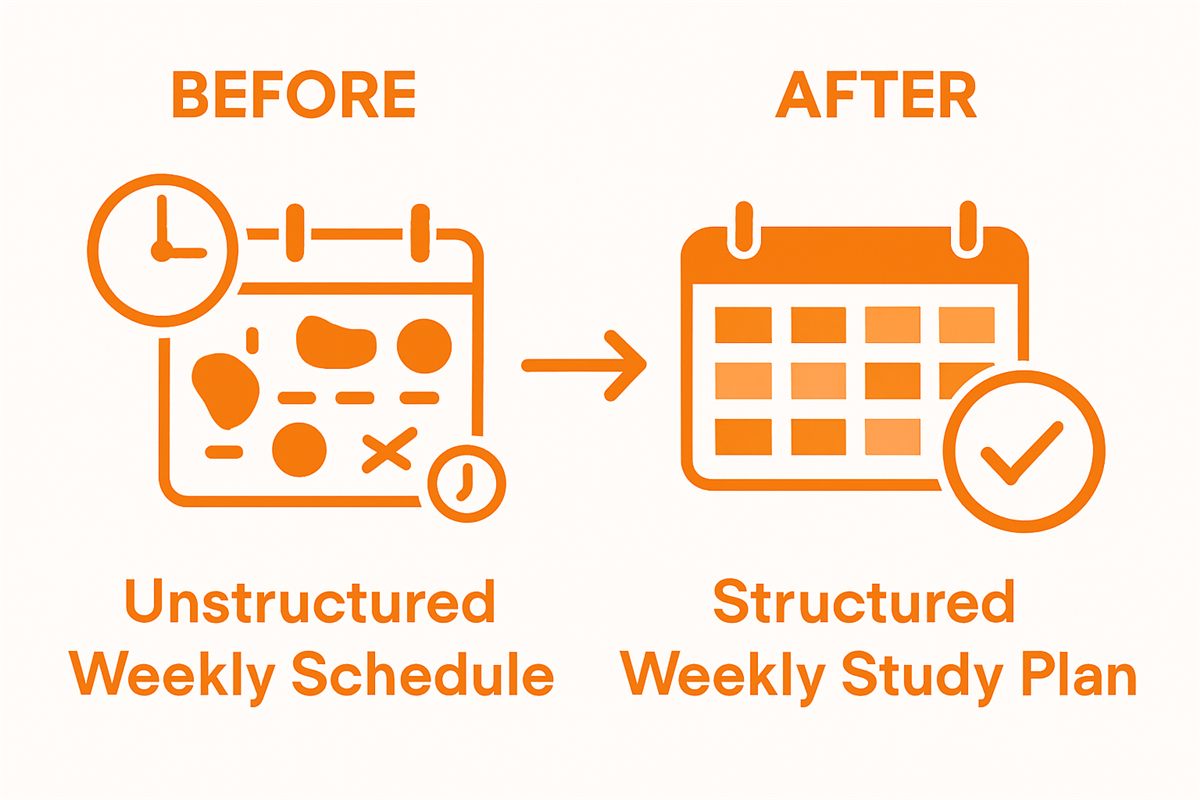
To verify you’ve successfully created your structured study schedule, you should have a complete weekly plan that includes specific study times for each subject, aligned with your goals from the previous step. This schedule should feel balanced, realistic, and tailored to your personal learning style and life commitments. Remember, the perfect schedule is one you can actually follow consistently.
Step 4: Develop Engaging Study Techniques
Engaging study techniques transform learning from a boring chore into an interactive, memorable experience. Your brain craves active learning, not passive information absorption. This step is about turning your study sessions into dynamic, interesting challenges that make information stick.
Understand more about effective study strategies by exploring techniques that go beyond traditional reading and memorization. Start by implementing active recall methods like creating flashcards, teaching concepts to an imaginary audience, or developing mind maps that visually connect complex ideas. These techniques force your brain to actively retrieve and process information instead of mindlessly scanning text.
According to research from the American Psychological Association, self-testing is one of the most powerful learning techniques. Design practice quizzes for yourself, use online quiz platforms, or exchange mock tests with study partners. The goal is to challenge yourself repeatedly, identifying knowledge gaps and reinforcing learning through repeated exposure and retrieval.
Experiment with different sensory learning approaches. Some students learn best by listening to recorded lectures, others by drawing diagrams, and some by creating physical models. Record yourself explaining complicated concepts, use colored pens for visual organization, or create physical representations of abstract ideas. The more senses you engage during studying, the more deeply you’ll understand and remember the material.
To verify you’ve successfully developed engaging study techniques, you should have at least three different active learning strategies tailored to your subjects. These techniques should feel enjoyable, challenging, and significantly more interactive than traditional passive reading. Your study sessions should now feel like intellectual puzzles you’re eager to solve, not monotonous tasks you’re forced to complete.
This table presents a comparison of engaging study techniques and their main features, as discussed in the guide.
| Study Technique | Description | Key Benefit |
|---|---|---|
| Active Recall | Use flashcards, self-quizzing, or explain topics aloud | Improves retention and highlights knowledge gaps |
| Mind Mapping | Create visual diagrams to organize complex ideas | Encourages deeper understanding through visual connections |
| Teaching Others | Teach concepts to a friend, family member, or even an imaginary audience | Deepens understanding and exposes weak areas |
| Practice Quizzes | Design or take online quizzes on the material | Reinforces memory through active challenge |
| Sensory Learning | Record audio explanations, use colored pens, or build physical models | Enhances memory by engaging multiple senses |

Step 5: Monitor and Adjust Your Study Habits
Building study habits isn’t a one-time event but an ongoing process of continuous improvement. This step is about becoming your own study coach, carefully observing what works and what doesn’t, and making intelligent adjustments along the way. Think of it like fine-tuning a musical instrument to create the perfect learning harmony.
Learn strategies for optimizing your morning study routine and apply similar principles of self-reflection to your overall study approach. Start by creating a weekly review system where you critically examine your study performance. Track metrics like study time, comprehension levels, grade improvements, and overall comfort with different learning techniques. Use a simple notebook or digital tracking app to record these observations.
According to research from Carnegie Mellon University, formative assessment is crucial for academic growth. This means regularly checking in with yourself, not just waiting for final exam results. After each study session, spend 5-10 minutes reflecting. Ask yourself questions like: Did I stay focused? Was my chosen study technique effective? What distractions interrupted my concentration? These reflections are gold mines of personal insight.
Be prepared to experiment and pivot. If a particular study technique isn’t working after two weeks, don’t stubbornly stick to it. Maybe mind mapping doesn’t click for you, or early morning study sessions drain your energy. That’s okay. The goal is finding your unique study rhythm, not following a one-size-fits-all approach. Be flexible and willing to try different strategies.
To verify you’ve successfully monitored and adjusted your study habits, you should have a clear record of your study performance, complete with honest reflections and specific changes you’ve implemented. Your study routine should feel like a living, breathing system that adapts to your evolving academic needs, not a rigid, unchangeable structure.
Step 6: Reflect on Your Achievements and Set New Goals
Reflection is the secret ingredient that transforms good study habits into exceptional academic performance. This final step is about celebrating your progress and using those insights to fuel future growth. It’s not just about tallying grades, but understanding the journey that brought you here.
Discover strategies to boost your productivity and apply similar reflective techniques to your academic growth. Start by creating a comprehensive achievement journal. Document not just your grades, but the strategies that worked, moments of breakthrough, and challenges you overcame. Write about the study techniques that surprised you, the times you pushed through difficult material, and the small victories that might seem insignificant but represent real personal growth.
According to research from the University of Edinburgh, goal reflection is crucial for continuous improvement. Schedule a quarterly review where you honestly assess your initial goals. Which ones did you achieve? Which fell short? More importantly, understand why. Maybe you discovered that your original goal of studying 3 hours daily was unrealistic, or you found more effective 45-minute focused sessions worked better for you.
Be kind to yourself during this reflection. Academic growth isn’t linear. Some semesters will be more challenging than others, and that’s completely normal. The goal is progress, not perfection. Use this reflection time to recalibrate your goals, drawing from the insights you’ve gained about your learning style, energy levels, and personal challenges.
To verify you’ve successfully completed this step, you should have a written document that captures your academic journey. This document should include your original goals, actual achievements, lessons learned, and refined goals for the next academic period. It’s a personal roadmap that demonstrates not just what you’ve learned academically, but how you’ve grown as a learner and an individual.
Take Your Study Habits From Routine to Results
You have already taken the first step by learning how to assess and improve your study routine for 2025. Yet, building habits that truly stick can feel overwhelming. Maybe you struggle with keeping a consistent schedule or turning good intentions into lasting behaviors. Perhaps you want to set stronger goals, stay motivated, and finally manage your time without feeling burned out. No matter where you are right now, you do not have to do it alone.
Unlock more achievement and less stress by exploring our proven strategies, tools, and personalized advice tailored for students who want real change. Dive into our curated library of study tips and time management resources created just for learners like you. Ready for the next level? Visit Learning With Angie to transform your academic journey into a balanced and successful routine. Start today and build habits that power your goals all year long.
Frequently Asked Questions
How can I assess my current study routine effectively?
To assess your current study routine, track your study behaviors for one week, noting when and where you study, how long you study, and any distractions. Analyze this data to identify patterns and areas for improvement.
What are SMART goals in the context of study habits?
SMART goals are Specific, Measurable, Achievable, Relevant, and Time-bound objectives that help structure your study goals in a way that is realistic and motivating. For example, instead of just saying ‘I want to study more,’ you could set a goal like ‘I will study biology for 45 minutes every Tuesday and Thursday.’
What techniques can enhance my study sessions?
To enhance your study sessions, implement active learning techniques such as creating flashcards, teaching concepts to others, and using mind maps. Active recall and self-testing are also effective methods to retain information better than passive reading.
How often should I monitor and adjust my study habits?
You should monitor and adjust your study habits regularly. Consider implementing a weekly review system to reflect on your study sessions, assess what techniques are effective, and make necessary changes based on your observations.