
How to stay motivated to study: proven strategies
Losing motivation to study is one of the most common struggles students face, whether you’re in high school cramming for finals or a college student juggling multiple courses. The good news? Research shows that specific, actionable strategies can help you build and maintain the drive to keep learning. This article walks you through evidence-backed techniques to boost your intrinsic motivation, prepare your mindset and environment, use engaging study methods, and troubleshoot motivation lapses. Parents will also discover how their support style directly impacts their student’s academic drive. Let’s dive into practical solutions that work.
Key Takeaways
| Point | Details |
|---|---|
| Intrinsic motivation boosts learning | High intrinsic motivation correlates with deeper learning, persistent effort, and higher academic performance. |
| Link tasks to goals | Connecting study tasks to long term goals is described as the most effective strategy to stay motivated. |
| Self efficacy matters | Belief in your ability to succeed strongly predicts academic achievement and helps you tackle difficult problems. |
| Parental support shapes motivation | The way parents support their students influences motivation, with authoritative style linked to higher drive and better engagement. |
Understanding motivation and its role in study success
Motivation isn’t just a nice-to-have feeling. It’s the engine that powers how you approach learning, which strategies you choose, and ultimately, how well you perform. Intrinsic motivation means you study because the material genuinely interests you or because you value the skills you’re building. Extrinsic motivation, on the other hand, means you study primarily for external rewards like grades, parental approval, or avoiding punishment.

Research demonstrates that high intrinsic motivation correlates with better use of motivational learning strategies and higher academic performance in university students. When you’re internally driven, you naturally adopt deeper learning approaches, persist through challenges, and retain information longer. Self-efficacy, your belief in your ability to succeed, acts as a powerful predictor of academic achievement. Students with strong self-efficacy tackle difficult problems with confidence, while those who doubt themselves often give up prematurely.
Consider two students preparing for the same biology exam. One studies because she’s fascinated by how cells work and wants to become a doctor. The other studies solely to avoid disappointing his parents. The first student will likely explore beyond the textbook, ask questions, and remember concepts long after the test. The second might memorize facts but forget them quickly and feel drained by the process.
Highly motivated students share several characteristics:
- They set specific, meaningful goals tied to their personal aspirations
- They view challenges as opportunities to grow rather than threats to avoid
- They actively seek feedback and adjust their approach based on results
- They maintain consistent study routines even when they don’t feel like it
- They connect new information to what they already know
- They celebrate small wins along the way
Understanding these foundations helps you recognize where your own motivation comes from and how to strengthen it. If you’re studying mainly for external reasons, that’s okay. You can gradually shift toward more intrinsic drivers by exploring ways to boost motivation naturally and building good study habits for high school students that make learning genuinely rewarding.
Preparing your study mindset and environment for lasting motivation
Before you crack open a textbook, you need the right mental and physical setup. Motivation doesn’t just appear randomly. It grows from intentional preparation.
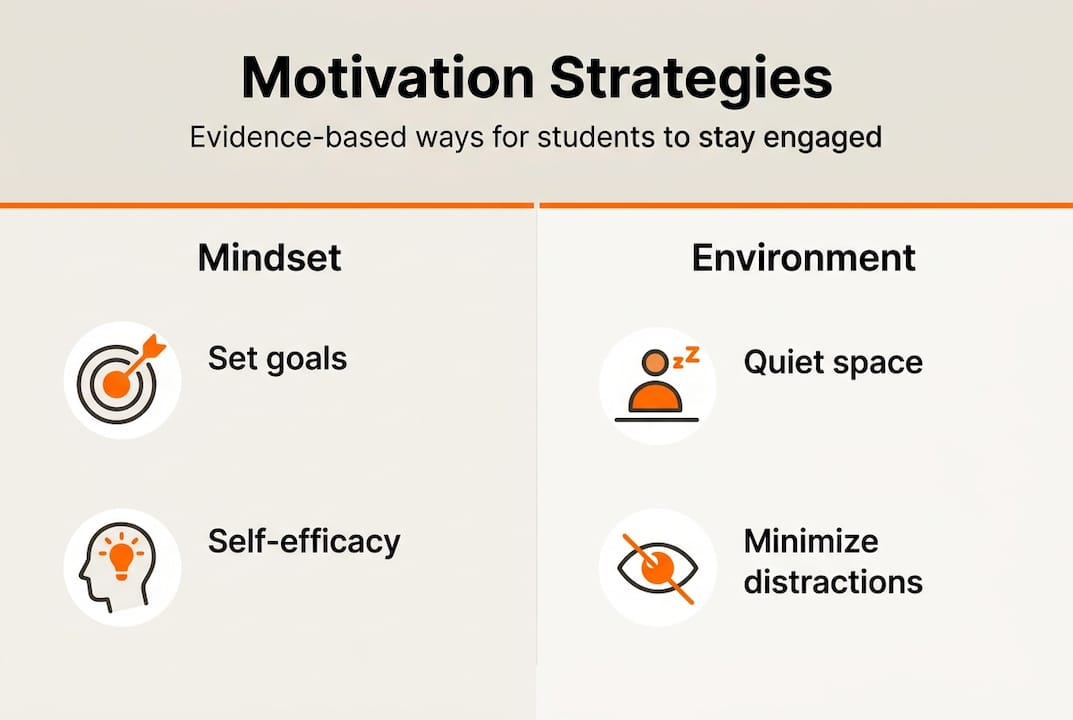
Start by connecting every study task to your long-term goals. Research confirms that connecting tasks to long-term goals is the single most effective strategy to stay motivated. When you sit down to study calculus, remind yourself how mastering math opens doors to engineering, data science, or finance careers. When you review history, think about how understanding the past shapes your ability to think critically about current events. This connection transforms boring homework into meaningful progress toward your future.
Self-efficacy deserves special attention because motivation and self-efficacy impact GPA more than any other factor in Norwegian students. You build self-efficacy through small, consistent wins. Break intimidating projects into manageable chunks. Complete one chunk successfully, acknowledge your progress, then move to the next. Each small victory strengthens your belief that you can handle bigger challenges.
For parents, your approach profoundly shapes your student’s motivation. Studies show that authoritative parenting positively predicts intrinsic motivation and competence in Iranian girls, and this pattern holds across cultures. Authoritative parents set clear expectations and provide structure while respecting their child’s growing autonomy. They ask questions, listen to concerns, and collaborate on solutions rather than dictating every detail. Conversely, over-controlling parenting, especially regarding higher-level goals like career choices, can seriously damage motivation.
Pro Tip: Break your semester goals into monthly milestones, then weekly targets. Achieving these smaller checkpoints builds momentum and confidence far more effectively than staring at one massive end goal.
Here are preparatory actions students and parents can take together:
- Students: Write down three specific reasons why each subject matters to your future
- Students: Create a dedicated study space free from distractions and social media
- Parents: Schedule regular check-ins to discuss progress without judgment or pressure
- Parents: Share your own learning struggles and how you overcame them
- Both: Celebrate effort and improvement, not just perfect grades
- Both: Identify one study challenge and brainstorm solutions together
Explore detailed guidance on goal setting steps achieving success to structure your preparation systematically. When mindset and environment align, motivation becomes far easier to sustain.
Effective study strategies and active learning to maintain motivation
Once your foundation is solid, the methods you use to study make or break your motivation. Passive reading and highlighting feel productive but rarely engage your brain deeply. Active learning techniques force you to interact with material, which keeps you alert and interested.
Active learning means doing something with the information rather than just absorbing it. You might teach concepts to a friend, create practice questions, build diagrams, or apply theories to real-world scenarios. Gamification adds game elements like points, levels, or challenges to studying. Research indicates that gamification shows moderate effect on motivation and performance in educational settings. While not a magic solution, gamification makes repetitive practice more enjoyable.
Compare traditional versus active approaches:
| Traditional method | Active learning alternative | Motivation impact |
|---|---|---|
| Reading textbook chapters | Creating summary flashcards and teaching concepts aloud | Higher engagement, better retention |
| Highlighting passages | Writing practice questions and answering them without notes | Deeper processing, immediate feedback |
| Watching lecture videos | Pausing to predict next steps or solve problems alongside instructor | Active participation, sustained focus |
| Memorizing vocabulary | Using new terms in sentences or conversations | Practical application, meaningful context |
Pro Tip: Mix study methods every 25 to 30 minutes to avoid boredom and boost retention. Your brain stays fresher when you alternate between reading, writing, discussing, and practicing.
Here are engaging study activities and resources to try:
- Use Quizlet or Anki for spaced repetition flashcards with built-in gamification
- Join or create study groups where members quiz each other and explain concepts
- Try educational games in group activities to make review sessions fun
- Set up friendly competitions with classmates on practice problems
- Teach material to a younger sibling or friend who knows nothing about the topic
- Create mind maps or concept webs that visually connect ideas
Study groups deserve special mention because they combine social accountability with active learning. When you commit to meeting peers, you’re less likely to skip studying. Explaining concepts to others forces you to truly understand them, and hearing different perspectives deepens your grasp. Learn how to create study groups academic success for structured guidance on forming effective groups.
The key is variety. No single method works perfectly for everyone or for every subject. Experiment with different techniques, notice which ones keep you engaged, and rotate through your favorites. When studying feels like an interesting challenge rather than a chore, motivation takes care of itself. Revisit ways to boost motivation naturally whenever you need fresh ideas to revitalize your routine.
Troubleshooting motivation lapses and sustaining progress
Even with perfect preparation and engaging methods, motivation will occasionally drop. That’s normal. The difference between students who succeed long-term and those who don’t is how they respond to these inevitable slumps.
Common causes of motivation loss include overwhelming stress from too many commitments, lack of clear direction about why you’re studying certain subjects, perfectionism that makes any mistake feel catastrophic, social isolation that removes accountability, physical exhaustion from poor sleep or nutrition, and parental pressure that shifts your focus from learning to pleasing others. Research shows that parental behavioral control over higher-order goals more negatively impacts motivation than over lower-order goals in US and Korean students. When parents micromanage big life decisions, students lose their sense of autonomy and internal drive.
Follow these steps to recover motivation after setbacks:
- Pause and identify the specific reason your motivation dropped without judging yourself
- Revisit your long-term goals and write down how current tasks connect to them
- Break your next study session into tiny, achievable tasks that take 10 to 15 minutes each
- Complete one small task and acknowledge your success before moving to the next
- Reach out to a friend, classmate, or mentor for support and perspective
- Adjust your study schedule if you’re genuinely overcommitted rather than pushing through exhaustion
For parents supporting students through motivation challenges, focus on listening first. Ask open-ended questions about what’s making studying difficult right now. Avoid immediately jumping to solutions or criticism. Share your own experiences with motivation struggles to normalize the challenge. Offer help with practical obstacles like time management or finding resources, but resist the urge to control how your student approaches their work. Your role is guide and supporter, not manager.
Sustaining motivation long-term requires consistent healthy habits:
- Maintain regular sleep schedules because fatigue destroys motivation faster than anything
- Take genuine breaks that involve physical movement or social connection
- Practice self-compassion when you fall short of your own expectations
- Track small wins in a journal to remind yourself of progress during tough weeks
- Periodically reassess your goals and adjust them as your interests evolve
- Build in rewards for completing challenging tasks or reaching milestones
Reflective practice helps you continuously improve your approach. Every few weeks, ask yourself what’s working well, what’s draining your motivation, and what you want to try differently. This ongoing adjustment keeps your strategies aligned with your current needs and prevents stagnation. Explore learning motivation tips study success for additional strategies to maintain momentum over months and years.
Explore our resources to boost your study motivation
You’ve now learned evidence-based strategies to understand, build, and maintain study motivation. Putting these ideas into practice consistently is where real transformation happens. To support your journey, we offer comprehensive guides designed specifically for students and parents navigating academic challenges.
Our study skills 2025 guide provides detailed frameworks for note-taking, active reading, and exam preparation that complement the motivation strategies you’ve learned here. If time management is your biggest obstacle, our time management step by step resource breaks down how to balance academics, activities, and self-care without burning out. For students ready to set and achieve ambitious academic goals, goal setting steps achieving success offers structured planning tools that turn vague aspirations into concrete action plans.
These resources work together to address the full spectrum of challenges students face. When you combine strong motivation with effective study skills, smart time management, and clear goals, academic success becomes not just possible but sustainable and even enjoyable.
FAQ
How can I stay motivated when studying feels overwhelming?
Break large tasks into smaller steps that each connect clearly to your long-term goals. Use active learning techniques like teaching concepts aloud or creating practice questions to make sessions more engaging and manageable. Celebrate completing each small step rather than focusing only on the final outcome.
What role do parents play in supporting study motivation?
Authoritative parenting that balances clear expectations with respect for student autonomy positively supports intrinsic motivation and academic competence. Parents should avoid over-controlling higher-level goals like career choices, as this significantly reduces student motivation. Instead, ask questions, listen actively, and collaborate on solutions while letting students make final decisions about their own learning.
Which study techniques best help maintain long-term motivation?
Active learning and gamification significantly raise motivation and performance compared to passive reading or highlighting. Study groups foster accountability and social motivation by creating regular commitments and opportunities to teach others. Mixing different methods every 25 to 30 minutes prevents boredom and keeps your brain engaged.
How can I regain motivation after falling behind?
Reflect on your original goals and reconnect current tasks to those aspirations to rebuild purpose. Adjust your study plan to include smaller, immediately achievable tasks that rebuild confidence through quick wins. Seek support from peers, mentors, or study groups who can provide encouragement and accountability as you restart with manageable expectations.