
Organizing Flash Cards for Efficient Exam Prep
Most American students face a tough reality when preparing for exams: messy flashcards can sabotage hours of hard work. Getting organized is not just a good idea, it is proven to help people remember up to 50 percent more information over time. With the right flashcard system, you can make study sessions less stressful and score higher on everything from Math to US History. This step-by-step guide breaks down how to sort, label, and arrange flashcards for smarter review and better long-term retention.
Quick Summary
| Key Insight | Explanation |
|---|---|
| 1. Gather all materials first | Collect essential supplies like flash cards, markers, and a ruler to streamline your sorting process. |
| 2. Organize by subject and topic | Create clear categories for subjects and specific topics to enhance information retention and recall. |
| 3. Implement a consistent labeling system | Use a standard format for card labels to simplify identification and retrieval during study sessions. |
| 4. Sort cards by difficulty levels | Arrange flash cards into easy, moderate, and challenging categories to focus your study efforts effectively. |
| 5. Regularly verify your organization | Conduct periodic reviews of your flash card system to ensure continued effectiveness and adapt to your learning needs. |
Step 1: Gather essential materials for flash card sorting
Preparing your study materials is the first crucial step in creating an organized flash card system that will help you crush your upcoming exams. You’ll want to collect everything you need before diving into the sorting process to ensure a smooth and efficient workflow.
First, grab a collection of blank flash cards or index cards. White or colored cards work great depending on your preference. You’ll also want to have several supplies on hand: colored markers or pens for color coding, a ruler for precise measurements if you like super neat cards, and a pencil for initial drafting. Sticky notes can be helpful for temporary labels or quick organization ideas. A sturdy folder or card storage box will help keep your sorted cards protected and easily accessible.
Your card sorting system works best when you have a clean, organized workspace. Clear off a large table or desk surface where you can spread out your materials and start categorizing. Good lighting is important so you can read and sort cards without straining your eyes.
Pro tip: Keep a small trash can nearby to quickly discard any cards with mistakes or unnecessary information to maintain a clean and focused sorting environment.
Step 2: Group flash cards by subject and topic for clarity
Organizing your flash cards is more than just shuffling papers around its about creating a strategic system that helps your brain absorb information faster and more effectively. The goal here is to transform your random collection of cards into a well structured learning toolkit.
Start by spreading out all your cards and creating broad subject categories. If youre studying for multiple classes, create separate piles for each subject like Math, Science, History, or Literature. Within each subject pile, break things down further into specific topics or chapters. For example, your Science section might include subcategories like Biology Cell Structure, Chemistry Periodic Table, or Physics Mechanics. DIY study flashcards work best when you create a clear visual hierarchy that makes sense to your brain.
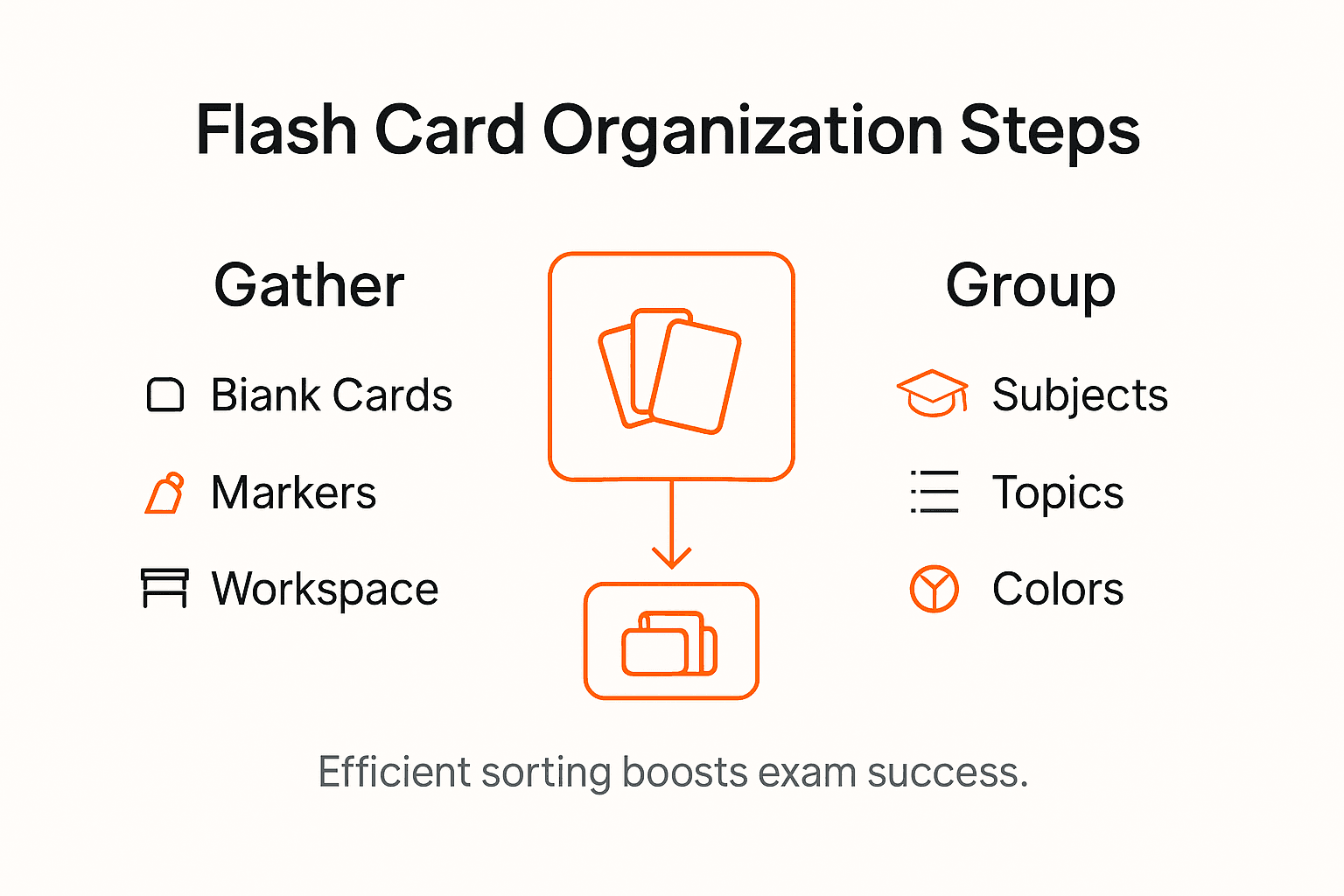
Consider using different colored cards or colored markers to distinguish between subjects and subtopics. Blue cards might represent Math, green for Science, yellow for History. This color coding system helps your brain quickly recognize and process information during study sessions. By creating these visual and logical connections, youre not just sorting cards youre building a personalized learning map that makes reviewing information feel more intuitive and less overwhelming.
Pro tip: Keep a master index or quick reference sheet that outlines your sorting system so you can easily track and locate specific cards when youre deep in study mode.
Step 3: Label and categorize flash cards for easy retrieval
Labeling your flash cards effectively is like creating a roadmap for your brain a strategic system that transforms random information into a memorable learning journey. The goal is to design a labeling approach that makes studying feel less like work and more like solving an exciting puzzle.

Start by creating clear and consistent labels for each card. Effective flashcard labeling techniques recommend using a standard format that includes the subject, topic, and specific concept. For instance, a Math card might read “Algebra Quadratic Equations Solving by Factoring” while a History card could say “US History Civil War Causes Battle of Gettysburg.” This detailed approach helps your brain quickly recognize and file away information during study sessions.
Consider using additional visual cues to enhance your labeling system. Small symbols or icons can help you quickly identify card types or difficulty levels. A star might indicate complex concepts, while a circle could mark basic review material. Include the date or exam related to the material on the back of each card this helps you prioritize and track your learning progress. By creating a personalized and intuitive labeling system, youre essentially building a custom study tool that speaks directly to how your brain processes and remembers information.
Pro tip: Develop a quick reference key for your symbols and labeling system and keep it nearby so you can maintain consistency across all your flash cards.
Step 4: Arrange flash cards by difficulty and review frequency
Arranging your flash cards strategically is like creating a personalized study roadmap that helps you focus your energy where it matters most. The key is to develop a system that prioritizes challenging topics while keeping easier material accessible.
Create three primary difficulty zones for your flash cards: easy, moderate, and challenging. Start by sorting your cards into these categories based on how comfortable you feel with each concept. Cards in the “easy” zone are topics you almost always remember correctly. “Moderate” cards represent concepts you sometimes struggle with. The “challenging” zone contains the material that consistently trips you up and demands more attention. Digital study techniques can help you track these difficulty levels more precisely, but a physical sorting method works just as well.
Design a review schedule that matches your difficulty zones. Spend more time with challenging cards perhaps reviewing them daily while checking easy cards less frequently. Consider using a rotating system where challenging cards get more frequent reviews and gradually move to moderate and then easy categories as you master them. This dynamic approach ensures youre always focusing on your weakest areas without getting overwhelmed.
Pro tip: Use rubber bands or separate folders to keep your difficulty zones physically separated and create a visual reminder of your study priorities.
Use this reference guide to set up a flash card review rotation based on difficulty:
| Difficulty Level | Review Frequency | Example Storage Method |
|---|---|---|
| Easy | Once per week | Separate folder or rubber band |
| Moderate | Twice per week | Middle tab in file box |
| Challenging | Daily | Front compartment or red sleeve |
Step 5: Verify flash card organization for effective studying
Verifying your flash card system is like conducting a personal learning audit. Its about making sure your study strategy isnt just organized but actually helps you learn and remember information more effectively.
Regularly test your organization by running through your cards and tracking your performance. Metacognitive study strategies recommend creating a simple tracking system where you mark cards youre consistently struggling with. Consider using a small notebook or digital tracker to record which topics require more attention. Pay close attention to patterns in your learning you might discover that certain subjects or specific types of information need a different approach or more frequent review.
Create a periodic review schedule to assess your flash card system. Every week or two weeks, take some time to shuffle your difficulty zones and see if cards have become easier or more challenging. Move cards between your easy moderate and challenging categories based on your actual performance. This dynamic approach ensures your study method remains flexible and responsive to your evolving understanding. Think of it like a fitness routine for your brain constantly adapting and improving to help you achieve maximum learning potential.
Pro tip: Set a recurring calendar reminder to review and recalibrate your flash card organization system every two weeks to keep your study strategy sharp and effective.
Here is a summary of key flash card organization strategies and when to use each:
| Strategy | When to Apply | Benefit to Studying |
|---|---|---|
| Subject/Topic Grouping | When preparing multi-class sets | Easier retrieval and review |
| Color Coding | For fast subject recognition | Enhances memory and recall |
| Symbol/Icon Labeling | To mark concept difficulty | Quick identification of priorities |
| Difficulty Zoning | During ongoing study reviews | Focuses effort on weak areas |
| Regular System Review | Every 1-2 weeks | Ensures system stays effective |
Transform Your Flash Card Study Routine Today
Struggling to keep your flash cards organized by subject, difficulty, and review frequency can make exam prep feel overwhelming and inefficient. This article highlights common challenges like cluttered materials, inconsistent labeling, and the need to prioritize tough topics for better learning. If you want to simplify your study process with proven strategies such as color coding and dynamic review systems, you are not alone.
At Learning With Angie, we understand how vital an effective flash card study system is for students aiming to boost focus and retention. Discover tools and resources specially designed to help you master flash card organization techniques, manage your study time wisely, and build consistent, personalized review habits. Don’t wait until exam stress takes over. Visit our main page now to find strategies and solutions that will empower your study routine. Take control of your exam prep with confidence and efficiency today.
Frequently Asked Questions
How do I gather the essential materials for organizing my flash cards?
Gather blank flash cards or index cards, colored markers or pens for color coding, and a ruler for neatness. Set up a clean workspace with good lighting to easily spread out your materials and start sorting.
What is the best way to group my flash cards by subject and topic?
Start by creating broad subject categories for your flash cards, such as Math, Science, and History. Within each category, break it down into specific topics, like Chemistry or Biology, to create a clear and organized learning structure.
How can I label my flash cards effectively for better memorization?
Use a consistent labeling format that includes the subject, topic, and concept, like “Math Algebra Quadratic Equations.” Consider adding visual cues such as symbols to indicate difficulty levels, making it easier to find and review specific concepts.
How should I arrange my flash cards by difficulty to optimize my study time?
Sort your flash cards into three categories: easy, moderate, and challenging based on your grasp of each concept. Review challenging cards daily, moderate cards a couple of times a week, and easier cards weekly to focus on areas that need the most attention.
When should I verify my flash card organization for effectiveness?
Conduct a verification of your flash card system every week or two by going through your cards and noting which ones you struggle with. Adjust your categories based on your performance to continuously improve your study effectiveness.
What are some simple strategies for maintaining my flash card organization?
Implement subject/topic grouping, color coding, and regular system reviews to keep your flash card organization effective. Schedule a reminder to review your system bi-weekly, ensuring it aligns with your evolving learning needs.