
Setting goals that boost academic success and growth
You’ve probably heard that setting goals is important, but if you’re like many students, your goals might sound like ‘study more’ or ‘get better grades.’ These vague intentions rarely lead anywhere because they lack the structure needed to guide real action. Effective goal setting isn’t about wishful thinking. It’s about using proven frameworks that transform abstract hopes into concrete plans. When you learn to set goals properly, you unlock better academic performance, stronger motivation, and clearer direction for your personal growth. This guide breaks down the exact strategies that help students like you achieve meaningful progress.
Key takeaways
| Point | Details |
|---|---|
| SMART goals create clarity | Specific, Measurable, Achievable, Relevant, and Time-bound objectives give you a clear roadmap to follow. |
| Mastery focus builds motivation | Learning-oriented goals keep you engaged and resilient when challenges arise. |
| Small steps prevent overwhelm | Breaking large goals into manageable actions makes progress feel achievable and sustainable. |
| Time management amplifies results | Planning your schedule around goals ensures consistent progress and reduces last-minute stress. |
| Regular tracking improves outcomes | Weekly reviews help you adjust strategies and celebrate wins along the way. |
Why most goal setting fails and what you can do instead
Many students set goals that sound good but don’t actually work. Phrases like ‘do better in math’ or ‘be more organized’ feel motivating at first, but they lack the specificity needed to guide daily actions. Without clear direction, you can’t measure progress or know when you’ve succeeded. This vagueness leads to frustration and the false belief that you’re not capable of achieving your aims.

Another common mistake is over-ambition without breaking down large goals into smaller, manageable steps. When you set a massive target like ‘get straight A’s this semester’ without identifying the daily habits required, the goal feels overwhelming. You might start strong but lose momentum when the path forward isn’t clear. This pattern creates discouragement and makes you less likely to try again.
The solution involves shifting how you think about goals. Instead of focusing solely on outcomes (performance goals), consider mastery goals that emphasize learning and improvement. Mastery goals focus on understanding concepts deeply rather than just earning high marks. This approach builds intrinsic motivation because you’re working toward genuine knowledge, not just external validation. When you stumble, mastery goals encourage you to learn from mistakes instead of giving up.
Here’s how to start making this shift:
- Write down exactly what you want to achieve in specific, observable terms
- Identify the smallest first step you can take today
- Focus on what you’ll learn or improve, not just the grade you’ll earn
- Build in regular check-ins to assess progress and adjust your approach
“The difference between a goal and a dream is a plan. Without actionable steps, even the best intentions remain wishes.”
Pro Tip: When you catch yourself setting a vague goal, ask ‘How will I know I’ve achieved this?’ If you can’t answer clearly, refine the goal until success is obvious and measurable.
Once you understand these pitfalls, you’re ready to learn a framework that eliminates them. The goal setting steps achieving success process becomes much clearer when you have a structured method to follow.
Introducing SMART goals: A proven framework for success
The SMART framework transforms fuzzy intentions into actionable plans. SMART goals are Specific, Measurable, Achievable, Relevant, and Time-bound, giving you five criteria to evaluate whether your goal will actually drive results. This method works because it forces you to think through the practical details of what you’re trying to accomplish.
Let’s break down each component:
- Specific: Define exactly what you want to achieve. Instead of ‘improve my writing,’ try ‘write one practice essay per week focusing on thesis development.’
- Measurable: Include numbers or clear indicators so you know when you’ve succeeded. ‘Study more’ becomes ‘complete three 45-minute study sessions daily.’
- Achievable: Set challenging but realistic targets based on your current situation. If you’re struggling in chemistry, aiming for an A+ next week isn’t achievable, but improving your quiz average by 10% over the next month might be.
- Relevant: Ensure the goal matters to your larger academic or personal objectives. Don’t set goals just because they sound impressive.
- Time-bound: Attach a deadline. ‘Eventually’ never comes, but ‘by March 15’ creates urgency and focus.
Here’s how SMART goals look in practice:
| SMART Element | Vague Goal | SMART Goal |
|---|---|---|
| Specific | Get better at math | Master quadratic equations and graphing |
| Measurable | Exercise more | Work out 30 minutes, 4 times per week |
| Achievable | Read everything | Read 2 chapters of my textbook daily |
| Relevant | Learn random facts | Study vocabulary for my upcoming Spanish exam |
| Time-bound | Someday improve | Raise my GPA by 0.3 points by end of semester |
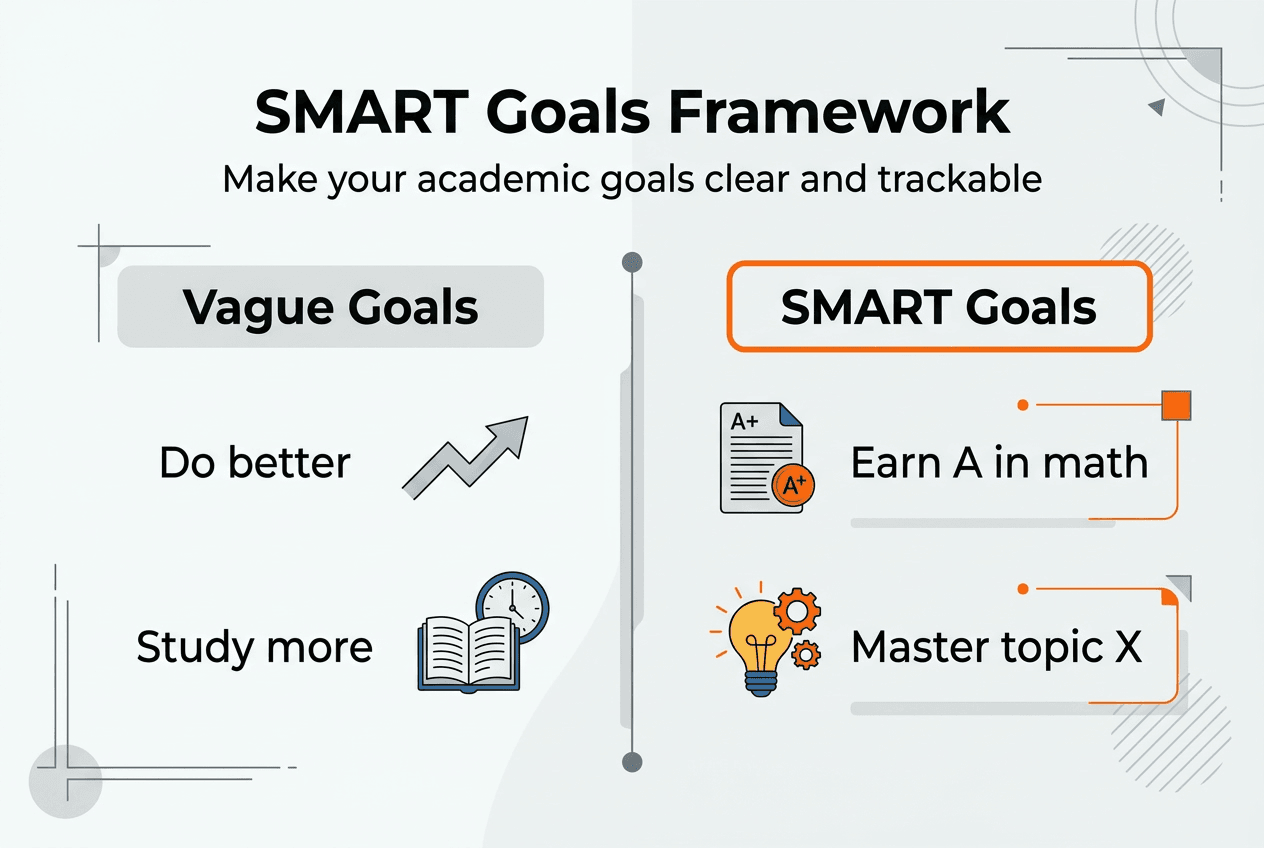
When you apply all five criteria together, you create goals that naturally guide your behavior. A complete SMART goal might be: ‘I will complete all assigned readings for my history class within 24 hours of assignment and take summary notes, maintaining this habit through the end of the semester to improve my class participation grade from B to A.’
Pro Tip: Write your SMART goals down and review them every Sunday evening. Adjust timelines or methods if something isn’t working, but keep the core objective clear.
The beauty of SMART goals is their flexibility. You can apply them to examples of goal setting 7 across academics, fitness, relationships, or any area where you want to grow. They work because they eliminate ambiguity and create accountability. Once you’ve mastered this framework, you’ll find that goal setting steps achieving success become second nature.
Beyond goals: How time management and mindset fuel achievement
Setting great goals is only the beginning. Without the right systems and mindset to support them, even SMART goals can stall. This is where time management and a mastery-oriented mindset become essential partners in your success journey.
Time management and goal-setting procedures lead to significant improvements in students’ efficiency, confidence, and academic outcomes. When you plan your days and weeks intentionally, you create protected time for goal-related activities. Without this structure, urgent but less important tasks crowd out the work that actually moves you forward.
Here’s how to integrate time management with your goals:
- Start each week by reviewing your goals and identifying the specific tasks needed to advance them.
- Block time in your calendar for these tasks, treating them as unmissable appointments.
- Use a daily prioritization method like the 1-3-5 rule: accomplish one big task, three medium tasks, and five small tasks.
- Build in buffer time for unexpected challenges or slower progress than anticipated.
- End each day by noting what you accomplished and planning tomorrow’s top three priorities.
Equally important is developing a mastery mindset. Mastery goals focusing on learning and understanding are associated with higher academic achievement and intrinsic motivation compared to performance goals. When you care more about truly understanding calculus than just passing the test, you approach studying differently. You ask deeper questions, seek help when confused, and persist through difficulties because the learning itself matters to you.
This mindset shift reduces anxiety because you’re no longer constantly comparing yourself to classmates. Instead, you’re competing with your past self, celebrating growth and improvement. When you don’t do well on an assignment, a mastery mindset helps you ask ‘What can I learn from this?’ instead of ‘Why am I not good enough?’
“Your goals should pull you forward with excitement, not push you with pressure. When learning is the prize, every step forward feels like winning.”
The combination of structured time management and mastery orientation creates a powerful foundation. You know what you’re working toward (SMART goals), when you’ll work on it (time blocks), and why it matters (mastery mindset). This triple approach is what separates students who achieve their goals from those who just wish for better results.
To dive deeper into these complementary skills, explore how to manage time for academic success and discover time management tips for busy students that fit your schedule.
Setting and tracking your goals: Practical strategies for students
Knowing the theory behind effective goals is valuable, but you need practical systems to turn knowledge into results. This section gives you concrete methods to create, monitor, and adjust your goals throughout the semester.
Start by writing your goals down. Research consistently shows that written goals are more likely to be achieved than those kept only in your head. Use a dedicated notebook, digital document, or goal-tracking app. The format matters less than the act of externalizing your intentions.
Here’s your step-by-step process:
- Choose 3-5 goals across different areas (academic, personal, health) to avoid overwhelm.
- Write each goal using the SMART framework, ensuring all five criteria are present.
- Break each goal into weekly milestones or action steps.
- Select your tracking method based on your preferences and habits.
- Schedule a weekly 15-minute review session to assess progress and make adjustments.
Tracking methods vary based on personal style. Some students prefer analog systems like bullet journals where they can see everything at a glance. Others thrive with digital tools that send reminders and generate progress reports. The key is choosing something you’ll actually use consistently.
Consider these tracking approaches:
- Habit tracking apps that let you check off daily actions
- Spreadsheets with weekly progress percentages
- Physical calendars where you mark successful days with an X
- Goal-specific journals with reflection prompts
- Accountability partnerships with friends pursuing similar goals
| Tracking Tool | Best For | Key Feature |
|---|---|---|
| Notion | Visual learners who like customization | Flexible templates and database views |
| Google Calendar | Students who need time blocking | Integration with existing schedule |
| Habitica | People motivated by gamification | Turns goals into a role-playing game |
| Simple notebook | Those who prefer analog methods | No tech distractions, fully portable |
| Trello | Project-based goal tracking | Card system for moving tasks through stages |
Weekly check-ins are where the magic happens. During these sessions, ask yourself three questions: What progress did I make? What obstacles did I encounter? What will I do differently next week? This reflection builds self-awareness and helps you spot patterns. Maybe you consistently skip morning study sessions, signaling you need to move them to afternoons when your energy is higher.
Pro Tip: Pair your tracking system with small rewards for hitting milestones. Finished all your study sessions this week? Treat yourself to your favorite coffee or an episode of a show you love. These positive reinforcements strengthen the habit loop.
SMART goals can be used in various professional and educational contexts, including personal growth and academic plans, making this skill valuable far beyond your current semester. The tracking systems you build now will serve you in college, career, and personal projects for years to come.
For additional strategies to support your goals, check out effective time management tips and revisit the complete goal setting steps achieving success framework to ensure you’re covering all the bases.
Explore resources to master goal setting and study skills
You’ve learned the frameworks, strategies, and systems that make goal setting actually work. Now it’s time to deepen these skills and explore how they connect to other areas of academic success. Goal setting doesn’t exist in isolation. It works best when combined with strong study habits, effective time management, and a clear understanding of how you learn best.
Our comprehensive study skills 2025 guide shows you how to apply goal-setting principles to your daily study routine, helping you retain more information in less time. When you pair clear goals with proven study techniques, your academic performance improves dramatically.
If time management is your biggest challenge, the time management step by step resource breaks down exactly how to structure your days and weeks around your priorities. You’ll discover how to protect time for goal-related work while still handling everything else on your plate.
And for a complete deep dive into the entire goal-setting process, explore goal setting steps achieving success, where you’ll find additional examples, templates, and strategies to refine your approach.
Frequently asked questions
What are some quick tips to start setting goals effectively?
Begin by choosing just one area to focus on, whether academic, personal, or health related. Write down a specific outcome you want within the next month, making sure you can measure your progress clearly. Break that goal into weekly action steps and schedule time in your calendar to work on them. Start small to build confidence and momentum before tackling bigger objectives.
How do I stay motivated when working toward long-term goals?
Break long-term goals into monthly and weekly milestones so you experience regular wins. Celebrate small victories to maintain positive momentum and remind yourself why the goal matters personally. Connect with friends pursuing similar goals for accountability and encouragement. When motivation dips, focus on taking just the next small step rather than thinking about the entire journey ahead.
What should I do if I’m not making progress on my goals?
Review whether your goal meets all SMART criteria, especially the achievable component. Identify specific obstacles blocking your progress and brainstorm solutions for each one. Consider whether you need to adjust your timeline, break the goal into smaller steps, or change your approach entirely. Sometimes lack of progress signals that a goal isn’t truly important to you, and it’s okay to let it go in favor of something more meaningful.
How many goals should I work on at once?
Focus on three to five goals maximum across different life areas to avoid spreading yourself too thin. Having multiple goals lets you make progress in various domains without feeling one-dimensional. If you’re new to structured goal setting, start with just one or two until the process feels natural. Quality of focus matters more than quantity of goals.
Can goal setting really improve my grades and academic performance?
Research consistently shows that students who set specific, measurable goals perform better academically than those who don’t. Goals provide direction for your study efforts and help you prioritize effectively. The process of setting and tracking goals also builds self-awareness about your learning patterns and habits. When combined with good study techniques and time management, goal setting becomes a powerful tool for academic improvement.