
Why You’re Missing Half of Every Lecture (and How to Fix Your Notes)
Research shows students miss up to 40% of key lecture points during note taking, yet most believe they capture everything important. This disconnect happens because effective note taking isn’t about transcribing every word a teacher says. It’s about actively processing information, identifying core concepts, and creating a personalized study resource. This guide explains what note taking truly means, explores proven methods that boost retention and exam scores, and reveals practical strategies you can apply immediately to transform your academic performance.
Key takeaways
| Point | Details |
|---|---|
| Active processing matters | Effective note taking requires summarizing and engaging with material, not copying verbatim. |
| Method impacts results | Cornell note takers outperform personal note takers in test scores and confidence. |
| Handwriting boosts cognition | Longhand note taking produces higher cognitive scores than stylus digital methods. |
| Review drives retention | Regular note review after class is critical for long-term learning and exam preparation. |
| Common mistakes hurt learning | Disorganization, copying everything, and skipping reviews lead to information overload. |
What is note taking and why does it matter?
Note taking is the deliberate process of recording and organizing important information from lectures, textbooks, or other learning sources. It goes far beyond simple transcription. When you take notes effectively, you actively engage with material by identifying key concepts, making connections, and translating ideas into your own words. This cognitive work transforms passive listening into active learning.
The role of note taking in academic success is backed by solid research. Students who take notes score higher on both immediate and delayed tests of recall and synthesis than students who do not take notes. This advantage holds true across different subjects and grade levels, making note taking one of the most reliable study strategies available.
Effective note taking delivers multiple benefits:
- Improves memory retention by forcing your brain to process information actively
- Enhances comprehension through summarization and organization
- Creates a personalized study resource tailored to your learning needs
- Keeps you engaged during lectures and reduces mind wandering
- Provides a framework for exam preparation and review
Pro Tip: Focus on capturing main ideas and supporting details in your own words rather than trying to write down everything the instructor says. This summarization process strengthens understanding and makes review sessions more productive.
Many students mistakenly believe that filling pages with every spoken word equals good note taking. This approach actually works against learning. When you’re busy transcribing, you can’t think critically about the material or identify relationships between concepts. Effective note taking requires judgment about what matters most and how ideas connect.
Common note-taking methods and their effectiveness
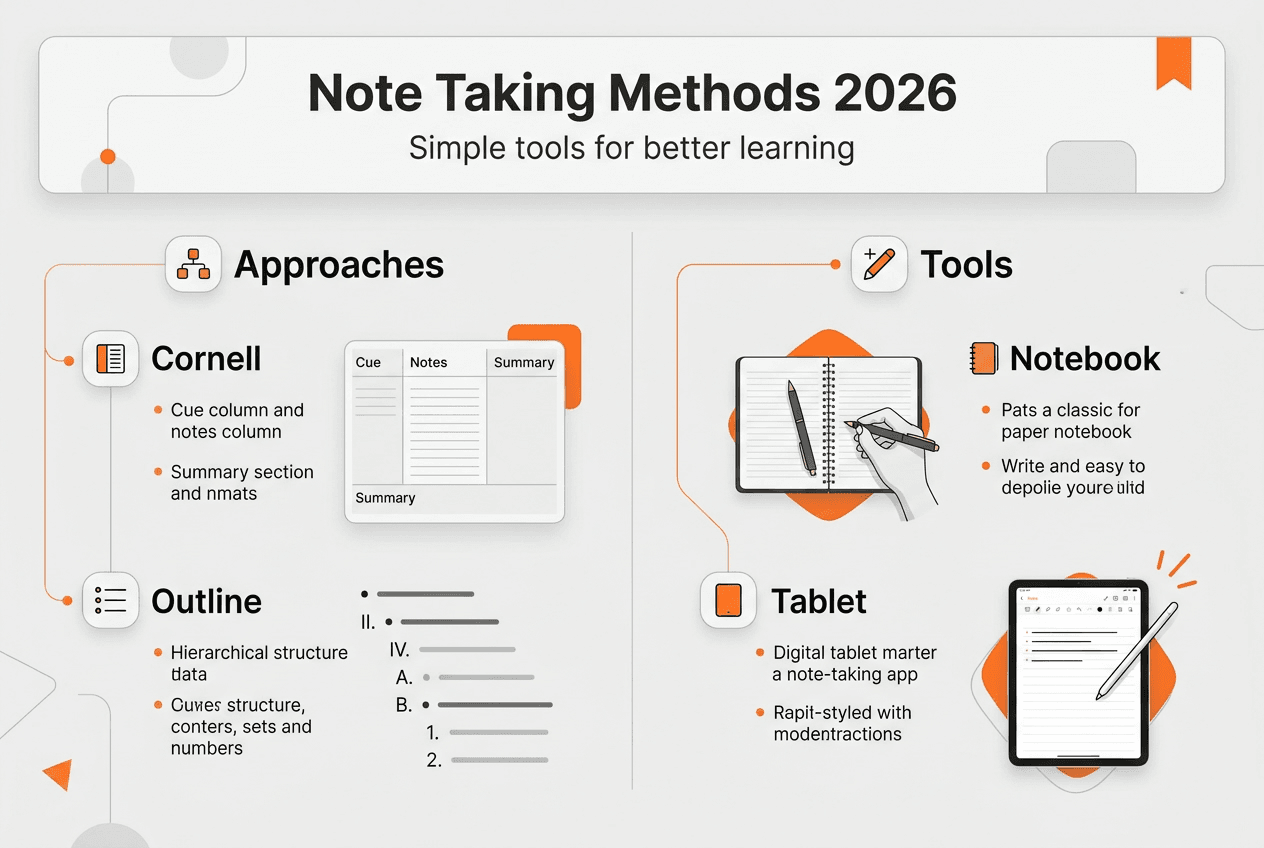
The Cornell note-taking system stands out as one of the most researched and effective approaches. This method divides each page into three sections: a narrow left column for cues and questions, a wider right column for notes during class, and a bottom section for summaries. The structure encourages active engagement and makes review sessions more efficient.
Research confirms the Cornell method’s superiority. The Cornell note-taking group outperformed the personal note-taking group, with a significant difference in test scores over time. Students using this system also reported higher confidence in their understanding of course material. The built-in summary section forces you to synthesize information, which deepens learning.
The debate between handwritten and digital note taking continues, but recent studies reveal important distinctions. Students who used longhand note-taking demonstrated significantly higher overall cognitive scores compared to those who used stylus digital note-taking. Handwriting appears to engage different cognitive processes that enhance memory formation and information processing.
Here’s how different methods of note taking compare:
| Method | Strengths | Considerations |
|---|---|---|
| Cornell System | Structured organization, built-in review prompts, proven test score improvements | Requires initial setup, takes practice to master |
| Handwritten Notes | Enhanced memory retention, better cognitive processing, fewer distractions | Slower writing speed, harder to reorganize or search |
| Digital Notes | Easy editing and organization, searchable content, multimedia integration | May reduce retention, increased distraction risk |
| Outlining | Clear hierarchy of ideas, shows relationships between concepts | Can become too detailed, may miss nuances |
Pro Tip: Combine the cognitive benefits of handwriting with digital note-taking advantages by writing notes by hand during class, then digitizing and organizing them later. This two-step process reinforces learning through repetition.
Each method offers unique advantages. The Cornell system excels at creating structured, reviewable notes. Handwriting provides cognitive benefits that support deeper learning. Digital tools offer flexibility and organization. Your choice should match your learning style, course requirements, and available technology. Many successful students adapt their approach based on the subject, using handwriting for conceptual courses and digital tools for classes requiring frequent updates or collaboration.
Common mistakes and best practices for effective note taking
Six common mistakes sabotage even well-intentioned note taking efforts. Copying everything verbatim tops the list, followed by disorganized notes lacking structure, failing to review or edit notes after class, writing too much or too little, not using abbreviations or symbols effectively, and neglecting to date or label notes properly. Ineffective note-taking leads to information overload and hinders understanding.
These mistakes create real consequences. When you copy everything, you can’t identify what truly matters. Disorganized notes become useless for exam preparation because you can’t find key concepts quickly. Skipping the review process means you never consolidate learning or catch gaps in understanding. Students who make these errors often study harder but see worse results, creating frustration and burnout.

Best practices flip these mistakes into strengths. Start by summarizing information in your own words rather than transcribing. This forces comprehension and makes notes more memorable. Create structure using headings, subheadings, and bullet points that mirror how concepts relate. Leave white space for additions and clarifications. Use consistent abbreviations and symbols to speed up note taking without sacrificing clarity.
Regular review separates effective note takers from struggling students. Effective note-taking significantly improves information retention and recall, leading to better academic performance. The review process matters as much as the initial note taking. Spaced repetition, where you review material at increasing intervals, dramatically boosts long-term retention compared to cramming.
Follow these steps to review notes effectively:
- Review notes within 24 hours of class while material remains fresh
- Fill in gaps, clarify confusing points, and add examples
- Create summary statements or concept maps connecting ideas
- Generate questions that test your understanding of key concepts
- Schedule follow-up reviews at spaced intervals over the coming weeks
- Use active recall by covering notes and testing yourself
Pro Tip: After class, spend 15 minutes editing and clarifying your notes while the lecture remains fresh in your mind. Add examples, fix unclear sections, and highlight key concepts. This immediate review deepens understanding and makes later study sessions more efficient.
Developing good note taking techniques requires practice and adjustment. Pay attention to which strategies help you understand and remember material best. Some students benefit from color coding different concept types. Others prefer minimal formatting with clear hierarchies. Experiment with different approaches, then stick with what works. The goal is creating a system you’ll actually use consistently, not adopting someone else’s perfect method that doesn’t fit your style.
Implementing effective note review methods transforms notes from passive records into active learning tools. Each review session strengthens neural pathways and reveals areas needing more attention. This ongoing process builds genuine understanding rather than surface-level familiarity that evaporates after exams.
Strategies to apply effective note taking and improve academic performance
Developing a consistent note-taking workflow creates the foundation for academic success. Your system should cover three phases: preparation before class, active engagement during class, and consolidation after class. Each phase serves a specific purpose in the learning process.
Implement these steps to build an effective note-taking routine:
- Preview reading materials or lecture topics before class to identify key concepts
- Prepare your note-taking tools and create a clear heading with date and topic
- Listen actively during class, focusing on main ideas rather than transcribing everything
- Use your chosen method consistently to capture information in an organized way
- Mark confusing sections with question marks or symbols for later clarification
- Review and edit notes within 24 hours, adding details and fixing unclear sections
- Create summary statements connecting new material to previous learning
- Schedule spaced review sessions at increasing intervals over time
Personalizing notes makes them more effective and engaging. Use colors strategically to highlight different types of information like definitions, examples, or key formulas. Develop a consistent symbol system for marking important points, questions, or connections to other topics. Add your own examples that make abstract concepts concrete and relatable.
Generating questions within your notes stimulates critical thinking and prepares you for exams. After each major section, write 2-3 questions that test understanding of core concepts. These questions become valuable study tools and reveal whether you truly grasp the material or just recognize it superficially.
Regular review of notes is crucial for long-term retention and understanding of the material. Spaced repetition techniques can improve retention rates by up to 50% compared to massed practice or cramming.
Study habits that complement best note-taking techniques include:
- Setting specific times for note review rather than waiting until exam week
- Testing yourself actively instead of passively rereading notes
- Teaching concepts to others to identify gaps in understanding
- Connecting new information to existing knowledge through concept maps
- Maintaining organized storage so you can find and review notes easily
- Getting adequate sleep to consolidate learning and memory formation
Parents can support effective note taking by encouraging consistent routines and providing necessary supplies. Help your student establish a dedicated study space with minimal distractions. Ask about their note-taking methods and review strategies without micromanaging. Celebrate improvements in organization and study habits. Model good information management in your own work.
Exploring good note taking skills through examples helps you see these strategies in action. Look at sample notes from successful students in your courses. Notice how they organize information, use visual elements, and create review tools within their notes. Adapt elements that resonate with your learning style.
The key to improvement is consistent practice with reflection. After each exam, analyze which note-taking strategies helped most and which areas need adjustment. This ongoing refinement process builds skills that serve you throughout your academic career and beyond. Effective note taking isn’t just about getting better grades. It develops critical thinking, information processing, and knowledge organization skills valuable in any profession.
Explore study aesthetics and note-taking tools to enhance your learning
Visually appealing notes do more than look pretty. They boost motivation, make review sessions more enjoyable, and help you stay organized throughout the semester. Creating aesthetic notes combines effective study strategies with visual design principles that enhance both engagement and retention.
If you’re ready to elevate your note-taking game, discover how to take aesthetic notes that balance beauty with functionality. You’ll find beginner-friendly guides covering layout design, color schemes, and organizational systems that make studying feel less like a chore.
Study aesthetics explained reveals how your study environment, note design, and organizational systems work together to create a holistic approach to learning. Small changes in how you present information can significantly impact your motivation and consistency.
Explore the Learning with Angie shop for curated tools and resources designed specifically for students seeking to improve their study habits. From planning templates to organizational systems, these resources support the note-taking strategies covered in this guide.
FAQ
What is the best note-taking method for students?
The Cornell method stands out for its proven effectiveness in improving test scores and building organized, reviewable notes. However, the best method depends on your learning preferences and course type. Science courses might benefit from detailed outlines, while humanities classes often work well with concept mapping. Experiment with different note-taking methods to find what helps you understand and remember material most effectively.
How can I improve my note-taking skills?
Start by practicing summarization rather than transcription. Focus on capturing main ideas in your own words, which forces deeper processing of information. Organize notes clearly using consistent headings, bullet points, and visual hierarchy. Most importantly, review and edit notes regularly after class to fill gaps and clarify confusing sections. These good note-taking techniques become more natural with consistent practice and reflection on what works for your learning style.
Is it better to take notes by hand or digitally?
Handwritten notes provide cognitive advantages including enhanced memory, better working memory, and improved information processing. Students who used longhand note-taking demonstrated significantly higher cognitive scores compared to those who used stylus digital note-taking. Digital notes offer benefits like easy organization, searchability, and multimedia integration. Consider using handwriting vs digital notes strategically based on your course needs, or combine both approaches by handwriting during class and digitizing later.
How often should I review my notes for best retention?
Review notes within 24 hours of class while material remains fresh, then schedule additional reviews at spaced intervals. Spaced repetition techniques can improve retention rates by up to 50% compared to cramming. A typical schedule might include reviews after one day, one week, and one month. Avoid waiting until exam week to review notes. Consistent, distributed practice supports deeper learning and long-term retention better than massed practice. Track your note review frequency and adjust based on how well you retain information.