
Academic planner strategies that boost grades in 2026
Most students assume that putting in more hours at the desk is the secret to better grades. But here’s the thing: study time alone doesn’t reliably predict your GPA. What actually moves the needle is how you organize your time. An academic planner is one of the most powerful tools you can use to take control of your schedule, reduce stress, and show up to every exam feeling prepared. In this article, we’ll cover exactly what an academic planner is, why the science backs it up, which types work best, and how to set one up so it actually sticks.
Key Takeaways
| Point | Details |
|---|---|
| Strategy beats study hours | Using an academic planner with effective methods is more important for grades than study hours alone. |
| Choose your planner type | Select paper for focus and memory or digital for easy access based on your needs. |
| Consistency builds results | Regular use and review of your planner makes routines automatic and reduces academic stress. |
| Small steps, lasting habits | Start simple and tweak your approach over time to keep your planning system working for you. |
What is an academic planner?
An academic planner is a daily organizational tool designed specifically for students. It helps you track assignments, manage deadlines, and build consistent study routines. Think of it as your personal command center for school life.
It’s worth clarifying something right away. The term ‘academic planner’ can sometimes refer to degree maps or course planning tools used by advisors. Here, we’re talking about the hands-on, day-to-day planner you use to organize your tasks, deadlines, and routines. That distinction matters because the two serve very different purposes.
A solid academic planner typically includes:
- A monthly or weekly calendar for seeing the big picture at a glance
- Daily task lists so you know exactly what to tackle each day
- Assignment and exam trackers to avoid last-minute panic
- Semester overviews for mapping out major projects and test dates
- Space for notes and personal goals to keep you motivated
Unlike a general planner, an academic planner is built around the school calendar and student workflow. It gives you structure and clarity so nothing slips through the cracks. If you want a head start, check out this study planner checklist to see exactly what features to look for.
How academic planners drive better grades and lower stress
Here’s where things get really interesting. A large meta-analysis on planning found that time management, specifically planning and prioritizing, correlates with academic performance at r=0.38 and with student engagement at r=0.29. That’s a meaningful relationship. Even more surprising? Better planning strategies can actually compensate for less study time.
In other words, a student who plans well and studies for two hours can outperform a student who studies for four hours without a system. That’s not an excuse to study less. It’s a reminder that strategy matters enormously.
“Better time management strategies predict goal achievement and can compensate for less raw study time.” — BMC Psychology meta-analysis
Here’s a quick look at what the research tells us:
| Benefit | What the research shows |
|---|---|
| Academic performance | Planning correlates at r=0.38 with GPA outcomes |
| Student engagement | Planning correlates at r=0.29 with engagement |
| Stress reduction | Routines free up mental energy and reduce anxiety |
| Goal achievement | Strategic planners reach goals more consistently |
Building a routine with your planner also reduces decision fatigue. When you already know what you’re doing at 4 p.m. on Tuesday, you don’t waste energy figuring it out. That mental clarity is huge. Explore more about time management for academic success and discover effective time management tips that pair perfectly with your planner. The OSU time management guide is also a fantastic free resource to bookmark.

Types of academic planners: Paper vs. digital tools
With the benefits understood, the next challenge is choosing which type of academic planner fits your style. There’s no single right answer, but there are some clear differences worth knowing.
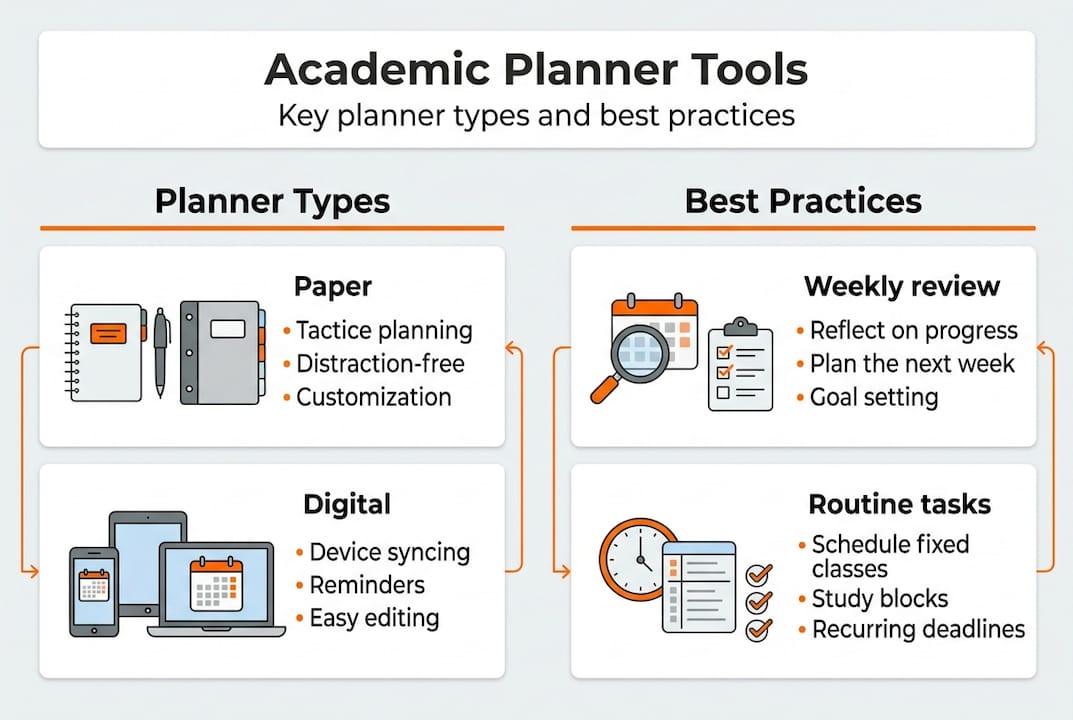
Paper planners are preferred by many experts for visual mapping, memory retention through handwriting, and fewer distractions. Digital planners, on the other hand, sync across devices and send reminders, but they can pull you into social media or notifications if you’re not careful.
Here’s a side-by-side comparison:
| Feature | Paper planner | Digital planner |
|---|---|---|
| Memory retention | Higher (handwriting boosts recall) | Lower |
| Distraction risk | Very low | Moderate to high |
| Accessibility | Requires physical access | Available on any device |
| Customization | Flexible, creative | Template-based or app-limited |
| Cost | One-time purchase | Free to subscription-based |
| Reminders | Manual | Automated |
So which one should you choose? Here are a few tips:
- Choose paper if you love writing things out, get distracted easily on your phone, or enjoy decorating and personalizing your planner
- Choose digital if you’re always on the go, prefer syncing with your calendar app, or tend to lose physical notebooks
- Use both if you want the best of both worlds: a paper planner for daily tasks and a digital calendar for big deadlines and reminders
Pro Tip: Start simple. Don’t buy the most elaborate planner system right away. Pick one format, use it for two weeks, and then add features as you figure out what you actually need. You can also check out this guide on how to create a study schedule and explore time management tools that complement your planner.
How to set up and use your academic planner for real results
Once you’ve chosen a planner, you need a concrete process to put it to work day by day. Here’s a step-by-step setup that actually works:
- Gather your materials. Pull out your course syllabi, any school calendars, and your planner. You’ll need all of this in front of you for the first setup session.
- Write in all major deadlines first. Add every exam, paper due date, and project deadline for the entire semester. This gives you the full picture before you plan anything else.
- Block out fixed commitments. Add classes, work shifts, sports practice, and any recurring obligations. These are non-negotiable time blocks.
- Schedule study sessions. Using time-blocking and weekly schedules, assign specific study windows for each subject. Be realistic about how long things actually take.
- Create daily task lists. Each evening or morning, write out three to five tasks you want to complete that day. Keep it manageable.
- Use color coding. Assign a color to each subject or type of task. It makes your planner easier to scan and honestly makes it look pretty too.
- Do a weekly review. Every Sunday (or whatever day works for you), look at the week ahead, check what you completed, and adjust your plan.
The Pomodoro technique (studying in 25-minute focused bursts with 5-minute breaks) pairs beautifully with a planner. You can block out Pomodoro sessions right in your daily schedule. For small tasks that take under two minutes, do them immediately instead of writing them down. That’s the two-minute rule, and it keeps your list clean.
Pro Tip: Set a recurring 15-minute “planner check-in” every Sunday evening. Review the past week, celebrate what you finished, and set up the week ahead. This one habit can completely transform how in control you feel. For more guidance, read how to build a study routine and revisit the planner checklist to make sure your setup covers all the essentials.
Expert tips and common mistakes
Beyond basic setup, maximizing your results means learning from the mistakes students make most often. Here are the biggest pitfalls to watch out for:
- Overloading your planner. Writing 20 tasks for one day sets you up to feel like a failure. Keep daily lists realistic and focused.
- Not reviewing your planner. A planner you don’t check is just a pretty notebook. Build the review habit or the whole system falls apart.
- Using it as a wish list. Your planner should reflect what you will do, not what you hope to do someday. Be honest with yourself.
- Letting distractions creep in. Effective planner use reduces stress and improves grades best when paired with self-control strategies to avoid distractions during study blocks.
- Giving up after one bad week. Everyone misses a day or falls behind. The key is to reset and keep going, not to abandon the system entirely.
Pro Tip: Pair your planner with an accountability partner or a study group. Sharing your weekly goals with someone else adds a layer of motivation that’s hard to replicate on your own. Trust me, it makes a real difference.
For digital users, apps like Google Calendar, Notion, or Todoist can complement your paper planner without replacing it. Use them for reminders and syncing, but keep your core planning on paper if retention is a priority for you.
Connect your academic planner with more study strategies
Your academic planner is a fantastic starting point, but it works even better when it’s part of a bigger productivity system. On Learning with Angie, you’ll find in-depth guides on time management tools and techniques that show you exactly which apps and methods pair best with your planner. If you want your study space to feel as organized as your schedule, explore the world of study aesthetics for inspiration. Ready to go deeper? The guide on mastering time management walks you through advanced strategies, and if you want to get more done in less time, these tips to increase productivity are a must-read. Your best semester yet is absolutely within reach!
Frequently asked questions
Is a paper planner better than a digital planner for students?
Paper planners support memory retention through handwriting and come with fewer distractions, while digital planners offer convenience and automatic reminders. Your best choice depends on whether you get easily distracted by devices and how you prefer to organize your thoughts.
How can I stick to using my academic planner all semester?
Start with a simple setup, set a daily reminder to open your planner, and do a short weekly review every Sunday. Consistency builds the habit faster than motivation alone ever will.
Does a planner help improve grades even if I study less?
Yes! Research confirms that strong planning strategies can boost academic outcomes even for students who log fewer study hours, because strategy and prioritization matter more than raw time.
What’s the difference between an academic planner and a regular planner?
An academic planner is built around the school calendar and designed to track assignments, exams, and study routines. A regular planner focuses on general life or work tasks and usually lacks the school-specific structure students need.
Which planner features matter most for students?
Look for a monthly and weekly calendar view, daily task lists, assignment and exam trackers, a semester overview, and space for personal goals and notes. Those five features cover the essentials for most students.