
What is making notes: boost learning with 34% more retention
Think writing down every word helps you learn better? Research shows summarizing notes leads to stronger understanding. Making notes isn’t about transcribing everything you hear. It’s an active process where you convert information into your own words, improving how your brain stores and recalls knowledge. This guide reveals how effective note-making strategies, backed by cognitive science, can transform your study habits and boost academic performance.
Key takeaways
| Point | Details |
|---|---|
| Active note-making improves memory | Converting information into your own words creates deeper understanding than passive listening. |
| Different methods suit different needs | Cornell, outlining, and mapping techniques each offer unique advantages for various subjects. |
| Common myths undermine effectiveness | Believing you must write everything or that digital is always better limits learning potential. |
| Strategic implementation drives results | Following structured processes and regular review significantly enhance academic outcomes. |
| Research proves measurable benefits | Studies show retention improvements exceeding 30% when using effective note-taking strategies. |
Introduction to making notes
Making notes means actively recording and processing information in your own words rather than copying text verbatim. You’re not creating a transcript. You’re building a personalized learning tool that reflects your understanding of the material.
The purpose extends beyond having something to study later. Note-taking enhances learning and memory by converting passive input into active engagement. When you summarize a lecture point or textbook section, your brain processes information more deeply than when you simply listen or read.
Academic benefits backed by cognitive research include:
- Improved comprehension during initial learning
- Enhanced long-term memory retention
- Better organization of complex information
- Increased engagement with course material
- Stronger preparation for exams and assignments
Effective note-making relies on a cognitive framework with three components. Encoding happens when you actively process information while writing. External storage provides a reliable reference that reduces memory load. Retrieval and reflection occur when you review notes, strengthening neural pathways that help you recall information later.
Before you start taking notes, you need the right prerequisites. Choose tools that match your learning style, whether paper notebooks or digital apps. Develop focus skills to filter important information from less critical details. Most importantly, understand why note-taking is important so you approach it with intention rather than habit.
How note-taking aids learning and memory
Your brain doesn’t work like a recording device. When you actively take notes, you trigger encoding processes that transform raw information into meaningful knowledge. This cognitive work requires effort, but that effort creates stronger memory traces than passive listening ever could.

Encoding happens through active processing. Writing notes forces you to decide what matters most, rephrase concepts in familiar language, and connect new information to what you already know. These mental operations create multiple pathways to retrieve information later.
External storage serves as your second brain. Notes reduce the burden on working memory, letting you focus on understanding rather than memorizing every detail during class. When you need information later, your notes provide reliable access without taxing your mental resources.
Reflection and metacognition strengthen learning over time. Reviewing notes helps you identify gaps in understanding and reinforces what you’ve learned. This process of thinking about your thinking improves both retention and comprehension.
The benefits of note-taking for memory aren’t just theoretical. Research demonstrates quantifiable improvements in academic performance:
- Memory retention increases over 30% with active note-taking
- Comprehension scores improve significantly compared to passive listening
- Long-term recall strengthens through regular note review
- Test performance rises when students use structured note-taking methods
Active note-taking can boost memory retention by over 30% compared to passive listening alone.
These benefits multiply when you combine note-taking with regular review sessions. Each time you revisit your notes, you reactivate neural pathways and strengthen connections between concepts. This distributed practice creates lasting knowledge rather than temporary memorization.
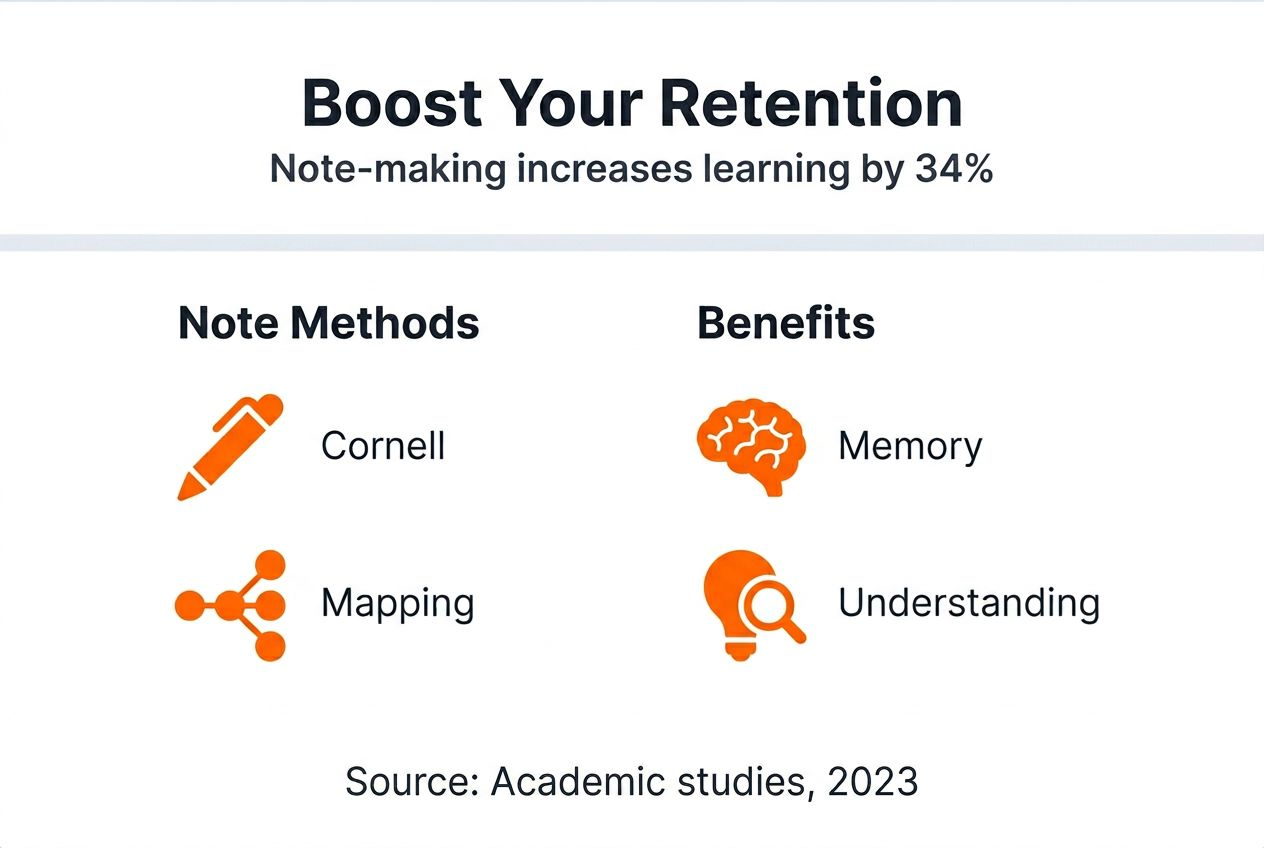
Popular note-taking techniques and methods
Different note-taking methods serve different purposes. Understanding each technique’s strengths helps you choose the right approach for each class or study session.
The Cornell method divides your page into three sections. A narrow left column captures cues and questions. The large right section contains your main notes. A bottom summary space lets you synthesize key points. Students using the Cornell method scored 17% higher on comprehension tests than those using unstructured notes.
Outlining organizes information hierarchically using numbered or bulleted lists. Main topics sit at the top level, with supporting details indented beneath. This structure works well for content with clear hierarchies and sequential relationships.
Mapping techniques create visual diagrams showing relationships between concepts. You place the main topic in the center, then branch out to related ideas. This spatial organization helps visual learners see connections that linear notes might obscure.
| Method | Best For | Strengths | Limitations |
|---|---|---|---|
| Cornell | Lectures, test prep | Structured review, built-in summaries | Time-consuming to set up |
| Outlining | Textbooks, hierarchical content | Clear organization, easy to follow | Can miss connections between topics |
| Mapping | Brainstorming, complex relationships | Visual connections, flexible | Hard to capture sequential information |
Handwritten notes versus digital notes remains a hotly debated choice. Handwriting engages different cognitive processes than typing, often leading to better retention. However, digital notes offer searchability, easy reorganization, and backup capabilities. Each approach has merit depending on your goals and preferences.
Match your method to both learning style and subject matter. Use mapping for interconnected topics like history or literature. Choose outlining for technical subjects with clear hierarchies like mathematics or science. Apply Cornell for lecture-heavy courses where regular review matters most.
Pro Tip: Combine handwritten notes during class with digital organization afterward. This hybrid approach captures the cognitive benefits of writing while gaining digital tools’ organizational advantages.
Experiment with multiple note-taking methods before committing to one. What works for biology might not suit philosophy. Flexibility in your approach prevents you from forcing content into unsuitable structures.
Common misconceptions and errors in note-taking
Many students sabotage their own learning by following counterproductive note-taking practices. Recognizing these errors helps you avoid wasting time on ineffective strategies.
The verbatim myth suggests writing every word creates comprehensive notes. Actually, summarizing and rephrasing notes leads to better understanding than transcription. When you copy text word-for-word, you bypass the cognitive processing that builds real comprehension.
Excessive note-taking causes cognitive overload. Trying to capture everything divides your attention between listening and writing, preventing deep engagement with either task. You end up with extensive notes but shallow understanding.
The digital superiority fallacy assumes technology automatically improves learning. While digital tools offer convenience, digital versus handwritten note-taking research shows handwriting often produces better retention. The slower pace and physical engagement of writing by hand strengthen memory encoding.
Passive transcription without thinking represents another common error. Simply copying information from slides or boards creates an illusion of productivity while delivering minimal learning benefit. Real note-making requires active mental processing.
Key errors to avoid:
- Writing complete sentences when keywords would suffice
- Recording obvious information you already understand
- Creating notes so detailed you never review them
- Ignoring the relationship between concepts
- Postponing note organization until exam time
Pro Tip: Focus on keywords and concepts rather than complete sentences. Capture the essence of ideas in your own words, then add brief supporting details only when necessary for clarity.
Many students also fail to correct common note-taking mistakes until grades suffer. Don’t wait for poor test results to evaluate your note-taking effectiveness. Regularly assess whether your notes help you understand and recall material.
Practical strategies to implement note-making
Transforming note-taking theory into consistent practice requires deliberate strategy. These actionable steps help you develop effective note-making habits that improve academic performance.
Follow this five-step process for better notes:
- Engage actively before, during, and after recording information
- Select a method matching your subject and learning style
- Summarize concepts in your own words rather than copying text
- Organize notes with clear headings, visual cues, and logical structure
- Review regularly to reinforce learning and identify knowledge gaps
Active engagement starts before class begins. Preview assigned readings or review previous lecture notes to activate relevant knowledge. During class, listen for main ideas rather than trying to write everything. After class, spend 10 minutes clarifying unclear points while material remains fresh.
Method selection matters less than consistency. Choose one approach and master it before experimenting with alternatives. Switching methods constantly prevents you from developing fluency with any single technique.
Summarizing effectively requires practice. Ask yourself what main point the professor or textbook emphasizes. Express that concept in your own words, then add only the supporting details necessary for comprehension. This selective approach produces concise, meaningful notes.
Organizational tools enhance usability:
- Use headings and subheadings to show information hierarchy
- Employ visual cues like arrows, boxes, or highlighting for emphasis
- Create symbols representing frequently used concepts or relationships
- Leave white space for adding connections or questions later
- Date each note-taking session for easy reference
Balance depth versus conciseness by capturing enough detail for understanding without creating overwhelming volume. If you wouldn’t reference a detail when studying, don’t write it down. Your notes should trigger recall, not serve as complete textbooks.
Pro Tip: Schedule dedicated review sessions within 24 hours of taking notes, then weekly thereafter. This spaced repetition cements knowledge far more effectively than cramming before exams.
Implement effective note-taking by starting with one class rather than overhauling everything simultaneously. Once you see results, expand successful strategies to other courses. The outline method steps provide a straightforward starting point for students new to structured note-taking.
Deliberate practice and organized notes significantly improve study effectiveness, but improvement takes time. Expect several weeks before new habits feel natural and you notice measurable changes in comprehension or grades.
Conclusion: applying effective note-making to your studies
Effective note-making transforms passive information absorption into active knowledge building. The cognitive and practical advantages extend far beyond having study materials. You develop deeper understanding, stronger memory, and better exam performance.
Experiment with methods that align with your learning style and subject requirements. What works for one course might need adjustment for another. This flexibility helps you optimize learning across all your classes.
Remember that note-taking is a trainable skill, not an innate talent. The strategies covered here improve with practice:
- Active processing during encoding strengthens comprehension
- Structured organization enhances retrieval and review
- Regular reflection reinforces long-term retention
- Strategic method selection optimizes effectiveness
Consistent application of these evidence-based techniques leads to measurable improvements in exam scores and study efficiency. Students who master note-making gain advantages that compound throughout their academic careers. Start implementing these strategies today to see results in your next test or assignment.
Explore more effective learning strategies
Mastering note-taking represents just one component of academic success. Combining strong note-making habits with broader study skills creates even more powerful results. Understanding study skills helps you develop comprehensive learning strategies that address multiple aspects of academic performance. Effective note-taking becomes even more valuable when paired with smart test-taking strategies that help you apply your knowledge under exam conditions. Ready to take your learning further? Visit the Learning with Angie shop to discover resources, planners, and tools designed specifically for students committed to academic excellence.
FAQ
What is the best method for taking notes in a lecture?
The Cornell method is highly effective for lecture notes because it structures information into cues, notes, and summaries. However, the best method depends on your learning style and course subject. Try different approaches to find what helps you understand and remember material most effectively.
How often should I review my notes for maximum retention?
Review notes within 24 hours of taking them, then periodically on a weekly basis to reinforce memory. Active reflection during review sessions, where you test yourself and make connections, improves retention far more than passive rereading. This spaced repetition approach builds lasting knowledge.
Is digital note-taking better than handwriting notes?
Handwriting notes often leads to better memory retention because it requires deeper cognitive processing and slower, more deliberate recording. However, digital note-taking offers speed, searchability, and organizational advantages. Combine both approaches by handwriting during class and digitizing notes later for optimal results.
What common note-taking mistakes should I avoid?
Avoid transcribing notes verbatim without actively processing the information. Don’t overload notes with excessive detail, which causes cognitive overload and makes review overwhelming. Never rely solely on digital tools without engaged listening, and avoid note-taking mistakes like postponing organization until exam time when material has faded from memory.