Build a High-Performance Brain Through Body Health
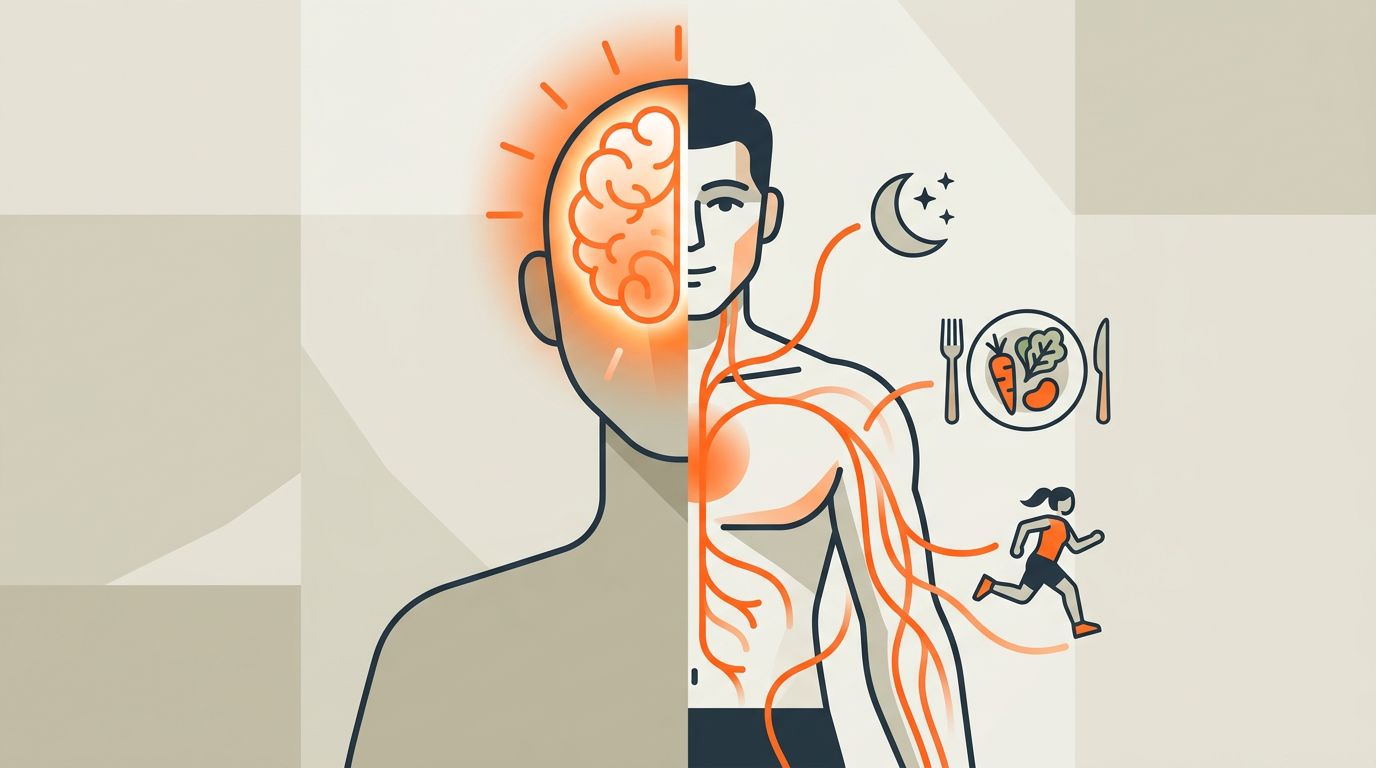
Your intellect doesn’t float above your body. It rides inside it.
When sleep is short, meals are chaotic, and stress never lets up, your concentration pays the price. If you want better learning, steadier focus, and cleaner recall, you need to care about BDNF, new brain-cell growth, and metabolic health.
The good news is simple. The strongest tools are ordinary habits, movement, sleep, food quality, blood sugar control, and recovery. Once you see how they connect, it gets easier to build a body that supports the mind you want to use.
Your intellect rides on biology
If you spend your days studying, writing, coding, solving math problems, or preparing for tests, it’s easy to treat your brain like a separate machine. It isn’t. Your brain is living tissue, and it responds to the same conditions that shape the rest of your body.
That matters because mental performance depends on basics you can influence. Blood flow helps deliver oxygen and fuel. Stable blood sugar helps you avoid attention crashes. Sleep helps memory stick. Stress changes how well you can think under pressure.
When people talk about a “high-performance vessel” for the mind, this is what they mean. Your body is the vessel. If it runs on poor sleep, low movement, and constant energy swings, your thinking gets noisy. If it runs on steady inputs and enough recovery, your thinking gets clearer.
Metabolic health is part of that foundation. In plain terms, it means how well your body handles energy, especially blood sugar and insulin. Good metabolic health doesn’t turn you into a genius. It does make it easier to stay alert, regulate hunger, and think with less friction.
None of this means every brain problem comes from lifestyle. It also doesn’t mean a morning run guarantees perfect grades. Still, daily habits change the odds. They shape the environment in which your brain learns, adapts, and recovers.
This is where BDNF, neurogenesis, and metabolic health meet. When those systems move in a good direction, your brain has a better shot at doing hard work well.
What BDNF and neurogenesis mean in plain English
BDNF stands for brain-derived neurotrophic factor. That’s a mouthful, so keep the simple version: it’s a protein that helps brain cells survive, grow, and communicate. You can think of it as one of the signals that supports learning-ready brain tissue.
Neurogenesis means the birth of new neurons, or nerve cells. Most of the interest here centers on the hippocampus, a memory-related area deep in your brain. In animals, exercise can increase neurogenesis there. In humans, the story is harder to prove directly because you can’t casually inspect living brain tissue. So the idea is promising, but some parts are still debated.
Another term you’ll see is synaptic plasticity. That means your brain connections can strengthen or weaken with use. Every time you practice a skill, recall a fact, or learn a pattern, plasticity is part of the process.
This quick map keeps the terms straight:
| Term | Simple meaning | Why you care |
|---|---|---|
| BDNF | A protein that supports neuron health and signaling | It relates to learning, memory, and adaptation |
| Neurogenesis | Creation of new neurons, often studied in the hippocampus | It may support memory, with stronger evidence in animals |
| Metabolic health | How well your body manages energy, blood sugar, and insulin | It affects focus, stamina, and brain fuel |
| Synaptic plasticity | Brain connections changing with experience | It sits at the center of learning |
A broad open-access review on BDNF and whole-body regulation shows why this topic keeps getting attention. BDNF isn’t only a “brain chemical.” It also interacts with appetite, energy use, and body-wide stress responses. In other words, your brain and metabolism are talking to each other all the time.
That link helps explain why body-based habits can sharpen mental work. You’re not only “feeling better.” You’re changing the conditions that support memory, attention, and adaptation.
Exercise is the clearest signal for a sharper brain
If you change one habit first, make it regular exercise. Right now, it has the clearest evidence for improving the biology behind cognitive performance.
Aerobic exercise appears to raise BDNF, at least for a period after activity, and it supports blood flow, insulin sensitivity, sleep quality, and mood. Recent reviews also suggest BDNF links exercise to brain metabolism and prefrontal cortex function, which matters because your prefrontal cortex helps with planning, focus, and self-control.

You do not need extreme workouts to get value. A brisk walk, steady bike ride, jog, swim, or sports practice can help. The key is consistency. Your brain responds better to repeated signals than to one heroic session followed by five sedentary days.
A strong starting point is 30 to 45 minutes of moderate aerobic work, three to five times each week. Moderate means you can talk in short sentences, but you’re not strolling. If you’re already well-trained, one or two short interval sessions may add a bigger short-term BDNF bump. Still, hard sessions only help when recovery is in place.
Strength training belongs here too. Lifting weights may not be the top BDNF tool, but it helps glucose control, posture, mood, confidence, and sleep. Those gains feed back into better thinking. Two or three sessions each week is plenty for most students and busy parents.
A 2025 review on exercise, nutrition, sleep, and neuroplasticity backs up this broader view. Exercise doesn’t work in isolation. It works best as part of a stable routine.
If your goal is stronger cognitive performance, regular aerobic exercise is the most reliable place to start.
You can also use movement tactically. A 10-minute walk before studying can wake up attention. Short activity breaks during homework can keep your brain from fading out. During exam week, movement often helps more than another hour of sluggish, unfocused review.
Metabolic health keeps attention from crashing
If your energy rises fast and drops hard, your brain feels it. That’s one reason metabolic health matters for learning.
Your brain needs a steady fuel supply. When blood sugar swings wildly, you may feel sharp for a short burst and then hit a wall. That wall can look like brain fog, irritability, cravings, or the classic sleepy feeling after a large sugary meal.
Insulin sensitivity is part of this picture. It describes how well your cells respond to insulin, the hormone that helps move glucose out of the blood and into tissues. Better insulin sensitivity usually means better energy handling. Poorer insulin sensitivity can make energy control rougher, and mental steadiness can suffer with it.
You don’t need a fancy diet to improve this. Start with balanced meals. Put protein and fiber at the center, then add carbohydrates that digest more slowly for you, such as oats, beans, fruit, potatoes, rice, or whole grains. Add healthy fats in normal amounts. That combination usually holds attention better than ultra-processed snacks or liquid sugar.
A few simple moves help more than people expect. Eat regular meals instead of swinging between under-eating and giant binges. Walk for 10 minutes after your biggest meal. Keep sugary drinks for occasional use, not default fuel. If caffeine helps you study, pair it with food and avoid pushing it late into the day.
What about fasting? The science is interesting, but the hype gets ahead of the data. A review of intermittent fasting and BDNF points to plausible mechanisms and stronger animal evidence than human evidence. So far, exercise is still the more dependable tool for cognitive benefits.
That matters even more if you’re a teen, a college student under heavy load, or someone with a history of disordered eating. Long fasting windows can backfire when sleep is poor, stress is high, and nutrition is already shaky. Before you experiment with meal timing, fix meal quality and daily rhythm first.
Sleep is when the upgrades stick
You can study for hours, but sleep is where a lot of learning gets locked in. It helps memory consolidation, which means your brain stabilizes and organizes what you practiced during the day.
Sleep also affects BDNF, blood sugar control, mood, and stress tolerance. Miss enough of it, and your body becomes less efficient at handling glucose. At the same time, focus slips, patience shrinks, and emotional reactions get louder. That is a bad setup for school, work, or creative thinking.
For teens, eight to ten hours is a healthy target. Many adults and college students do best around seven to nine. Your exact number may vary, but “I function fine on five hours” is often a story your tired brain tells you.
A steady sleep schedule matters almost as much as the total. Going to bed and waking up at wildly different times can leave you feeling jet-lagged without leaving home. A stable wake time anchors the system.
The biggest sleep upgrades are boring, which is why they work. Get bright light in the morning. Exercise most days. Keep caffeine earlier. Dim screens and room lights at night. Make your room cool, dark, and quiet if you can. If you nap, keep it short so it doesn’t steal sleep later.
That same 2025 review on exercise, nutrition, sleep, and neuroplasticity treats sleep as part of the same brain-performance network, not a side note. If you want BDNF, neurogenesis, and metabolic health to move in your favor, sleep isn’t optional background maintenance. It’s part of the mechanism.
Stress can sharpen you, or wear you down
Stress isn’t automatically bad. A short burst can help you perform. It can wake up attention before a test, a game, or a presentation. The trouble starts when stress never turns off.
Chronic stress keeps cortisol elevated too often. Over time, that can hurt sleep, appetite control, blood sugar regulation, and learning. Animal research also suggests stress can reduce hippocampal neurogenesis. In humans, the full picture is more complex, but the direction is clear enough: constant overload is not a brain-building strategy.
You don’t need a perfectly calm life. You need stress that comes with recovery. That could mean hard classes plus enough sleep, sports plus rest days, or family demands plus real downtime. Challenge helps you grow when your system gets time to reset.
Practical stress control is less glamorous than supplements, but it works better. Get outside early in the day. Keep your phone away when you’re trying to focus. Use slow breathing for a minute before a hard task. Write down open loops so your brain doesn’t keep rehearsing them at midnight. Protect a little social time, because isolation often makes stress feel larger.
Mental recovery also gets easier when your schedule has fewer collisions. If you stack hard workouts, late-night studying, skipped meals, and constant alerts, your brain stays in defense mode. It learns less efficiently there.
Build a week your brain can actually use
High-level thinking does not come from one perfect morning. It comes from a repeatable week.
The habits in this article work together. Exercise improves insulin sensitivity and sleep. Better sleep improves hunger control and learning. Stable meals make workouts and study feel easier. Lower stress makes all the other habits easier to keep. That is why body-based cognitive performance feels less like a hack and more like good systems design.
A simple weekly template works well for students, home schoolers, and parents:
- Put four movement blocks on your calendar. Aim for 30 to 45 minutes each, with most at a moderate pace.
- Add two short strength sessions. Twenty to 40 minutes is enough to help energy control and resilience.
- Keep your wake time steady. Try to stay within about an hour, even on weekends.
- Build your meals around protein, fiber, and steady carbs. Save desserts and energy drinks for occasional use.
- Take a 10-minute walk after your biggest meal or after long study blocks.
- Leave room for recovery. One quieter evening can do more for focus than squeezing in extra low-quality work.
If you’re in school, use this framework around your real life. Walk before homework. Lift on lighter academic days. Eat a solid lunch before afternoon classes instead of gambling on vending-machine sugar. During exams, protect sleep first and trim lower-value tasks.
If you’re a parent, your own habits shape the home more than speeches do. Family dinners, shared walks, bedtime routines, and visible fruit often matter more than the perfect lecture about health. Kids notice defaults.
The point isn’t to become obsessive. The point is to stop asking your brain to perform at a high level while your body runs on chaos.
Conclusion
Your intellect still rides inside your body. A sharper mind usually starts with better inputs, movement that supports BDNF, food that steadies blood sugar, sleep that locks in learning, and recovery that keeps stress from turning into static.
You don’t need a flawless routine or a stack of brain supplements. You need a repeatable one that gives your brain a better place to learn, remember, and think.
Build the vessel well, and your intellect has more room to do its best work.
This post may contain affiliate links. If you make a purchase through these links, I may earn a small commission at no extra cost to you.