
Effective reading strategies for better comprehension
TL;DR:
- Strategic, active reading methods significantly outperform passive reading in comprehension and long-term retention.
- Techniques like SQ3R and active reading involve purposeful steps such as surveying, questioning, annotating, and reviewing.
- Customizing strategies based on text type and regularly practicing them enhances academic success and critical thinking.
Most students assume that reading more pages automatically leads to better grades. Spoiler: it doesn’t. What actually moves the needle is how you read, not how much. A meta-analysis of 71 studies found that passive reading falls significantly short of active, strategic approaches when it comes to real comprehension gains. Whether you’re a student trying to keep up with heavy course loads or a parent looking to support your child’s learning, this guide walks you through evidence-based reading strategies that actually work. We’ll cover the science, the core methods, how to customize them, and how to build them into your daily routine.
Key Takeaways
| Point | Details |
|---|---|
| Active strategies matter | Research shows that active reading methods lead to higher grades and better comprehension than passive reading. |
| Adapt to your needs | Effective strategies can and should be tailored to fit different subjects, formats, and learner types. |
| Routine builds results | Consistency in applying these reading strategies is what transforms study habits and long-term learning. |
| Parents can empower | Family involvement and modeling reading strategies support students in forming lasting, effective habits. |
Why strategies matter: The science behind reading comprehension
Here’s something most students don’t realize: reading the same paragraph three times without a plan is almost always less effective than reading it once with a clear strategy. The research backs this up. Strategy instruction yields measurable gains across reading tests, with effect sizes of d=0.22 for vocabulary strategies, d=0.20 for cognitive strategies, and d=0.17 for metacognitive strategies. These numbers might sound small, but across a semester, they translate into real grade improvements.
So what’s the difference between passive and active reading? Passive reading is when you move your eyes across the page without truly engaging. You finish a chapter and realize you can barely recall the main idea. Active reading strategies flip that script by keeping your brain in the driver’s seat the whole time.
Here are the most common struggles students face without a strategy:
- Forgetfulness: Information disappears within hours of reading it
- Surface-level understanding: You can summarize a chapter but can’t apply the concepts
- Information overload: Dense textbooks feel impossible to process
- Low confidence: You re-read the same section repeatedly without feeling like you understand it
- Poor test performance: You studied but couldn’t retrieve what you needed
“Strategic reading instruction consistently outperforms unguided reading across academic levels. The gap between students who use strategies and those who don’t grows wider over time.”
Building good study habits around strategic reading is one of the highest-return investments you can make in your academic life.
Pro Tip: Combine cognitive strategies (like summarizing and questioning) with metacognitive ones (like monitoring your own understanding) for the strongest results. Using both together amplifies your comprehension more than either approach alone.
Now that you know what’s at stake, let’s break down the strategies that actually work.
Core strategies explained: SQ3R and active reading mechanics
Two of the most well-validated reading frameworks are SQ3R and general active reading mechanics. They’re not complicated, but they do require intentional practice. Let’s walk through both.
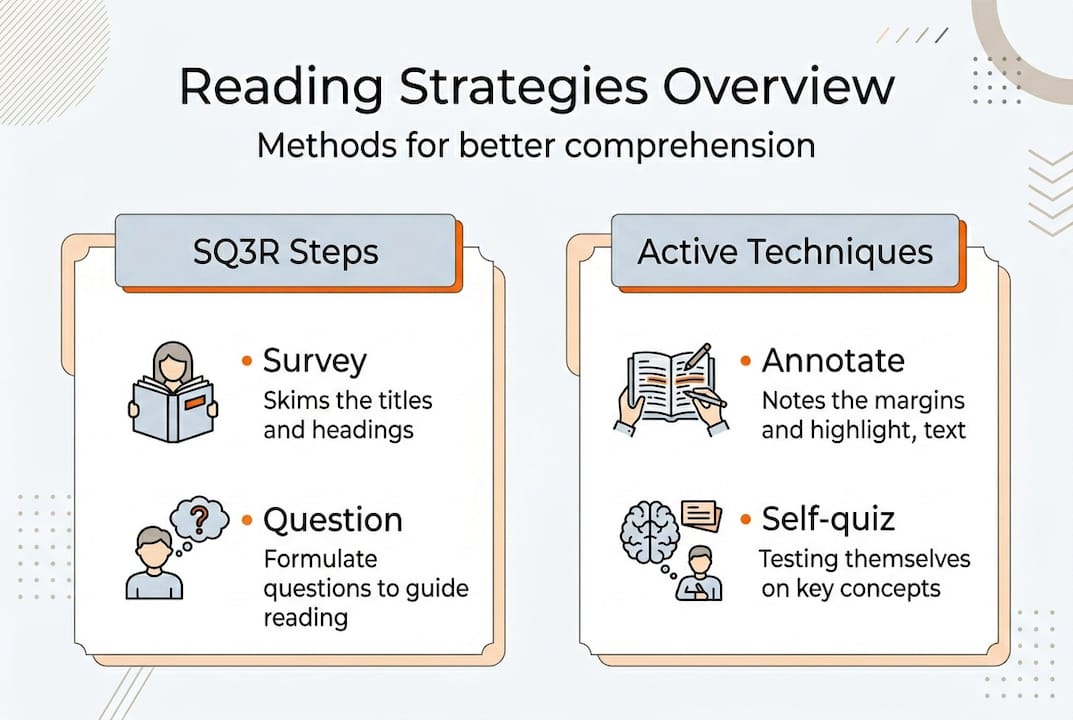
SQ3R stands for Survey, Question, Read, Recite, and Review. It’s a core effective reading strategy validated across university settings and multiple studies. Here’s how it works step by step:
- Survey: Skim the chapter before reading. Look at headings, subheadings, bold terms, and any summaries at the end.
- Question: Turn each heading into a question. For example, “The Civil War Causes” becomes “What caused the Civil War?”
- Read: Read to answer your questions. Stay focused and purposeful.
- Recite: After each section, close the book and say or write the answer in your own words.
- Review: At the end, go back and review your notes and questions to reinforce what you learned.
You can explore note-taking with SQ3R to see how this method pairs beautifully with organized notes.
Active reading, on the other hand, is a broader set of mechanics that includes previewing, annotating, monitoring, and summarizing. You preview by scanning before you read, annotate by marking key ideas as you go, monitor by checking your understanding throughout, and summarize by capturing the main points after each section.

Here’s a quick comparison to help you choose:
| Feature | SQ3R | Active reading |
|---|---|---|
| Best for | Textbooks, structured chapters | Articles, essays, web content |
| Main strength | Recall and retention | Engagement and critical thinking |
| Time investment | Moderate to high | Low to moderate |
| Works for digital? | Yes, with adaptation | Yes, very flexible |
| Recommended for | Science, history, social studies | Literature, journalism, research |
If you’re a visual learner, pairing these methods with visual study techniques can make a big difference. And if you want to go deeper on analysis, check out critical reading as your next step.
Pro Tip: For digital texts, use the highlight and comment features in apps like Notability or Google Docs to annotate. For print textbooks, sticky notes work great for recite steps without writing in the book. Adapt the method to your format.
To see how these strategies translate into everyday learning, let’s examine how to customize them for your specific needs.
Customizing strategies: Matching methods to student needs and text types
Not every reading strategy works equally well for every subject or format. A dense biology textbook demands a different approach than a short-story assignment or a news article. Strategies must be adapted based on text density, digital formats, and whether you have feedback built into your study session.
Here’s a helpful breakdown by text type:
| Text type | Best strategy | Key adaptation |
|---|---|---|
| Science textbook | SQ3R | Focus on diagrams and bold terms during survey |
| Novel or literature | Active reading | Annotate themes and character motivations |
| Online article | Active reading | Preview headings, summarize in one sentence |
| Research journal | SQ3R + annotation | Question the abstract before reading the full text |
| Math word problems | Active reading | Restate the problem in your own words first |
For science reading strategies and math reading support, there are specific techniques tailored to those subjects that build on these foundations.
Signs you need to switch up your strategy:
- You finish a reading and can’t recall the main point
- You feel overwhelmed halfway through a chapter
- You’re re-reading the same section more than twice
- You highlight almost everything (a sign of passive reading)
- Your quiz or test scores don’t reflect the time you spent reading
For parents, this is where you can make a real impact. Parents can support their children by modeling strategies like SQ3R at home. Try previewing a book or article together, asking questions before reading, and having a short summary chat afterward. These small routines build powerful habits over time. You can also explore strategies for diverse learners to find approaches that fit your child’s unique learning style.
Pro Tip: Add a self-quizzing step after every reading session. Even spending two minutes asking yourself “What were the three main ideas?” dramatically boosts long-term retention. Feedback, even self-generated, is one of the most powerful tools you have. Check out enhanced study strategies for more ways to build this in.
Now, let’s shift from method overviews to applying these techniques in a way that fits your unique learning context.
Practical applications: Bringing strategies into daily study routines
Knowing a strategy and actually using it are two different things. Here’s how to run a real study session using SQ3R and active reading mechanics together.
- Set your purpose (2 minutes): Before you open the book, ask yourself: “What do I need to get out of this reading?” Write it down.
- Survey the material (3 to 5 minutes): Skim headings, subheadings, images, and end-of-chapter summaries.
- Generate questions (2 minutes): Turn each heading into a question you want to answer.
- Read actively (varies): Read one section at a time. Annotate, underline key terms, and pause to monitor your understanding.
- Recite after each section (1 to 2 minutes): Close the text and write or say the key points in your own words.
- Review your notes (5 minutes): At the end of the session, look over everything and identify gaps.
- Self-quiz (3 minutes): Use your questions from step 3 to test yourself without looking at your notes.
Strategy effectiveness increases with regular practice and metacognitive reflection, so the more consistently you do this, the faster it becomes second nature.
Common pitfalls to avoid:
- Skipping the review step because you feel like you already understand the material
- Using the same strategy for every assignment regardless of the text type
- Not reflecting on whether the strategy actually worked for you
- Highlighting without annotating, which creates the illusion of engagement
- Waiting until the night before a test to use these strategies for the first time
For students who learn better through listening, auditory study techniques can complement these reading strategies perfectly. If you’re more hands-on, kinesthetic study tips offer great ways to reinforce what you’ve read through movement and activity.
Pro Tip: Try habit stacking. Attach your reading strategy routine to something you already do, like starting every study session with a two-minute preview before anything else. Small anchors create consistent habits faster than willpower alone. You can also use the before-during-after reading framework to structure every session.
Why ‘more reading’ isn’t enough: Lessons from real student improvement
Here’s something I genuinely believe after looking at the research and hearing from students: the obsession with reading more is actually holding a lot of students back. Parents especially tend to measure effort in hours, but two hours of passive re-reading is almost always less valuable than 30 focused minutes with a real strategy.
What actually drives improvement is tracking your comprehension after each session, not the clock. Did you answer your questions? Could you summarize the section without looking? Those checkpoints reveal more about your learning than any timer.
I also think students underestimate how much critical reading insights matter beyond just getting through assignments. Strategic reading builds analytical thinking that pays off across every subject and every year of school.
For parents, the most powerful thing you can do isn’t enforcing reading time. It’s modeling the habit. Sit down with your own book, talk about what you’re reading, and ask your student what they learned. That kind of engagement builds lasting academic confidence.
Next steps: Enhance your study toolkit
Ready to take your reading strategies to the next level? Here’s where to get proven tools and inspiration.
If you loved these strategies, you’ll want to explore the full study aesthetics guide to create a study environment that actually supports deep focus. Pairing strong reading habits with beautiful, organized notes makes everything click faster. Learning how to take aesthetic notes is a game-changer for retention and motivation. And if you’re looking for even more resources, tools, and study essentials, explore more study resources to find everything you need in one place. Your best study sessions are just ahead!
Frequently asked questions
What is the SQ3R reading strategy and how does it work?
SQ3R stands for Survey, Question, Read, Recite, Review, a structured five-step process designed to improve comprehension and memory by keeping you actively engaged throughout the reading.
Can these strategies help with digital texts or online reading?
Absolutely. SQ3R and active reading adapt well to e-books and web articles, and research shows that digital media enhances SQ3R strategy results significantly, with an effect size of Cohen’s d=2.323.
How can parents help their children build effective reading habits?
Parents can support their children most effectively by modeling strategies like SQ3R, discussing readings together, and encouraging their student to set a clear purpose before starting any text.
What’s the main difference between passive and active reading?
Active reading involves engagement such as questioning, annotating, summarizing, and reviewing, while passive reading means moving through text without intentional interaction or comprehension checks.