Homeschool Socialization Myth: Building Real Connections
Every homeschooled student in the United States and Canada has heard the question about socialization. People assume choosing homeschooling means missing out on real friendships or learning how to connect outside the classroom. Research shows the opposite. Homeschool students often perform above average on social, emotional, and psychological measures compared to their traditionally schooled peers. If you want practical strategies to strengthen your social life and confidently challenge common myths, you’re in the right place.
Key Takeaways
| Point | Details |
|---|---|
| Understanding Socialization | Homeschooled students often excel socially and emotionally, interacting with diverse age groups and developing stronger communication skills. |
| Active Engagement | Successful homeschooling relies on intentional involvement in activities; simply learning at home without engagement can hinder social growth. |
| Building Friendships | Meaningful friendships stem from consistent participation in shared-interest activities, fostering deeper connections over time. |
| Balancing Academics and Social Life | Homeschooling allows for flexibility, enabling a balanced approach between academic pursuits and social engagements for overall well-being. |
Understanding the Homeschool Socialization Myth
You’ve probably heard it before. “But what about socialization?” That question gets thrown at homeschoolers constantly, as if choosing to learn from home automatically means you’ll become a hermit. The reality? It’s way more complicated than that one-liner suggests, and the actual research tells a pretty different story than the myth.
Here’s what’s actually happening. Research on homeschool socialization shows that homeschooled students perform well on social and emotional measures, often scoring equal to or better than their traditionally schooled peers. Some studies even find that homeschoolers develop stronger social skills because they interact with people across different age groups and backgrounds, not just kids their own age in a classroom. Think about it this way: when you’re at public school, you’re mostly hanging around people born in the same year as you. Homeschoolers? They’re meeting people in co-ops, community service projects, sports teams, and clubs where age doesn’t matter. That exposure actually teaches you how to communicate with different types of people.
Now, there’s a catch. The research does have some limitations. Most studies rely on volunteer families who chose to participate, which means they might not represent everyone who homeschools. Plus, some homeschool graduates have reported struggling with social situations, while others felt totally prepared for relationships and group settings. The truth is that socialization depends way more on what you and your parents actually do with your time than on whether you’re homeschooled or not. A homeschooler who only stays home? Yeah, they might face challenges. But a homeschooler involved in multiple activities, clubs, and community programs? They’re getting plenty of real social experience.
The core misconception comes from confusing “staying home to study” with “staying home all the time.” Homeschooling is just how you learn academics. What you do outside those study hours is completely up to you. You can build genuine friendships, develop social skills, and learn how to navigate group dynamics just as effectively as any traditionally schooled student. The difference is that you have to be more intentional about creating those opportunities.
To understand the main differences in socialization approaches, consider this comparison:
| Socialization Factor | Homeschooling | Traditional School |
|---|---|---|
| Age range of peers | Mixed ages, broad exposure | Primarily same-age classmates |
| Choice in activities | High personal choice | Limited by school schedule |
| Social skill development | Real-world communication | School-focused group interaction |
| Exposure to community | Frequent community engagement | Mainly school-based environment |
Pro tip: Start identifying 2-3 activities or clubs that genuinely interest you right now, whether that’s sports, volunteer work, debate clubs, or music ensembles. Consistent participation in one or two things beats jumping around to ten different activities, because real friendships form through repeated interaction with the same people.
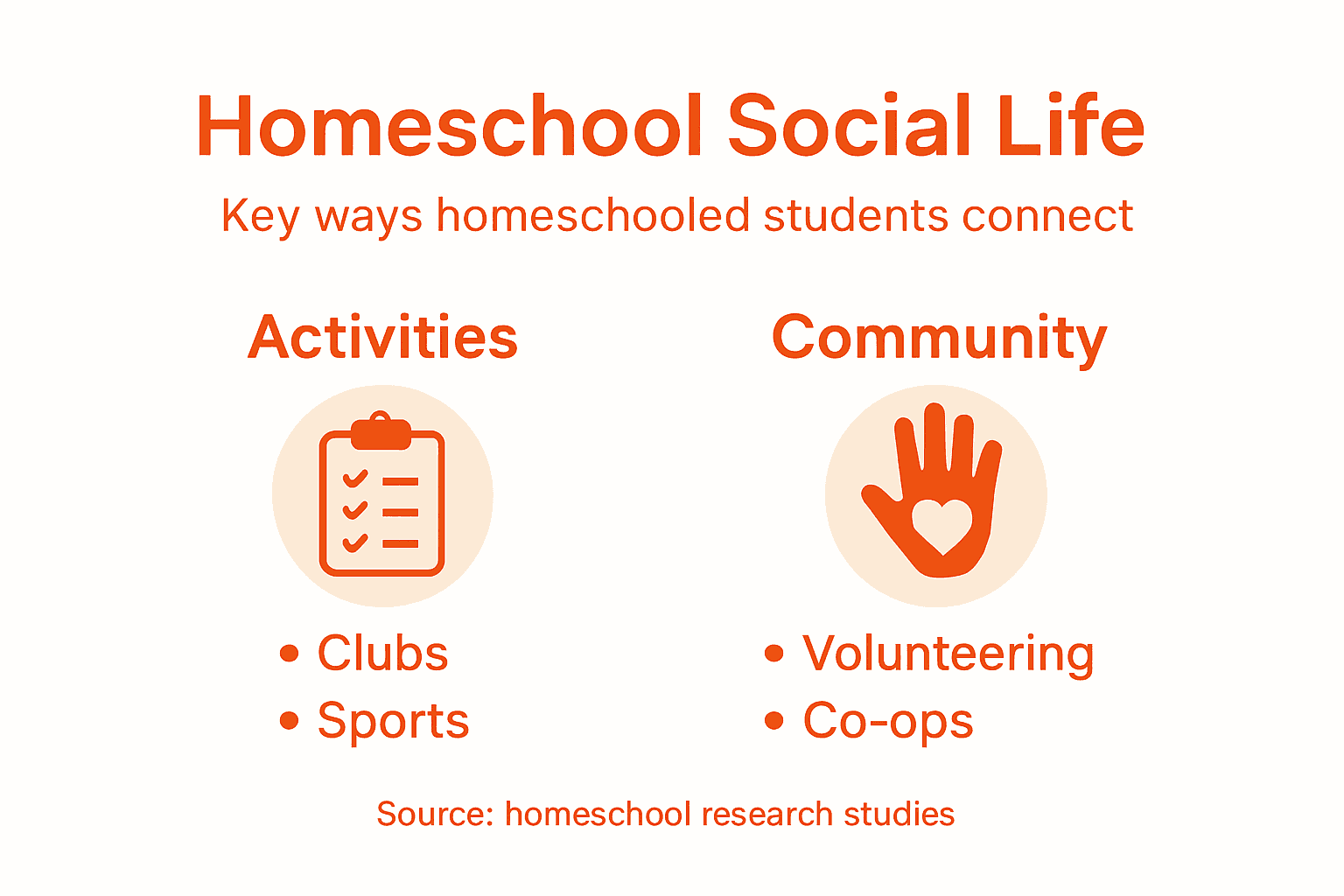
Types of Social Opportunities for Homeschoolers
Here’s something that might surprise you: homeschoolers actually have access to way more social options than you’d think. The misconception is that homeschooling limits your social life, but the reality is that you get to choose from a broader range of activities and groups than traditionally schooled students. Instead of being stuck with just the people in your grade at school, you can pick activities based on your actual interests.
Let’s break down what’s actually available to you. Homeschoolers participate in diverse social environments including homeschool co-ops where you meet other homeschooling families, local clubs based on your hobbies, sports teams in your community, church or religious groups, volunteer organizations, and structured classes or workshops. Some homeschoolers join debate clubs, robotics teams, art classes, music lessons, or academic competitions. Others get involved in environmental groups, youth leadership programs, or service projects. The key difference is that you’re not automatically grouped with everyone your age. You’re around people who share your actual interests, which means the friendships you form tend to be deeper and more meaningful.
The quality of these connections matters too. When you’re in a homeschool co-op learning chemistry together, you’re working with kids who chose to be there because they wanted to learn that subject. When you’re on a community sports team, you’re with people focused on that sport, not just forced into the same grade. Mixed age interactions through varied social settings actually help you develop better communication skills because you learn how to relate to people at different life stages. You figure out how to talk to younger kids, peers, adults, and older teens. That’s a skill that traditional school doesn’t naturally teach, since everyone around you is basically the same age.

One more thing worth knowing: homeschoolers who participate in these activities tend to have strong self-concept and actually resist negative peer pressure better than their traditionally schooled peers. Why? Because you’re choosing your communities instead of being assigned them. You’re less likely to feel trapped in a social situation that doesn’t work for you, which means you’re more confident saying no to things that don’t align with your values.
Here’s a summary of key socialization opportunities for homeschoolers and the unique benefits they offer:
| Activity Type | Example Opportunities | Unique Social Benefit |
|---|---|---|
| Homeschool co-ops | Group learning, science labs | Mixed-age collaboration, teamwork skills |
| Community-based clubs | Robotics, art, debate | Shared interests, lasting friendships |
| Sports & recreation | Youth leagues, martial arts | Teamwork, discipline, diverse peers |
| Volunteer organizations | Food banks, charity events | Empathy, service mindset, adult mentors |
| Religious groups | Youth groups, choir, study | Shared values, multigenerational ties |
Pro tip: Browse your local community calendar or search online for activities that match your interests (sports leagues, art classes, volunteer opportunities, debate clubs), then commit to one or two for the next few months to build real friendships rather than sampling everything at once.
Practical Ways to Build Meaningful Friendships
Knowing where to find social opportunities is one thing. Actually building real friendships from those opportunities is another. The good news? Homeschoolers have some serious advantages here because you’re not forced into surface-level relationships with people you barely know. You can actually be intentional about the friendships you develop.
Start by showing up consistently to activities you genuinely care about. Meaningful friendships develop through regular interaction in groups focused on shared interests, whether that’s a robotics club, volunteer project, or sports team. Consistency matters way more than you think. When you show up week after week to the same activity, people start recognizing you, conversations get deeper, and actual bonds form. One person you see every week will become a better friend than five people you see once each. Plus, when you’re both there because you actually want to be doing that thing, you have something real to connect over. You’re not just stuck together in a classroom. You chose this, and they chose it too.
Be the person who initiates plans outside of the main activity. This is where friendships actually solidify. After robotics team practice, suggest grabbing food. After volunteer day, ask if someone wants to hang out this weekend. After sports practice, text that person a funny meme about what happened that day. Small gestures matter. You’re building history together, creating inside jokes, and showing that you value the friendship beyond just seeing them in one setting. Community involvement strengthens interpersonal connections and emotional development because you’re actually investing in relationships rather than treating friendships as something that just happens automatically.
Here’s something else worth knowing: quality beats quantity every single time. You don’t need ten friends. You need two or three real ones who actually get you. When you’re being selective about where you spend your time and who you spend it with, you naturally build deeper connections. You’re less likely to get pulled into drama or situations that don’t work for you because you chose these people and these communities. That confidence in your friendships? That’s gold.
Pro tip: After you find an activity or group you like, challenge yourself to have one genuine conversation per week with someone there, and suggest doing something together outside that activity within the first month to deepen the connection.
Overcoming Barriers and Common Misconceptions
Let’s be honest. Even with all the research showing homeschoolers are socially fine, you’re still going to hear the same tired question from relatives, neighbors, and random people at the grocery store. “But what about socialization?” It gets old. What’s frustrating is that outdated stereotypes about homeschool isolation persist even though they don’t match reality. These stereotypes come from a time when homeschooling looked completely different than it does now. Back then, maybe some homeschoolers were more isolated. Today? The homeschooling community actively connects kids with diverse social environments. But perception lags behind reality, which means you might have to do some educating of your own.
The real barriers aren’t what people think they are. It’s not that homeschoolers can’t socialize. It’s that you don’t automatically get handed a built-in social life the way traditional school students do. You have to be more intentional. If you live in a rural area with limited access to community programs, that’s a genuine obstacle. If your family can’t afford to pay for multiple activities, that matters. If you’re shy and struggle to put yourself out there, that’s real too. But here’s the thing: these barriers are solvable. You don’t need expensive programs. Free or low-cost options exist everywhere: community centers offer sports and classes, libraries host clubs and events, volunteer opportunities abound, churches and religious organizations run youth groups, and online communities connect homeschoolers across distances. The barrier isn’t homeschooling itself. It’s access and effort.
The other misconception people have is thinking socialization only means hanging out with peers your age. Socialization involves family and community engagement, not just friendships. When you volunteer at a food bank, you’re learning how to work with diverse adults and contribute to something bigger than yourself. When you attend family gatherings or help at community events, you’re developing social responsibility and understanding how society actually works. That’s socialization too, and homeschoolers get tons of it because they’re out in the real world doing real things, not sitting in a classroom all day.
So how do you handle the skepticism? Stop trying to convince everyone. Seriously. You can’t force people to understand, and you’ll drive yourself crazy trying. Instead, live your life. Build your friendships. Join your activities. Be well-adjusted and confident in your social skills. That’s the best argument you have. When people see that you’re friendly, confident, and socially capable, the stereotype loses its power. You become the proof that the myth isn’t real.
Pro tip: Keep a simple list of the activities and clubs you’re involved in, along with a few genuine friendships you’ve built, so when someone questions your socialization, you have concrete examples ready instead of getting defensive.
Ensuring Balanced Social and Academic Growth
Here’s something that might seem obvious but actually trips up a lot of homeschoolers: you need both a solid academic life and a solid social life. They’re not competing with each other. They work together. When you’re getting a good education and building real friendships at the same time, you feel more confident overall. You’re not stressed about falling behind academically, and you’re not lonely because you’re stuck studying all the time. Balance is key, and homeschooling actually gives you the flexibility to make that happen better than traditional school does.
The way you build this balance is by being intentional about both sides. Set aside dedicated time for your academics. Get your schoolwork done during focused study blocks, then you can relax knowing it’s handled. But don’t isolate yourself during those study hours. Homeschoolers achieve positive outcomes in social and academic domains by participating in co-ops, volunteer projects, and extracurricular activities that complement their academics rather than compete with them. A homeschool co-op where you attend two classes per week doesn’t take away from your academics. It actually supports them because you’re learning from other teachers and interacting with peers in an educational setting. Same with joining a debate club or academic team. You’re studying, but you’re doing it with other people. That’s not a distraction from academics. That’s enhancement.
The timing matters too. Don’t try to cram everything into every day. Some days you might have heavier academics with lighter social commitments. Other days you might have a big social event and lighter academics. That flexibility is one of homeschooling’s superpowers. You can actually structure your week to balance things out instead of forcing yourself into the same schedule every single day. One week you might be focused on finishing a big project, so you scale back social stuff. The next week you might have less academic work and can dive deeper into a club or activity. This rhythm actually reduces stress because you’re not trying to do everything at maximum intensity simultaneously. Traditional school doesn’t give you this option. You’re stuck in a fixed schedule regardless of what’s going on in your life.
One more thing worth mentioning: the research shows that homeschoolers who do this well actually experience fewer behavioral problems and less emotional turmoil than their traditionally schooled peers. Why? Because you’re in a supportive family setting, you’re learning in a way that works for you, and you’re choosing your social communities. That combination creates a healthier overall development. You’re not stressed out trying to fit into a system designed for someone else. You’re building a life that actually works for you.
Pro tip: Create a weekly planner that blocks out your academic time and your social commitments side by side, aiming for roughly 60 percent academics and 40 percent social activities, then adjust the ratio based on how you’re actually feeling and performing.
Break the Socialization Myth and Thrive in Your Homeschool Journey
Feeling uncertain about finding real social connections while homeschooling is common but avoid letting that worry hold you back. This article shows that socialization depends on intentional engagement and meaningful activities rather than just being in a traditional classroom. You can build strong friendships through consistent participation in groups and community events that inspire you. If you want to balance academic growth with social well-being and build the skills that matter beyond the classroom, there is support available.
Explore proven strategies on mastering time management, productivity, and cultivating a healthy lifestyle tailored for high school and college students. At Learning With Angie, you will find resources designed to help you manage your academic workload while making space for enriching social activities that nurture genuine friendships. Begin with simple steps like creating a personal planner or developing habits that boost your confidence in social settings. Don’t wait to take control of your learning experience and social life.
Embrace the freedom of homeschooling while building meaningful connections and achieving your goals with our expert guidance.
Frequently Asked Questions
What is the homeschooling socialization myth?
The homeschooling socialization myth is the misconception that homeschooled children lack social skills and opportunities for social interaction. Many people believe that learning at home leads to isolation, but research shows that homeschoolers often develop strong social skills through diverse interactions.
How can homeschoolers build meaningful friendships?
Homeschoolers can build meaningful friendships by consistently participating in activities they enjoy, such as sports, clubs, or community service. Initiative is key; they should suggest hanging out outside of these activities to deepen connections.
What types of social opportunities are available for homeschoolers?
Homeschoolers have access to various social opportunities, including homeschool co-ops, community clubs, sports teams, volunteering, and religious groups. These activities allow for interactions with peers of different ages and shared interests, enhancing social skills.
How can I ensure a balance between academics and social life while homeschooling?
To ensure balance, set dedicated time for academic studies and participate in social activities that complement learning. Creating a flexible schedule allows you to prioritize academics on some days and social commitments on others, promoting overall well-being.
Recommended
- 10 Unique College Essay Ideas to Stand Out in Applications
- Create Your Success: Ultimate Goal Setting Checklist
- 15 Reasons the Feynman Technique Is a Game-Changer for Students
- 12 Apps That’ll Stop Social Media From Destroying Your GPA (From Someone Who Almost Failed Because of TikTok)
Want a head start? The Building Self-Confidence workbook in my shop was made for exactly this — it’ll save you a ton of time.