You know the feeling when your to-do list keeps growing and your energy starts shrinking before lunch. Balancing homework, interests, and downtime as an American high school student takes more than willpower. When you define a clear daily purpose and build a plan that centers on your personal goals, you tap into intrinsic motivation that can last all week. This guide shows you how to set meaningful goals, create effective study habits, and celebrate progress so your motivation actually sticks.
Quick Summary
| Key Insight | Explanation |
|---|---|
| 1. Set a Clear Daily Purpose | Identifying a specific goal boosts motivation and focus throughout the day. Write down your purpose visibly to remind yourself. |
| 2. Design a Custom Study Schedule | Create a realistic study plan that matches your energy levels and commitments for better consistency. Adjust as needed. |
| 3. Incorporate Rewards for Achievements | Reward yourself immediately after completing tasks to strengthen motivation and create positive associations with studying. |
| 4. Track Progress and Adjust Plans | Monitor your study habits weekly to identify patterns and make necessary adjustments, enhancing overall effectiveness. |
| 5. Celebrate Consistency and Growth | Acknowledge your achievements regularly to boost motivation and reinforce the commitment to your study habits. |
Step 1: Set a Clear Daily Purpose
When you’re managing your own school day, having a clear purpose is what separates a productive morning from one where you’re just spinning your wheels. Think of your daily purpose as your anchor. It’s the reason you’re showing up, what you actually want to accomplish today, and why it matters to you. Without this, motivation evaporates like water on a hot sidewalk.
Start by asking yourself what you really want to get done today. Not what you think you should do or what sounds good on paper, but what actually drives you. Maybe it’s finishing that challenging math assignment before dinner so you can finally relax. Maybe it’s nailing your chemistry presentation because you want to ace that class. Maybe it’s reading two chapters for history because you’re genuinely curious about that time period. Defining your why gives you a concrete reason to stay focused when distractions creep in. Write down your purpose somewhere visible. Your phone note app works. A sticky note on your monitor works. Your actual notebook works. The act of writing it down makes it real, not just a vague feeling in your head.

Here’s what happens next: when you feel unmotivated to study at 2 PM, you look at that purpose and remember why you committed to today. Maybe you promised yourself you’d understand calculus better, or finish a project early so you can help a friend with theirs. Intrinsic motivation thrives when you experience autonomy, meaning when your goals feel chosen by you, not forced by someone else. This is huge. You’re not studying because a teacher demanded it. You’re studying because you decided this matters to you. That difference changes everything.
Take five minutes right now to set your purpose for today. What’s one thing you want to accomplish in your academics right now? What’s one thing you want to learn? Write it down. Be specific. “Do homework” is vague. “Complete the first four chemistry problems and understand how to balance equations” is clear. When your purpose is crystal clear, your motivation has something to grab onto.
Pro tip: Revisit your daily purpose around midday, especially when you’re feeling the afternoon motivation slump. A quick 30-second reminder of why you started can reignite your focus and pull you through the final push of your study session.
Step 2: Design a Custom Study Schedule
Now that you know your daily purpose, it’s time to build a study schedule that actually works for you, not against you. This isn’t about following some rigid plan that looks good on paper but falls apart by Wednesday. This is about mapping out your week in a way that fits your real life, your energy levels, and your commitments.
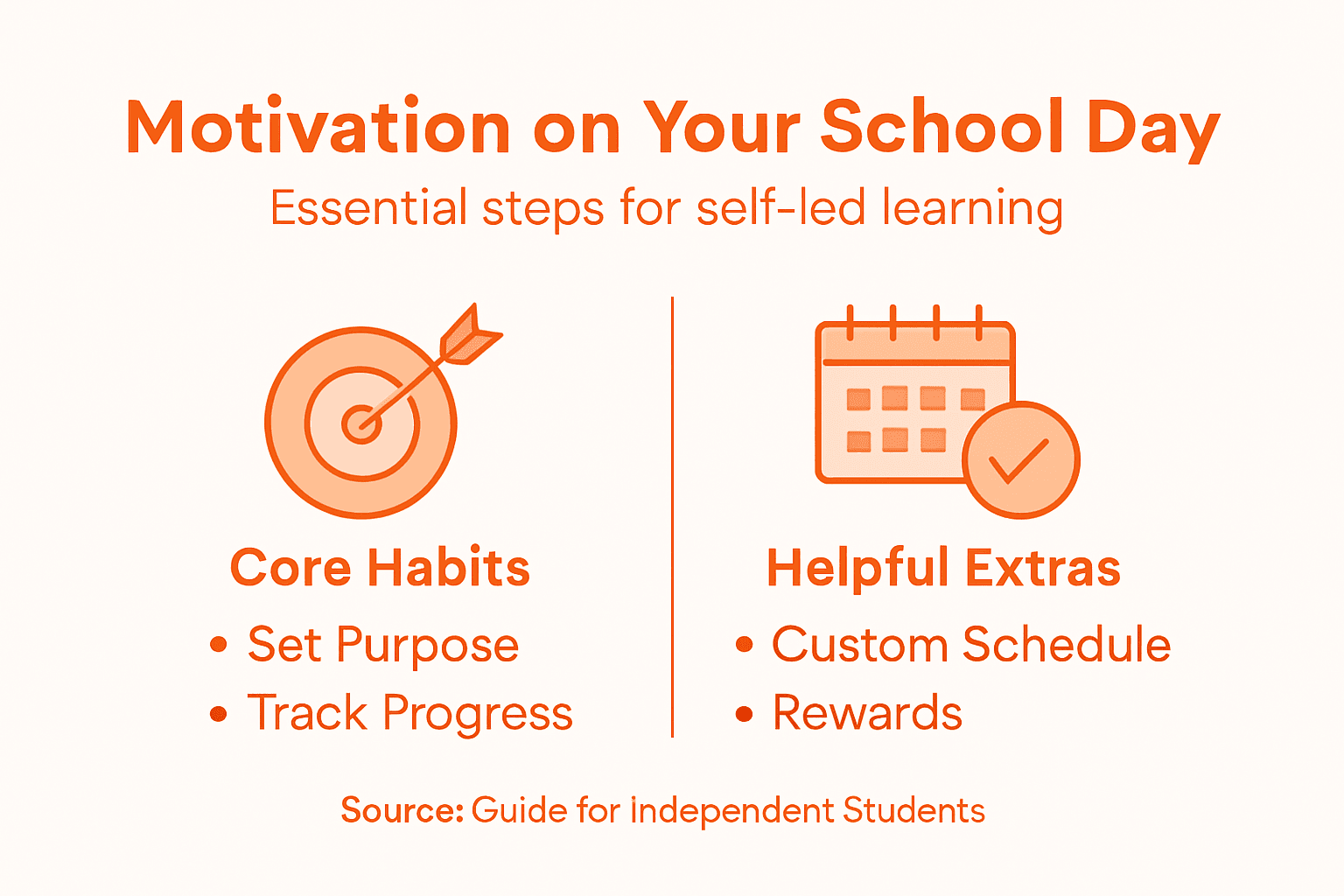
Start by looking at everything on your plate right now. What classes are you taking? When are your assignments due? Do you have sports, work, or other activities eating into your time? Write all of this down. Then look at your calendar and map out your deadlines and priorities so you can see exactly what’s coming at you and when. This gives you the full picture. Now comes the real work: designing blocks of study time that feel realistic. If you’re a morning person who wakes up at 6 AM, don’t force yourself into a midnight study session because some productivity article said you should. If you have soccer practice at 3 PM, don’t schedule your hardest studying right before that when your brain is exhausted from physical activity.
Think about when your brain actually works best. Are you sharp first thing in the morning? Then claim that time for challenging subjects like math or chemistry. Do you hit a wall around 2 PM? Schedule lighter tasks like organizing notes or reading for classes where you don’t need full focus. Be honest with yourself about how long you can actually concentrate. Most people can handle about 90 minutes of deep focus before they need a real break, not just scrolling on your phone for two minutes. So instead of blocking off three hours of “study time” that never happens, try three sessions of 90 minutes with actual breaks in between. Your schedule should also account for your self-care because let’s be real, if you’re burned out and exhausted, your motivation disappears completely. That means sleep, movement, eating actual food, and time to just relax. These aren’t luxuries that come after studying. They’re part of your schedule because they directly support your ability to show up and do good work.
Once you build your initial schedule, live with it for a week and then adjust. Maybe you realized you need more time on Mondays for planning, or Thursday evenings are way too chaotic for studying. That’s fine. Your schedule should evolve as you learn what actually works for you. The goal isn’t perfection. The goal is consistency and a schedule that you’ll actually follow because it fits your real life.
Below is a summary of key study schedule design factors and their real-world impact:
| Factor | Why It Matters | Impact on Results |
|---|---|---|
| Time of day | Matches energy peaks | Improves focus and retention |
| Session length | Prevents burnout | Boosts productivity and consistency |
| Breaks included | Supports mental recovery | Maintains steady motivation |
| Adapts to commitments | Fits sports, work schedules | Reduces conflict and stress |
| Personal adjustment | Reflects ongoing feedback | Enhances long-term success |
Pro tip: Block off your study time like you would a class or a job commitment, treating it as non-negotiable time on your calendar, and use the same time slots each day so your brain gets into a rhythm and doesn’t need as much willpower to get started.
Step 3: Incorporate Rewards for Achievements
You’ve set your purpose and built your schedule. Now comes the fun part: giving yourself credit when you actually follow through. Rewards aren’t just about feeling good, though that’s definitely part of it. They’re about creating a system that keeps you motivated over the long haul. When you celebrate your wins, no matter how small, your brain releases dopamine. That’s the chemical that makes you want to keep going. It’s the difference between white knuckling your way through studying and actually enjoying the process.
Start by identifying what kinds of rewards actually appeal to you. This is super personal. Maybe you love taking a 30-minute gaming session after completing a tough assignment. Maybe it’s ordering your favorite coffee, scrolling through social media guilt-free, watching an episode of a show you’re obsessed with, or just lying in bed doing absolutely nothing for 15 minutes. The key is that your reward has to mean something to you, not something you think you should want. Don’t make your reward something that contradicts your goal either. If you’re studying to feel healthier, rewarding yourself with junk food doesn’t send the right message to your brain. Structured reward systems can enhance motivation when they recognize achievements and celebrate milestones, which means you’re not just casually throwing in rewards, you’re being intentional about it. Set specific achievement thresholds before you get the reward. Don’t tell yourself “I’ll reward myself when I’m done studying” because that’s too vague and easy to negotiate away. Instead say “I’ll reward myself after completing all five chemistry practice problems accurately” or “After finishing this chapter and writing three study notes, I get 20 minutes of free time.” The specificity matters because it gives you a clear finish line.
Here’s what makes rewards actually work: they need to happen right after you finish what you set out to do. Don’t say you’ll reward yourself on Friday for all your hard work this week. That’s too far away. Your brain needs the connection between effort and reward to be fresh. So you finish those chemistry problems, and boom, you get your coffee or your gaming time or whatever it is. The timing creates a strong association in your brain that says “I did hard things, and good things happened.” Over time, this makes it easier to motivate yourself because your brain knows there’s something enjoyable waiting on the other side. Also remember that your rewards don’t have to cost money or take forever. Some of the best rewards are tiny moments of pleasure that add up. A favorite snack, a walk outside, calling a friend, watching funny videos for ten minutes, taking a hot shower, or even just writing a win in your journal. These small acknowledgments add up and keep you moving forward without burning you out.
Pro tip: Create a list of 10 to 15 rewards ranging from quick (five minutes or less) to medium (15 to 30 minutes) so when you finish a task, you can immediately grab a reward that matches the size of your accomplishment without having to think about what you deserve.
Here’s a comparison of common reward types and their motivational benefits for students:
| Reward Type | Example Activities | Motivational Benefit |
|---|---|---|
| Quick (≤5 min) | Enjoy a favorite snack | Immediate boost to motivation |
| Medium (15–30 min) | Watch one TV episode | Sustained incentive after effort |
| Social | Call a friend after studying | Emotional support and recharge |
| Physical | Take a walk outside | Refreshes mind and reduces stress |
Step 4: Track Progress and Adjust Plans
Tracking your progress isn’t about obsessing over every detail or turning your study life into a data science project. It’s about knowing what’s actually working and what’s not so you can make smart changes instead of just grinding away hoping something sticks. Think of it like checking the GPS on a road trip. If you’re heading in the wrong direction, you want to know that before you’ve driven for three hours.
Start by deciding what you want to track. This depends on your goals. If you’re trying to improve in math, track your quiz scores or how many problems you’re getting right. If you’re working on reading comprehension, track how well you understand what you read or how many chapters you complete each week. If you’re managing overall motivation, track how many days you stuck to your schedule or how many study sessions you actually completed. Pick two or three things max, or you’ll spend more time tracking than studying. Write these down somewhere simple. A notebook page works. A spreadsheet works. Even a notes app on your phone works. The format doesn’t matter. What matters is that you’re actually recording what’s happening. Once a week, usually Sunday works well, spend five minutes looking at what you tracked. What patterns do you see? Are you crushing it in math but struggling with writing? Are you staying consistent on Mondays but falling off by Friday? Regular progress monitoring helps you make informed decisions about adjusting your approach rather than guessing about what’s working.
Now here’s the crucial part: be willing to change your plan based on what you learn. If your schedule looked perfect on paper but you’re realizing you’re way more focused at night than in the morning, change it. There’s no prize for sticking to a plan that doesn’t work for you. If you set a goal to study for two hours every day but you’re burning out by day three, cut it to 90 minutes. If your reward system isn’t motivating you, swap out the rewards. This isn’t failure. This is learning. Your first plan is basically a hypothesis. You’re testing it out to see what actually works in real life. Some parts will be solid. Other parts will need tweaking. That’s completely normal. The students who stay motivated aren’t the ones who follow the perfect plan. They’re the ones who pay attention to how their plan is actually working and adjust it when something isn’t landing. You’re in charge here. Your system should serve you, not the other way around.
Pro tip: Set a specific time each Sunday evening to review your progress for just five minutes, checking what went well and what needs adjusting, so you start each week with a plan that’s based on real data instead of hope.
Step 5: Celebrate Consistency and Growth
This is the step that most students skip, and it’s actually the one that determines whether you’ll stick with your motivation system or abandon it in three weeks. Celebrating your consistency and growth isn’t frivolous or self-indulgent. It’s the fuel that keeps you going when things get harder. When you acknowledge what you’ve done, your brain releases those feel-good chemicals again, and suddenly you want to keep doing the thing that made you feel that way.
Start by recognizing what consistency actually looks like. You don’t need to be perfect. Perfect is boring and impossible anyway. Consistency means showing up most of the time. It means studying on three out of five weekdays instead of zero. It means sticking to your schedule for two weeks straight even though you wanted to quit on day three. It means trying a new study technique even though the old one was comfortable. These are wins. Real wins. Not the flashy kind you see on social media, but the kind that actually matter because they’re building something sustainable. Take a moment every week to genuinely acknowledge what you’ve done. Maybe you tell a friend about your progress. Maybe you write it down in your journal. Maybe you literally pat yourself on the back or do a little victory dance in your room. It sounds silly, but your brain doesn’t care if you look silly. What it cares about is the signal that you’re doing something right. Growth doesn’t always look like jumping from a C to an A on an exam. Growth looks like understanding a concept that confused you last month. Growth looks like being able to focus for 90 minutes when you could only manage 30 before. Growth looks like having one day where you actually felt motivated instead of dragging yourself through your assignments. These tiny, incremental improvements are what real learning looks like, and they deserve to be celebrated.
Here’s what happens when you celebrate consistency and growth: you create positive associations with your study habits. Your brain starts thinking “I do hard things and then I feel good about myself.” That’s the mindset shift that turns motivation from something you’re chasing to something that’s actually part of who you are. You’re not white knuckling through studying anymore. You’re building a system that works for you because you’ve taken the time to notice what’s working and appreciate it. When you hit a rough patch down the road, and you will, you’ll remember that you’ve done hard things before. You’ll remember that consistency paid off. You’ll remember that growth happened. That memory is powerful. It’s way more powerful than trying to motivate yourself from scratch every single day.
Pro tip: Create a “wins” section in your journal or notes app where you write down one thing you’re proud of each week, whether that’s nailing a test, staying consistent with your schedule, or finally understanding something difficult, so you have a visible record to look back on when motivation dips.
Take Control of Your School Day with Proven Tools and Support
Struggling to maintain motivation when you are the boss of your own school day is a common challenge many students face. The article highlights key pain points like setting clear daily purposes, designing a study schedule that matches your natural energy, and rewarding yourself to build lasting motivation. If managing your time and staying on track sometimes feels overwhelming or if you want to make motivation stick beyond the first week, you are not alone.
Unlock your potential by pairing these strategies with tailored solutions designed for students like you. Explore the resources at Learning With Angie to find practical guides on mastering productivity and maintaining a balanced lifestyle. Whether you want to build a custom study routine or find easy rewards that fuel your drive, our expert tips make it easier to follow through every day. Don’t wait for motivation to come by chance. Start reinforcing your self-led school success and discover how to create your personalized plan. Take the first step now and transform your motivation into momentum!
Frequently Asked Questions
How can I set a clear daily purpose for my school day?
To set a clear daily purpose, identify one specific academic goal you want to achieve. Write it down in a visible place, such as a notebook or a notes app, to remind yourself of your motivation throughout the day.
What should I include when designing a custom study schedule?
When designing a study schedule, include your class commitments, assignment due dates, and personal energy levels. Create blocks of study time that match when you feel most focused and include breaks to maintain your productivity.
How can I incorporate rewards into my study routine?
Incorporate rewards by identifying activities that you genuinely enjoy and can use as incentives after completing specific tasks. For instance, allow yourself to play a game for 30 minutes after finishing a set number of practice problems.
How do I track my progress effectively during my study sessions?
Track your progress by selecting two or three key metrics that reflect your goals, such as quiz scores or days you followed your schedule. Review these metrics weekly to identify patterns and adjust your study plan as needed to optimize your efforts.
Why is celebrating consistency and growth important for motivation?
Celebrating consistency and growth reinforces positive study habits and helps you recognize your accomplishments. Take a moment each week to acknowledge your efforts, which can significantly boost your motivation and create a positive association with your studies.
Recommended
- Create Your Success: Ultimate Goal Setting Checklist
- Productive Day Schedule For Students—Be Productive 12+ Hours a Day!
- Transformative Power of Motivational Quotes in Academic Life
- Aesthetic Morning Routine for College Students Who Are Busy
Want a head start? The Goal Planner in my shop was made for exactly this — it’ll save you a ton of time.