
What’s Your Homeschool Style? Find Your Fit
Every parent faces the challenge of finding an education path that fits their child’s individual strengths. With homeschooling in North America growing quickly, families have more options than ever to craft learning experiences outside the traditional classroom. Exploring homeschool styles opens doors to personalized teaching methods and helps uncover what truly motivates your middle schooler. This overview will help you cut through common myths so you can confidently match resources to your child’s unique needs.
Key Takeaways
| Point | Details |
|---|---|
| Homeschooling Diversity | Families can choose from various styles like Traditional, Classical, Eclectic, and Unschooling to fit their educational goals and children’s learning preferences. |
| Ongoing Adaptation | Successful homeschooling requires regular evaluation and adaptation of teaching methods to meet a child’s evolving educational needs. |
| Financial and Legal Navigation | Parents must understand and navigate the financial and legal implications of homeschooling, as they vary significantly by state and can impact budget and compliance. |
| Social Interaction | Building social skills is crucial, so families should engage in community learning groups and extracurricular activities to ensure diverse social experiences. |
Defining Homeschool Styles and Misconceptions
Homeschooling represents an alternative educational approach that allows families to customize learning experiences outside traditional classroom settings. Home education has evolved dramatically in recent years, moving far beyond the stereotypical images of isolated students studying at kitchen tables.

Contrary to popular belief, homeschooling isn’t a one-size-fits-all method. Families can choose from multiple educational styles ranging from highly structured academic programs to more flexible learning environments. Some parents follow traditional curriculum models that mirror classroom experiences, while others embrace unschooling – an approach that prioritizes student-led exploration and natural curiosity.
The landscape of homeschooling in North America has undergone significant transformation, particularly during the COVID-19 pandemic. What was once considered an unconventional choice has become increasingly mainstream, with parents recognizing the potential for personalized education. Key misconceptions persist, including assumptions about socialization, educational quality, and legal restrictions. In reality, homeschooled students often demonstrate strong academic performance and develop robust social skills through community programs, cooperative learning groups, and extracurricular activities.
Pro tip: Research your state’s specific homeschooling regulations and connect with local homeschool networks to understand the diverse approaches and support systems available in your area.
Popular Homeschool Style Options Compared
Homeschooling offers a diverse array of educational approaches that cater to different learning styles, family philosophies, and student needs. National educational surveys reveal multiple distinct methods families use to customize their children’s learning experiences.
Four primary homeschooling styles emerge as particularly popular among American families:
-
Traditional School-at-Home: Closely mimics traditional classroom structures with structured curricula, textbooks, and scheduled lessons. Parents typically follow a predefined academic program that resembles conventional school settings.
-
Classical Education: Emphasizes critical thinking and language development through a structured approach based on historical learning models. This method divides learning into three developmental stages: grammar, logic, and rhetoric. Curious what the logic and rhetoric stages look like in practice? Hillsdale College, a school known for classical education, offers a free course called Classical Logic and Rhetoric that parents and teens can work through together.
-
Eclectic Homeschooling: A flexible approach that combines multiple curriculum sources and teaching methods. Parents selectively choose resources from various educational philosophies to create a personalized learning experience.
-
Unschooling: A student-led learning style that prioritizes natural curiosity and self-directed exploration. Homeschooling approaches in this method minimize formal instruction, allowing children to learn through real-world experiences and personal interests.
Each style offers unique benefits and challenges, reflecting the incredible diversity of homeschooling in North America. The key is finding an approach that matches your child’s learning preferences, your family’s educational goals, and available resources.
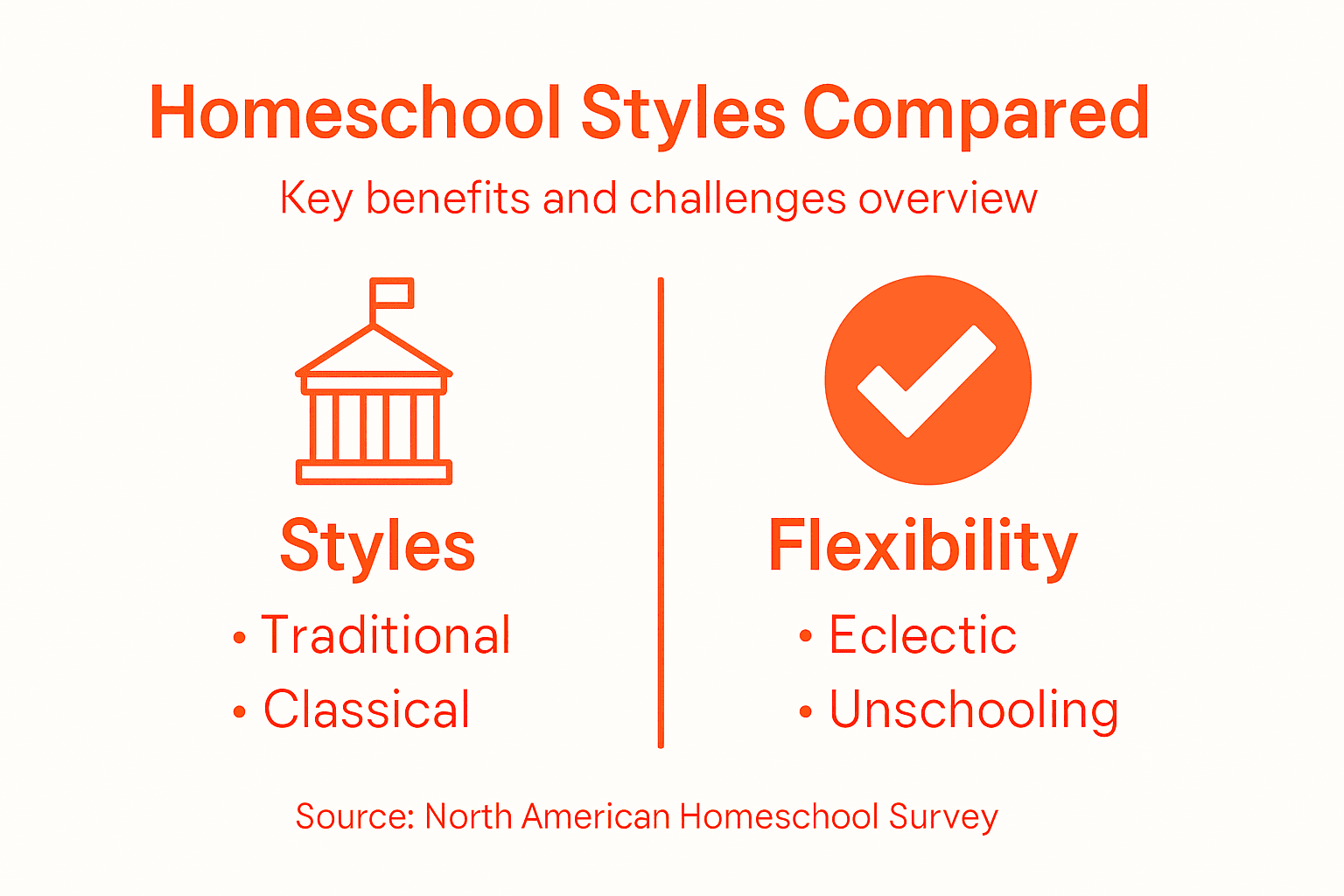
Here’s a quick summary of how major homeschool styles suit different learning preferences:
| Homeschool Style | Ideal For | Parental Involvement | Flexibility Level |
|---|---|---|---|
| School-at-Home | Structure-loving children | High daily guidance | Low flexibility |
| Classical | Analytical, language-driven students | Moderate planning | Moderate flexibility |
| Eclectic | Creative, adaptable learners | Tailored involvement | High flexibility |
| Unschooling | Self-motivated, curious children | Minimal direct teaching | Very high flexibility |
Pro tip: Experiment with different homeschooling styles and remain flexible, understanding that your approach might evolve as you learn more about your child’s learning preferences.
Key Features of Each Homeschool Approach
National educational surveys reveal the complexity and diversity of homeschooling approaches, highlighting how each style offers unique educational experiences tailored to individual family needs and student learning preferences.
Traditional School-at-Home Features
- Structured daily schedule mimicking conventional classroom environments
- Pre-packaged curriculum with standardized textbooks
- Regular testing and progress assessments
- Detailed record-keeping and academic documentation
- Minimal flexibility in learning pace and subject exploration
Classical Education Characteristics
- Focuses on developing critical thinking skills
- Organized into three developmental learning stages
- Emphasizes classical languages and historical literature
- Structured approach with rigorous academic expectations
- Strong foundation in logic, grammar, and rhetorical skills
Eclectic Homeschooling Approach
- Combines multiple curriculum sources
- Highly personalized learning experience
- Flexible teaching methods and resources
- Adaptable to individual student’s learning style
- Selective approach to educational materials
Unschooling Philosophy
- Homeschooling approaches prioritize student-driven learning
- Minimal structured curriculum
- Learning occurs through natural curiosity and real-world experiences
- No formal testing or standardized assessment
- Emphasizes intrinsic motivation and personal interests
Understanding these distinctive features helps families choose an approach that best supports their child’s educational journey and personal development.
Pro tip: Conduct periodic evaluations of your chosen homeschooling style and remain open to adjusting your approach as your child’s educational needs evolve.
Matching Styles to Your Child’s Learning Needs
Understanding learning dynamics requires moving beyond rigid categorizations and recognizing the unique ways each child absorbs and processes information.
Parents should observe their child’s natural learning tendencies through careful assessment of several key indicators:
- Engagement Level: Notice which activities capture your child’s sustained attention
- Information Processing: Watch how they naturally approach problem-solving
- Motivation Triggers: Identify what sparks genuine curiosity and excitement
- Comfort Zones: Recognize environments where they feel most confident
While traditional learning style models suggest fixed categories like visual, auditory, or kinesthetic learners, contemporary research emphasizes flexibility. Collaborative learning research indicates that most children benefit from multi-modal instructional approaches that engage multiple sensory pathways.
Successful homeschooling requires ongoing observation and adaptation. Your chosen approach should remain dynamic, shifting as your child grows and develops new intellectual capabilities. The goal isn’t to force a particular style, but to create an environment that supports natural learning curiosity and intellectual growth.
Pro tip: Conduct periodic informal assessments of your child’s learning preferences, using open-ended conversations and hands-on experimentation to discover what truly motivates their educational journey.
Financial, Legal, and Social Considerations
Homeschooling research reveals a complex landscape of challenges and opportunities that extend far beyond traditional educational decision-making. Families considering this path must carefully navigate multiple interconnected dimensions.
Financial Considerations
- Potential reduction in household income if a parent becomes primary educator
- Curriculum and learning materials cost between $500-$2,500 annually
- Additional expenses for supplemental resources, technology, and learning tools
- Potential tax deductions or educational credits in some states
- Long-term investment in personalized educational experiences
Legal Requirements
- Regulations vary significantly by state
- Mandatory documentation of educational progress
- Required standardized testing in many jurisdictions
- Specific parent qualification requirements
- Annual assessments and compliance reporting
Social Dimensions
Global community resources highlight critical social considerations for homeschooling families:
- Proactive engagement in community learning groups
- Participation in extracurricular activities
- Building social networks through homeschool cooperatives
- Ensuring diverse interaction opportunities
- Addressing potential socialization concerns
Successful homeschooling requires a holistic approach that balances educational goals with practical, legal, and social realities. Families must remain flexible, informed, and committed to creating comprehensive learning experiences.
Compare the major financial, legal, and social factors that affect homeschool families:
| Factor | Typical Challenge | Example Solution | Impact on Family |
|---|---|---|---|
| Financial | Cost of materials | Use free online resources | Budgeting needs |
| Legal | Regulations vary by state | Join local associations | Ongoing compliance |
| Social | Finding peer connections | Attend co-op activities | Fosters social skills |
Pro tip: Connect with local homeschool associations and online communities to gain insights, share resources, and navigate regulatory requirements more effectively.
Common Mistakes and How to Avoid Them
Homeschooling guidance reveals several critical pitfalls that can derail even the most well-intentioned educational journeys. Understanding these potential challenges is the first step toward creating a successful homeschooling experience.
Planning and Consistency Mistakes
- Failing to establish a structured daily routine
- Inconsistent learning schedules
- Neglecting long-term educational goals
- Avoiding comprehensive lesson planning
- Underestimating time management requirements
Legal and Documentation Errors
- Overlooking state-specific homeschooling regulations
- Inadequate record-keeping
- Missing mandatory assessment requirements
- Failing to track academic progress systematically
- Neglecting required documentation
Social and Emotional Challenges
Educational research highlights common social development mistakes:
- Insufficient social interaction opportunities
- Overprotecting children from diverse experiences
- Limiting extracurricular engagement
- Failing to develop independent learning skills
- Avoiding peer collaboration and group learning
Successful homeschooling requires continuous learning, adaptation, and a proactive approach to addressing potential challenges. Parents must remain flexible, informed, and committed to their child’s comprehensive educational development.
Pro tip: Create a monthly review process to assess your homeschooling strategy, allowing for timely adjustments and continuous improvement of your educational approach.
Find Your Perfect Homeschool Style and Boost Your Learning Journey
Choosing the right homeschooling style can feel overwhelming with so many options like Traditional School-at-Home, Classical Education, Eclectic Homeschooling, and Unschooling. Each approach comes with unique challenges such as maintaining consistency, adapting to your child’s learning needs, and balancing social and legal requirements. You might feel uncertain about how to manage time effectively, stay organized, or keep motivated throughout this personalized educational path.
That is where Learning with Angie can make a real difference. Our proven strategies for mastering time management, productivity, and budgeting empower you to create a structured yet flexible homeschool routine tailored to your family’s goals. Discover resources and tips to enhance your academic performance while maintaining a balanced lifestyle. Don’t let uncertainty hold you back — take the first step today and explore how our expert guidance can help you confidently navigate your homeschooling experience by visiting Learning with Angie.
Frequently Asked Questions
What are the main homeschooling styles?
Homeschooling styles include Traditional School-at-Home, Classical Education, Eclectic Homeschooling, and Unschooling. Each style caters to different learning preferences, parental involvement, and flexibility levels.
How do I choose the right homeschool style for my child?
Observe your child’s learning tendencies by assessing their engagement levels, information processing methods, motivation triggers, and comfort zones. This understanding will guide you in selecting the right approach that resonates with your child’s individual needs.
What are the financial considerations of homeschooling?
Financial considerations include potential reductions in household income, costs for curriculum and materials ranging from $500 to $2,500 annually, and additional expenses for tools and resources. Families should also explore possible tax deductions depending on their state regulations.
What legal requirements should I be aware of when homeschooling?
Legal requirements vary by state and may include documentation of educational progress, mandatory standardized testing, and specific qualifications for parents. It’s essential to research and comply with your state’s homeschooling regulations.