How to Create a Homeschool Schedule That Doesn’t Feel Like School
Every homeschooling parent knows that juggling academic goals and downtime can turn scheduling into a daily challenge. Middle school is a time when students crave both independence and structure, making it easy for rigid routines to miss the mark. By focusing on individualizing curriculum based on your student’s unique interests, you can build a flexible homeschool schedule that sparks real engagement while leaving room for creativity, choice, and much-needed leisure breaks.
Quick Summary
| Key Insight | Explanation |
|---|---|
| 1. Identify Student Interests | Engage in open conversations with your student to uncover their genuine interests and learning needs for a personalized educational approach. |
| 2. Create Dynamic Time Blocks | Design flexible time blocks that allow for varied learning activities, adapting them based on your student’s energy and engagement levels. |
| 3. Integrate Movement and Breaks | Schedule regular movement and leisure breaks to enhance focus and cognitive performance, making learning more effective and enjoyable. |
| 4. Allow for Schedule Flexibility | Build in buffer times within your schedule to adjust activities based on daily realities, ensuring your plan remains adaptable to your student’s needs. |
| 5. Regularly Review and Adjust | Periodically evaluate the effectiveness of your schedule, discussing with your student to make necessary adjustments for improved engagement and learning outcomes. |
Step 1: Identify learning priorities and interests
Before you build your schedule, you need to figure out what actually matters to your student. This isn’t about what you think should matter or what traditional school emphasizes. This is about discovering what your kid genuinely cares about and what skills they actually need to develop. When you take time to understand these priorities, your whole schedule becomes more natural and way less painful.
Start by having a real conversation with your student about what excites them. What do they love talking about? What do they spend their free time doing? Do they get lost in fantasy novels, spend hours coding games, or take apart appliances to see how they work? These aren’t distractions from learning, they’re doorways to it. Parents often homeschool specifically to individualize curriculum based on their child’s unique interests, and this step is where that magic happens. Ask your student what they want to get better at, what subjects feel boring to them, and what they’d choose to learn about if no one was forcing them. Write down their answers. Don’t judge them. Just listen.
Next, look at the practical side. What academic skills does your student actually need to master? Are they planning to go to college? Do they need to catch up in a specific area? Will they need certain certifications or credits? Homeschooling families customize their approach based on these real learning goals, not one-size-fits-all requirements. Ask yourself what non-negotiable academics matter for your family’s situation. Maybe reading and math are absolute must-haves. Maybe writing matters because your student loves storytelling. Maybe science is critical because they want to be an engineer. Maybe history is less important than practical life skills. You get to decide what actually counts.
Here’s where it gets practical. Create a simple list with two columns. On one side, write down what your student loves. On the other side, write down what they need to learn. Look for overlap. Can you teach grammar through creative writing? Can you teach research skills by diving deep into a topic they’re obsessed with? Can you cover history through documentaries about their favorite time period? The overlap between their interests and your priorities becomes the sweet spot where learning stops feeling like school and starts feeling like actual growth.
Don’t overthink this part. You don’t need a fancy system or a 50 page assessment. You just need clarity about what matters. Talk to your student multiple times if you need to. People’s interests shift, and that’s okay. The goal right now is to get a real picture of what you’re working with so that when you build your schedule, it actually fits your life instead of fighting against it.
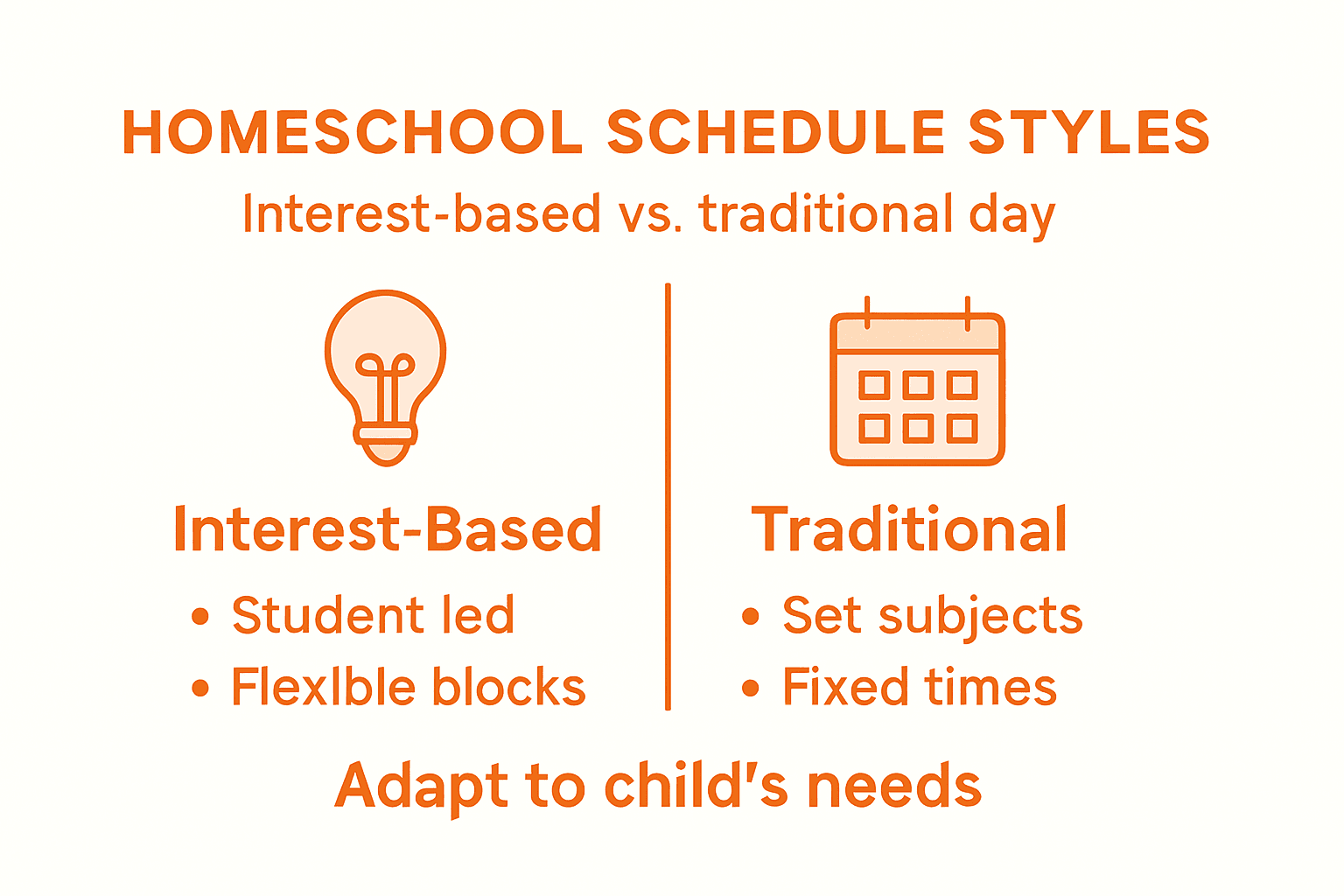
Here’s a quick overview of how interest-based and traditional homeschool scheduling approaches differ:
| Aspect | Interest-Based Schedule | Traditional Schedule |
|---|---|---|
| Content Selection | Follows student’s passions | Follows standard curriculum |
| Engagement | High, driven by interests | May vary, often lower |
| Adaptability | Easily adjusted as interests evolve | Fixed and less flexible |
| Role of Student | Central to decision-making | Follows teacher’s plan |
Pro tip: Start small by asking your student to list three things they’re genuinely interested in and three skills they actually want to develop, then look for one way to combine at least two of these in your schedule.
Step 2: Design blocks for dynamic activities
Now that you understand what your student cares about and what they need to learn, it’s time to create time blocks that actually hold their attention. A time block is just a chunk of your day dedicated to a specific type of learning activity. The key word here is dynamic, which means these activities can change and grow as your student’s engagement shifts. You’re not locking yourself into something rigid. You’re creating flexible containers for learning that keep things interesting.

Start by thinking about the types of activities your student needs throughout the week. Maybe they need focused time on math fundamentals. Maybe they need hands-on exploration time. Maybe they need reading time, project time, or creative time. Parents designing personalized curricula can select resources and create assignments tailored to their child’s interests, which means you have total freedom here. You might have a block called “Math Focus” from 9 to 10 AM where they tackle problem sets or work through a lesson. You might have a “Creative Exploration” block from 10 to 11:30 AM where they dive into whatever fascinates them that week, whether that’s writing a story, building something, conducting an experiment, or researching a topic they’re obsessed with. You might have a “Reading and Writing” block where they work on both comprehension and expression. The point is to group similar types of thinking together so your student gets into a flow state and actually makes progress.
When you’re designing these blocks, think about your student’s energy levels throughout the day. Are they sharpest in the morning? Save your hardest academic work for that time. Do they need movement and hands-on activities after sitting too long? Build that in. Hands-on, dynamic learning activities can be adjusted based on children’s evolving engagement and developmental needs, so you’re not stuck with the same thing forever. If math from 9 to 10 AM stops working because your student is hitting a wall, you can switch it. If they’re suddenly way more engaged in science projects than reading, you can shift your blocks around. This flexibility is actually what makes homeschooling so powerful.
Here’s the practical part. Write down what each block looks like. Don’t make it complicated. Your “Science and Exploration” block might just say “experiments, building projects, or research based on current interests.” Your “Core Skills” block might say “math, reading, writing.” Your “Flexible Learning” block might say “whatever the student chooses from an approved list.” Keep descriptions simple enough that on a random Tuesday morning, your student knows exactly what they’re supposed to be doing without asking a million questions.
One more thing: leave some breathing room in your schedule. Not every block needs to be packed back-to-back starting at 8 AM. Some families find that starting with three or four solid blocks and one flexible block works great. Others prefer more variety and shorter blocks. You’ll figure out what actually works for your family once you start living it.
Pro tip: Start with no more than four or five time blocks in your first schedule, then adjust based on what you actually observe about your student’s energy, focus, and engagement over the first month.
Below is a summary of different homeschool time blocks and their main benefits:
| Time Block Type | Primary Focus | Typical Activities |
|---|---|---|
| Core Skills | Academic essentials | Math, reading, writing |
| Creative Exploration | Curiosity and self-expression | Art, coding, building |
| Science/Inquiry | Investigation and experiments | Hands-on labs, research |
| Flexible Block | Customization | Catch up, deep dive, choice projects |
Step 3: Incorporate movement and leisure breaks
Here’s something that might surprise you: breaks are not interruptions to learning. They’re actually part of learning. When you build movement and leisure breaks into your schedule, you’re not being soft or letting your student slack off. You’re being strategic about how the brain actually works. Your student’s attention span is real, and it has limits. After about 45 minutes to an hour of focused work, their brain starts to fatigue. If you push through without a break, you’ll get diminishing returns. But if you step back and let them move around or do something fun, they reset and come back sharper.
The science backs this up. Short physical activity breaks improve children’s attention and cognitive performance, which means those 10 or 15 minutes your student spends stretching, dancing, or running around the house isn’t wasted time. It’s actually making them more capable of learning when they come back. Think about what happens in their body. When they sit still for long stretches, blood flow slows and their brain gets sluggish. When they move, physical activity boosts blood flow to the brain and enhances memory and attention, which means they literally become sharper. It’s not magic. It’s biology.
So what do these breaks actually look like in your schedule? Build them in intentionally between your time blocks. After your student finishes their math block, don’t immediately start reading. Instead, give them 10 minutes to move. They could go outside and run around. They could dance to their favorite song. They could do jumping jacks or yoga or walk the dog or ride their bike around the driveway. The movement itself matters more than what form it takes. Some families use a timer and make it a game. Some kids prefer going outside while others like dancing in their room. Figure out what your student actually enjoys doing, because they’re way more likely to do it if it’s something they want to do anyway.
Then there’s leisure time, which is different from movement breaks. Leisure time is when your student gets to do whatever they want without any learning goal attached. Read comics. Draw. Play video games. Build with Lego. Chat with friends. Watch their favorite show. This isn’t a reward for finishing their work (though it can be). This is genuine downtime that makes the whole schedule feel less like school and more like actual life. When there’s stuff your student genuinely enjoys built into the day, they stop seeing homeschooling as something they’re being forced to endure. They see it as their life, which it actually is.
Here’s how to actually structure this. Between major time blocks, add a 10 to 15 minute movement break. These should be non-negotiable parts of your schedule, just like math or reading. They’re not something you skip when you’re running behind. Then, build in at least one longer block of leisure time. Maybe it’s 30 minutes in the afternoon where your student can do absolutely anything they want. Maybe it’s an hour after lunch. Maybe it’s from 3 to 4 PM every day. The timing matters less than the consistency. When your student knows that leisure time is coming, they can push through their academic blocks with better focus.
Don’t overthink the types of breaks. Your student will tell you what they actually need. Some kids need wild, chaotic movement. Some prefer calm stretching or a walk. Some need to zone out and do something creative. The best breaks are the ones they’ll actually take without complaining. If you force your kid to do yoga when they actually want to run and jump, they’ll resent it. Pay attention to what works for your specific student and build that in.
Pro tip: Set a timer for breaks so your student knows exactly when movement or leisure time happens and when they need to transition back to learning, which removes the power struggles about whether it’s time to stop playing yet.
Step 4: Personalize routines for flexibility
You’ve identified what matters to your student, designed your time blocks, and built in breaks. Now comes the part that actually makes homeschooling feel less like traditional school: giving your student permission to have flexibility within the structure. This doesn’t mean throwing out your schedule. It means making sure your schedule works for your actual life, not against it. Some days will go exactly as planned. Other days, your student will be sick, inspired to dive deeper into something, struggling with a concept, or just having an off day. Your routine needs to bend without breaking.
Think about what flexibility actually means in your homeschool. Maybe your math block usually happens from 9 to 10 AM, but on Mondays your student has a doctor’s appointment, so you shift it to 2 PM. Maybe your student typically spends their creative exploration block on art projects, but this week they’re obsessed with coding, so they spend three days on code instead. Maybe you planned for reading time to be silent, independent work, but your student is struggling with the material and needs you to sit with them and talk through it. Tailoring pace, instructional approaches, and content to meet individual learner needs supports student engagement, which means you’re not being inconsistent when you adjust things. You’re actually being smart about how learning actually happens.
Here’s what personalization in practice looks like. Start by building buffer time into your schedule. Don’t pack every minute from 8 AM to 3 PM with back-to-back blocks. Leave 15 or 20 minute gaps where things can shift around. If your student finishes math early and wants to keep going, let them. If they finish and need a mental break before moving to the next activity, that’s fine too. These buffers give you flexibility without requiring you to overhaul your whole day. You also might have certain non-negotiable academic requirements that happen daily or several times a week, and then have other blocks that are more flexible. Maybe math and reading are locked in because they’re core skills your student needs to develop. Maybe science and social studies rotate based on what your student actually wants to explore that week. Maybe your student gets to choose between three different project options for their creative block instead of you assigning one specific thing.
Curriculum flexibility and autonomy enable adaptation to learners’ diverse needs and contexts, and this is where that autonomy actually shows up in your student’s life. Give them choices within your structure. Instead of “you’re reading chapter 3 today,” try “you’re reading for 45 minutes, and you can choose to read chapter 3 or that book series you started.” Instead of “you’re doing math problems 1 through 20,” try “you’re working on fractions for 45 minutes, and you can do practice problems, watch Khan Academy videos, or use the manipulatives.” The learning goal stays the same. The student gets to influence how they get there.
One practical way to build flexibility is to create what some families call a “flex block.” This is a time in your schedule that stays the same every day or week, but the content changes based on what your student needs. Maybe it’s 30 minutes from 2 to 2:30 PM every day, and depending on the day, it could be catch-up time if someone fell behind, deep-dive time if they found something they want to explore more, enrichment time for something totally new, or just free choice time. The structure is there. The content is flexible.
Don’t aim for perfection. Seriously. If your schedule works 80 percent of the time, that’s actually pretty good. The other 20 percent of the time, your student will have a bad day, you’ll have unexpected things come up, they’ll get sick, you’ll all be off your rhythm. That’s normal. The point of having a routine isn’t to create rigid control. It’s to create a framework that usually works, with enough flexibility built in that you don’t have to panic when things don’t go exactly as planned.
Pro tip: Build one completely flexible block into your weekly schedule where your student can work on whatever matters most to them that week, which keeps them engaged while maintaining overall structure.
Step 5: Review outcomes and adjust regularly
You’ve built your schedule, you’ve started living it, and now here’s the thing nobody talks about: the schedule you created on week one probably won’t be perfect by week four. And that’s completely okay. In fact, it would be weird if it was. The whole point of homeschooling is that you get to see what’s actually working and what isn’t, then change it. This step is where you make that happen. Regular review isn’t extra work you’re adding on top of everything else. It’s just paying attention to what you already see happening and being willing to adjust.
Start by noticing patterns in your student’s engagement and progress. Is your math block from 9 to 10 AM actually working, or is your student hitting a wall at 9:45 every single day? Is your student crushing their reading goals or are they dragging through it? Are they diving deep into their creative exploration time or just going through the motions? Are they actually using their leisure time or forgetting about it? You don’t need a complicated tracking system for this. Just pay attention. Homeschoolers can achieve comparable academic progress with less instructional time due to focused learning and flexible pacing, which means you might realize your student is actually learning more efficiently than you expected. Maybe that block you thought needed two hours only needs 90 minutes. Maybe your student needs more time with a particular concept and less with another. These observations are gold.
Then actually sit down and talk with your student about how things are going. This conversation should happen maybe once a month or once every six weeks, not constantly. You’re not trying to micromanage every detail. You’re getting their perspective on what’s working and what feels broken. Ask them what they liked about the past month. Ask what felt boring or frustrating. Ask what they wish was different. Ask if there’s anything they want to spend more time on or less time on. Your student might tell you something you completely missed. Maybe they love the morning schedule but hate the afternoon rhythm. Maybe a time block is too long or too short. Maybe they need more movement breaks or fewer. Maybe they’ve outgrown what used to interest them and want to try something totally different. Your student knows their own brain better than anyone, and honoring that actually makes the whole schedule work better.
Here’s where the actual adjustment happens. Based on what you’re observing and what your student is telling you, change things. Ongoing assessment and adaptation of curricula and schedules correlate with effective student achievement, which means you’re not being flaky or indecisive when you modify your schedule. You’re being responsive to real data about how learning is actually happening. Maybe you shift your math block to a different time. Maybe you extend your creative exploration block because that’s where your student is thriving. Maybe you swap out a curriculum that isn’t working for something your student actually enjoys. Maybe you add more outdoor time or less structured time. Maybe you realize your student needs certain things to happen at certain times and other things can be more flexible.
Don’t wait until everything is falling apart to review. Don’t white knuckle through an obviously broken schedule for three months hoping it’ll get better. A quick check-in once a month takes maybe 30 minutes. You’re looking at what’s working and what isn’t. You’re listening to your student. You’re making small tweaks. Over time, these small adjustments add up to a schedule that actually works for your real life, not some theoretical ideal life you imagined before you started.
One more thing: reviewing your schedule isn’t admitting failure. It’s not saying your original plan was wrong. It’s saying you have information now that you didn’t have before, and you’re using it. That’s exactly how good decision making works. Your student’s needs will probably shift throughout the year. What works in September might need tweaking by January. What your student loved in October might get boring by March. That’s not a problem. That’s just life. Your schedule should evolve with your student, not the other way around.
Pro tip: Schedule a 20 minute monthly check-in conversation with your student on the same day each month, and keep simple notes about what changes you made and why, so you can spot patterns over time.
Transform Your Homeschooling Experience with Personalized Support
Creating a homeschool schedule that feels natural instead of rigid requires understanding your student’s unique interests and building in dynamic learning blocks along with essential breaks. If you find yourself struggling with balancing flexibility and structure or seeking ways to keep your student engaged without burning out both of you, you are not alone. This article highlights common challenges like managing energy levels, incorporating movement breaks, and adjusting routines that many homeschooling families face.
Take control of your homeschool journey today by exploring practical resources designed to support your goals. Discover tools for mastering productivity, effective time management, and personalized learning strategies that help turn overwhelming scheduling tasks into manageable and even enjoyable experiences. Start building a balanced daily routine that fits your family by visiting Learning With Angie. Find inspiration to design schedules with flexibility and purpose through our helpful guidance, and empower both you and your student to thrive in homeschool life now.
Frequently Asked Questions
How do I identify my child’s learning priorities for homeschooling?
To identify your child’s learning priorities, have an open conversation about their interests and passions. Ask them what subjects they enjoy and what skills they want to develop, then take notes on their responses.
What are some effective ways to create a flexible homeschool schedule?
Create a schedule with time blocks dedicated to different types of activities while allowing some flexibility. Start with three to four time blocks per day, adjusting as needed based on your child’s engagement levels and interests.
How can I incorporate breaks into my homeschool schedule?
Incorporate breaks by scheduling 10 to 15 minutes of movement or leisure time between learning blocks. Ensure these breaks are non-negotiable, allowing your child to reset and return to learning sharper.
How often should I review and adjust my homeschool schedule?
You should review and adjust your homeschool schedule every month. Schedule a 20-minute check-in conversation with your child to discuss what’s working and what could be improved, making small tweaks based on their feedback.
What should I do if my child struggles with a particular subject in the schedule?
If your child struggles with a subject, make adjustments based on their needs. Consider spending more time on that subject or changing the time block to a period when your child is more engaged and focused.