When Your Homeschooler Pushes Back: Describe What You See, Don’t Diagnose Your Kid (Four Moves, 15 Minutes)
Fifteen minutes, one time, and you’ll have a different way to handle the next “I hate this.” Not a new curriculum. Not a consequence chart. Four questions you ask yourself at the table before you say anything, and one calm sentence to say when you do.
If you homeschool, you’ve had the morning this post is about. We’ve had it too. The math page is open, the pencil is down, and the sigh coming out of your child is bigger than the page deserves. With no teacher down the hall, you have to decide right now: push, or break? There’s a third option, and it starts with describing what you see instead of deciding what it means.
Quick answer: what to do when your homeschooler pushes back
Move 1: Ask whether they were engaged with the work, not whether they enjoyed it; those are different questions. Move 2: Look at what changed right before the fuss, in the task and the morning, not in the child. Move 3: Separate the actual objective (long division) from everything else the page demands (handwriting, copying, sitting still) and strip the extras for one day. Move 4: Say one calm sentence that offers partnership or a reset, not a verdict. Describe what you see. Don’t diagnose your kid.
9:40 a.m., the math page, and the two bad options
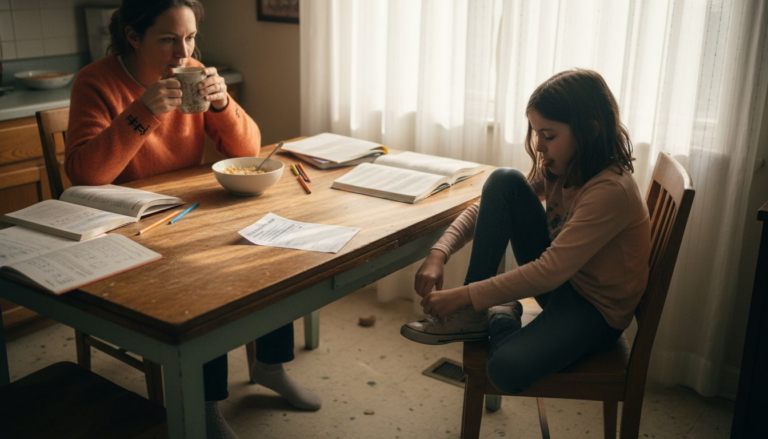
Here’s the scene. Reading went fine. Then the math page comes out, and within four minutes you’ve got a kid slumped sideways in the chair saying “this is stupid” to a worksheet on multiplying fractions. The sentence under the sentence is “I hate this,” and you both know it.
Option one is to push: “Sit up. Finish the page.” Sometimes that works, and sometimes you get a finished page with tear marks on it and a kid who has learned that math is the thing that makes mom mad. Option two is to fold: “Okay, we’ll do it tomorrow.” That works right up until tomorrow, when the same page is still there with a day of dread attached.
Both options treat the pushback as a fact about the child when most of the time it’s information about the task. The four moves below are a way to read that information before you respond. The first time through, give yourself the full fifteen minutes and write your answers down. After that, it’s a habit.
Move 1: Enjoyed it or engaged with it? Not the same question
When a lesson goes badly, the question that jumps into a parent’s head is “why don’t they like this?” It’s the wrong question, because enjoyment isn’t the goal. Engagement is. Plenty of kids don’t enjoy long division and are fully engaged with it: trying, frustrated in a working way, asking the right questions. And plenty of kids “enjoy” a lesson by coasting through it.
So the first thing to describe is what engagement looked like, or didn’t, in the ten minutes before the complaint. It looks different at every age:
- Around 7: engaged looks like touching the page, counting on fingers, getting mad at one specific problem. Disengaged looks like the body leaving first: sliding off the chair, asking about lunch.
- Around 11: engaged looks like trying a problem twice, erasing, arguing with you about the method. Disengaged looks like a fast, sloppy page with the hard ones skipped.
- Around 15: engaged looks like a teenager who’s annoyed at the work and still doing it. Disengaged looks like compliance with nothing behind it: every answer wrong in the same way.
If your kid was engaged and then hit a wall, the complaint is a sign of effort, and you respond to effort. If they were never engaged, the lesson lost them earlier, and you go looking for where.
Move 2: What changed right before the fuss?
This is the move that pays for the whole post. When the pushback starts, rewind five minutes and look at the task and the morning, not the child. Something usually changed:
- A new skill with no bridge. Yesterday’s page was adding fractions with the same denominator. Today’s page has different denominators, and nobody said out loud that this is a new thing. From the kid’s side, the rules changed without warning, and “this is stupid” is a reasonable response to that.
- Too much on one page. Thirty problems in a grid, small print, no white space. The kid isn’t refusing the math. They’re refusing the wall of it. Cover half the page with a sheet of paper and watch what happens.
- Hunger, or the sibling. Breakfast was at 7 and the four-year-old has been loud since. The math page didn’t cause the fuss. It was just the thing in front of them when the fuse ran out.
If your week keeps producing the same bad morning at the same time, that’s a scheduling problem, not a character problem. Our guide to creating a homeschool schedule that doesn’t feel like school walks through ordering the day so the hard thing doesn’t land on an empty tank.

Move 3: The objective versus everything else the task demands
Every worksheet has one thing it’s actually trying to teach and four or five things it demands along the way. If today’s goal is long division, the page also asks your kid to write small in boxes, copy the problem from the book, keep the columns lined up, sit still for most of an hour, and manage being wrong in front of a parent. For some kids, the long division is the easy part. It’s the extras that sink them.
So name the objective to yourself in one sentence: “Today I need to know whether she can divide a three-digit number by a one-digit number.” Then decide what else on the page you can take off for one day.
- If handwriting is the fight, you write the problems and they tell you the steps. You’re testing division, not penmanship.
Strip the extras for one day and one of two things happens. Either the pushback mostly disappears, which tells you the subject was never the problem, or it doesn’t, which tells you the objective itself is where the gap is. Both are useful. Neither required a lecture. You’ll put the extras back, one at a time, on days when the core skill is solid. We write more about this kind of thinking in the homeschool parent’s guide to teaching critical thinking skills, and it applies to you as much as to your kid.
Want the printables that make “strip the extras” easy to do on a Tuesday?
Our free downloads hub has planners and study templates built for this kind of homeschool week: a monthly planner to spread the hard subjects out, and a study plan page your older kid can run on their own.
Move 4: The one calm sentence
You’ve read the situation. Now you have to say something, and the first sentence decides whether the lesson continues or ends. The test: does your sentence offer partnership or a reset, or does it deliver a verdict?
Verdicts sound like this: “You’re being defiant.” “You’re not even trying.” They might feel true in the moment, and they end the lesson, because the kid now has to defend themselves instead of doing the math. A verdict makes the conversation about who they are. The page can’t compete with that.
Partnership sounds like this: “Let’s look at this one together.” A reset sounds like this: “Let’s stop here and come back after lunch.” Both keep the conversation about the task, the only thing either of you can change in the next ten minutes.
The sentence we come back to most often is the plainest one: “This page is a lot.” It’s true, it’s not about the kid, and it tells them you noticed. Most children will do a surprising amount of hard work for a parent who noticed. Say your sentence, then stop talking.
Is it burnout or is it the task?
Everything above is about one bad page. If the pushback shows up across subjects, across the week, and your kid who used to be engaged now looks flat before the books come out, you’re looking at a pattern, and patterns get a different response than moments.
A task problem is specific (this subject, this kind of page, this time of day) and it improves when you change the task. A burnout problem is general: the mornings are heavy no matter what’s on the table, and the kid is tired in a way sleep doesn’t fix. It doesn’t improve when you change the page, because the page was never the problem.
If it’s a pattern, change something bigger than the worksheet, on purpose:
- Change the day. A shorter day for two weeks, hard subject first and done by ten, is not falling behind. It’s a reset.
- Change the pace. If the curriculum assumes a lesson a day and your kid needs one every two days, the curriculum is wrong for your kid, not the other way around. Slowing down in November is how you avoid stopping in February.
- Change the curriculum. Rare, and sometimes right. If a program has fought your child for a full semester after you’ve stripped the extras and slowed the pace, it’s allowed to not be the one. Homeschooling 101 is a good place to rethink the weekly shape.
One gentle line about outside help. If what you’re seeing goes beyond school, into sleep, appetite, mood or friendships, and has lasted more than a few weeks, talk to your pediatrician. We’re homeschool parents, not clinicians, and nothing on this page is a diagnosis of anything. That’s rather the point.
The observation card: five lines, filled in once
This is the fifteen-minute part. The next time a lesson goes sideways, wait until the kid is out of the room and write five lines on an index card:
- What happened. Just the facts, the way a camera would record it. “Slid off the chair at problem four, said ‘I hate this,’ put pencil down.”
- What came right before. “New kind of fraction problem, no warm-up. Little brother was loud.”
- What the task actually required. “The skill: unlike denominators. The extras: copying from the book, 24 problems.”
- What I said. Honest version. “Said ‘we don’t quit in this house.’ Lesson ended.”
- What I’ll try tomorrow. One thing. “Name the new kind before the page. Eight problems on the whiteboard, not 24.”
Three cards over three bad mornings and you’ll see your kid’s pattern more clearly than any assessment would. You’ll also see your own, which is the harder and more useful part. The parent who writes “I said ‘we don’t quit in this house'” on a card tends to say it less the next week.
If the pushback is coming from the eleven-to-fourteen crowd and it’s more about starting at all, the card still works, and so does our guide to middle school executive function without the nagging: describe the system that’s failing, not the kid.
One more thing. A homeschool morning that’s gone quiet and tense often needs something that isn’t a worksheet at all. A short out-loud conversation with no right answer, where the kid argues a side and you argue back, does more for the mood of a school day than another page will. Our Logic Lab Discussion Cards are built for exactly that kind of fifteen minutes: pull one card, talk it through, go back to math.
Three questions parents ask
What if they refuse every single day?
Then it’s a pattern, not a page, and you go to the burnout section before the four moves. Daily refusal is almost never about the subject. It’s about the day’s shape, the pace, or something outside school entirely. Change one of those for two weeks and watch.
How long should a lesson be at this age?
Shorter than the curriculum says, almost always. A rough starting point: ten to fifteen minutes of focused work per subject for a six- or seven-year-old, twenty to thirty for a ten- or eleven-year-old, and forty-five minutes to an hour for a high-schooler, with a real break between subjects. A short lesson that ends well beats a long one that ends in tears.
Should I make them finish the page?
Finish the objective, not necessarily the page. Six correct problems means the other eighteen are practice, and practice can happen tomorrow. Six wrong problems means more of the same page won’t fix it; a bridge will.
Next bad morning, you’ll have a plan instead of a reaction.
Grab the free planners and study pages in the Learning with Angie free hub, print the monthly planner, and move your hardest subject to the hour your kid is most awake. That one change fixes more “I hate this” mornings than any speech.
You don’t need to have it all figured out. You just need the next step, and tomorrow’s step is one calm sentence and five lines on a card.
Rooting for you,
Team Angie