Interleaving Practice for Multiple Skills Without Burnout
Trying to learn coding, a language, and guitar at the same time can make your brain feel full by Tuesday. Many learners respond by pushing harder, staying longer, and switching tasks whenever motivation dips.
A better answer is interleaving practice with clear limits. When you rotate skills on purpose, protect your focus, and recover before you hit a wall, you learn more and burn out less.
Why interleaving practice works across different skills
Most people start with blocked practice. You do one kind of math problem for 40 minutes, one scale on piano for 20, or one coding lesson until your eyes blur. That feels smooth because the pattern stays the same.
Interleaving changes the pattern. You still focus, but you rotate topics or skill types in a planned way. In one study block, that might mean algebra, then vocabulary, then sketching. In a single subject, it might mean mixed problem types instead of one repeated format.
The reason it works is simple. Each time you return to a skill, your brain has to rebuild the path. That small struggle strengthens memory. You also get better at telling similar ideas apart, which matters in math, science, music, sports, and writing.
Research backs that up. In an open-access study on interleaved practice, alternating topics improved memory and problem-solving compared with practicing in one uninterrupted block. If you want a student-friendly overview, Washington University’s beginner’s guide to interleaving explains the basic method clearly.
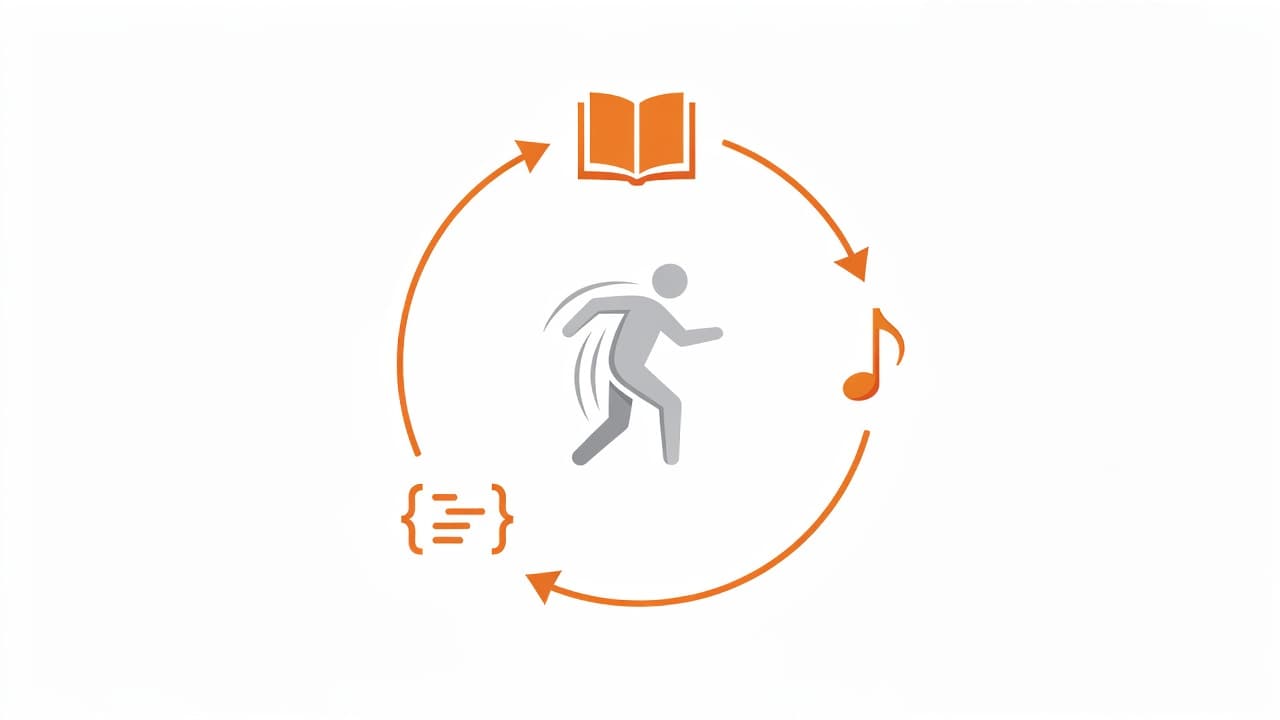
Still, you don’t want to confuse interleaving with constant task hopping. Healthy rotation has structure. You finish a block, pause, then switch. Random jumping between tabs, texts, and half-done assignments is something else.
When your skills are far apart, use a larger rotation. You don’t need to switch every five minutes between piano fingering and JavaScript loops. Instead, give each skill a real block, then return later in the day or week. That gap is part of the learning.
Interleaving works best when each block is long enough for real effort and short enough to keep your attention clean.
Where context switching starts to hurt
A planned switch can help learning. An unplanned switch can drain it. The difference often comes down to attention residue, which is the mental leftover from the last task.
If you stop mid-problem to answer messages, part of your mind stays with that unfinished problem. Then you open a history essay, but your brain is still chewing on algebra. The new block gets only part of your attention. That residue piles up across the day.

That is why structured rotation needs clear boundaries. Before you switch, close the loop. Write the next step in one sentence. Save the file. Put away the book. Stand up, get water, and let your eyes leave the screen.
Recovery matters here too. Your brain does not learn best under nonstop pressure. Short breaks lower mental noise, and sleep helps lock in what you practiced. If every session ends with strain, your later blocks will look busy but feel dull.
A few rules keep switching useful instead of exhausting:
- Keep most blocks between 25 and 60 minutes, based on your age and focus.
- Use a 3 to 5 minute reset before the next skill.
- End each block with a note about what to do first next time.
- Leave at least one lighter period in your day or week.
If you’re a parent or homeschool teacher, you can help by protecting those edges. Young learners rarely need more reminders to work harder. They need cleaner starts, cleaner stops, and fewer hidden distractions.
A weekly rotation that protects focus and energy
The easiest way to learn several skills at once is to stop giving them equal weight. Pick one anchor skill for the season, then fit the others around it. That keeps progress moving without making every day feel crowded.
Your anchor skill gets the most touches each week. A secondary skill gets fewer, shorter blocks. A third skill may stay in maintenance mode for a month. That is not failure. It is pacing.
Within each block, use deliberate practice. In plain English, that means you choose one small weakness, work on it at the edge of your current ability, and get feedback. A piano block might target left-hand timing. A coding block might focus on loops. A basketball block might isolate free-throw form.
Here is a simple weekly pattern for a learner building three skills at once.
| Day | Block 1 | Block 2 | Why it works |
|---|---|---|---|
| Monday | Algebra, 45 min | Piano, 25 min | Hard academic work first, then a shorter contrast skill |
| Tuesday | Python, 40 min | Walk or full rest | One deep skill block, then recovery |
| Wednesday | Algebra, 45 min | Piano, 25 min | Fast return to the anchor skill strengthens recall |
| Thursday | Python, 40 min | Light review, 15 min | Practice plus a low-pressure refresh |
| Friday | Algebra mixed review, 35 min | Piano, 25 min | Mixed retrieval before the weekend |
| Saturday | Longer project block, 60 min | Rest | One extended session, no pileup |
| Sunday | Off or gentle review | Off | Recovery protects next week’s focus |
The pattern matters more than the exact subjects. You are touching each skill often enough to keep it alive, but not so often that every day becomes a marathon.
Burnout signs to catch early
Burnout usually arrives as drift, not drama. You take longer to start. Small mistakes pile up. Practice feels flat, and your mood sours before the session begins.
Watch for a few early signs:
- You need more time to settle into work each day.
- Errors rise in skills you could usually handle.
- Sleep, patience, or motivation drops for several days.
- You keep extending sessions but remember less afterward.
When that happens, reduce load before you lose momentum. Shorten blocks by 10 minutes. Drop one active skill for a week. Keep the anchor skill, keep one maintenance block, and bring recovery back in. A lighter week often saves a whole month.
How to adapt the method to creative, technical, and physical skills
Creative work benefits from contrast. If you write, draw, or play music, rotate between making, studying, and revising. Drafting for 30 minutes, then practicing a technique, then returning later to edit often beats grinding one stage until it goes stale.
Technical skills also respond well to mixed practice, but the switches should stay clean. Pair concept study with problem solving. Read code, then write a small program, then debug yesterday’s work. For more classroom-style examples, Carl Hendrick’s short guide on interleaving shows how mixing similar tasks sharpens judgment.
Physical skills need even more respect for recovery. You can rotate footwork, strength, mobility, and sport-specific drills across the week. Still, avoid stacking two heavy sessions that hit the same muscles or the same kind of focus. A strong plan might pair hard tennis drills one day, mobility and light serves the next, then strength after that.
Across all three types, one rule stays the same. Keep the switch larger than the distraction. Moving from drafting an essay to piano scales after a break is useful. Checking notifications halfway through either block is not.
You will also do better if you track a few small signals instead of everything. Note your start time, the skill target, and one sentence about what improved. That record helps you spot when a block is too long, when a pairing works well, or when a skill needs more spacing.
The goal is steady return, not constant intensity. When you build a repeatable rhythm, separate tasks clearly, and rest on purpose, disparate skills stop competing for survival. They start taking turns.
Build a rhythm you can keep
Learning several skills at once does not require all-day hustle. It requires interleaving practice with real focus, clean transitions, and enough recovery to come back sharp.
Once you stop treating every session like a sprint, your progress becomes easier to trust. You remember more, switch with less friction, and keep enough energy to stay curious next week too.
This post may contain affiliate links. If you make a purchase through these links, I may earn a small commission at no extra cost to you.
Want a head start? The Study Skills System Notion Template gives each subject its own review slots, so rotating between skills is scheduled for you instead of decided on the fly.